

History of Prescribed Fire in California
The history of fire use in California is fraught with tension, controversy, and scientific debate. The traditional use of fire by Indigenous Californians was disrupted by colonialism, genocide, and forced assimilation, and it was later criminalized when California adopted a policy of full fire suppression in the early 20th century. This history has had long-lasting, far-reaching impacts on California’s Indigenous communities, but also on the state’s many ecosystems that evolved with and depend on frequent fire, and ultimately, on everyone who lives in the state.
Prescribed fire, a more Western rendition of fire use, emerged as a practice and conversation in the early 1900s. Part of a larger national debate around the use of “light burning” in dry forests, prescribed burning in California was hotly contested in the early fire exclusion era. Though the USDA Forest Service had enacted a fire exclusion policy in 1905, fire use on state and private lands was still up for debate. Advocates of light burning argued that frequent fire would reduce litter and fuel accumulation, mimicking the hazard reduction and forest health benefits that lightning and Indigenous burning had conferred for millennia. The opposition argued that all fires, including light burning, were damaging to timber, and that fire should be fully excluded from California’s forestlands. Though there were scientific and practical attempts to demonstrate the benefits of frequent burning, in the end, fire exclusion prevailed. In 1924, the California Board of Forestry adopted the federal government’s stance, commencing an era of full fire suppression throughout the state.
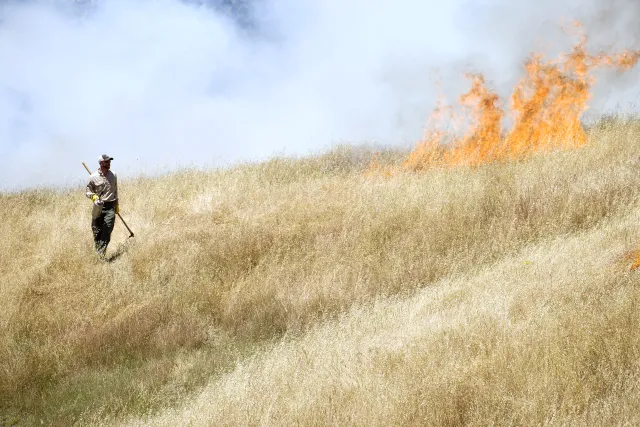
By the early 1940s, the effects of fire exclusion were becoming clear to ranchers, wildlife groups, and others across California. Without frequent fire, the open rangelands that supported livestock and big game were constricting, taken over by brush. Arson fires were also increasing during this time. In 1945, due to pressure from these groups, the state legislature authorized a permit program for landowners who wished to burn their brushlands. The permit program was managed by the California Department of Forestry (CDF, which later became CAL FIRE), but put the full liability of burning on the landowner. Though the permit program peaked in 1955, with more than 200,000 acres burned under permit, liability concerns ultimately overwhelmed its success. By the 1970s, the program had dwindled, and after 1981, many ranchers turned their burning over to CDF via their new legislatively approved Vegetation Management Program (VMP). This program alleviated liability concerns, but also supplanted landowner knowledge and capacity, with implications for private lands burning across the state.
The adoption of prescribed fire practices was much slower on California’s forestlands, with significant scientific and political debate throughout the 20th century. Harold Biswell, a professor at UC Berkeley who came to California from the Southeast in the late 1940s, was the tip of the spear during this era, experimenting with prescribed fire practices in ponderosa pine and other forest types, and pushing the boundaries of what people thought was possible or appropriate in California’s forests. Among professional foresters, Biswell said he was characterized as a “stubborn extremist” because of his refusal to stop research on forestland burning. However, thanks to his vision, persistence, and demonstrated success, perspectives started to shift.
The 1960s were pivotal for prescribed fire, especially on federal lands, as the widespread effects of fire exclusion came into focus. The National Park Service (NPS) began to look to prescribed fire as a potential vegetation management tool. Prescribed fire was first used in Sequoia-Kings Canyon National Park in 1968, and soon after in Yosemite. The NPS officially changed their fire policy that same year, moving away from full suppression and allowing for both prescribed fire and managed wildfire on national park lands. California State Parks followed suit seven years later, in 1975, first at Calaveras Big Trees State Park and then across a broader swath of parks. However, it wasn’t until 1978 that the USDA Forest Service changed their policy, shifting from full fire suppression to a fire management approach that included prevention, suppression, and fire use. CAL FIRE
came on board in 1981, with the advent of their Vegetation Management Program.
Recent History and Progress
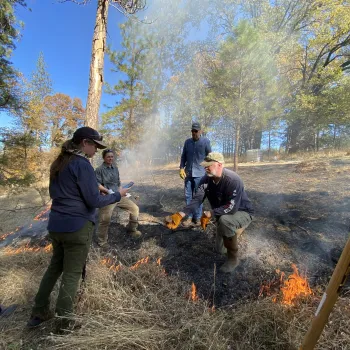
Despite the progress of the late 1900s, prescribed fire was still largely underappreciated and underutilized in California after the turn of the century. Many federal agencies had active burn programs, but they were careful not to draw attention to their challenges or successes, due to a lack of mainstream understanding and support for the practice. On the state side, the transition from the California Department of Forestry to CAL FIRE turned out to be more than nominal, representing real changes within the agency. In the early 2000s, CAL FIRE moved away from the natural resource/forestry focus of the late 20th century and refocused on fire suppression, affirming its status as the world’s biggest fire department. The implications for its prescribed fire program were severe. Research published in 2012 showed that the bulk of prescribed fire in Northern California was being implemented on federal lands, led in large part by the National Park Service, the USDA Forest Service, and the US Fish and Wildlife Service. State, private, and Indigenous partners were still struggling to implement burns (Quinn-Davidson and Varner 2012).
In 2009, a group of impassioned leaders founded the Northern California Prescribed Fire Council, an interdisciplinary team comprised of federal and state agency representatives, non-governmental organizations (NGOs), academics and researchers, Tribal members, and other fire practitioners. Community-based burning continued to evolve in 2017, when University of California Cooperative Extension advisors imported the prescribed burn association (PBA) model to California from the Great Plains. Nearly a decade later, there are 28 PBAs in California.
California's prescribed fire-related policy landscape continued to change following catastrophic wildfire seasons in 2017 and 2018. Devastating wildfires propelled the state legislature into action, and the subsequent years were full of policy progress around beneficial fire.
Key Recent Prescribed Fire-Related Policy Actions in California
Across the United States, there are four general categories of state liability law:
- Strict Liability holds a person legally responsible for harm even if no negligence was found;
- Simple Negligence holds a person legally responsible for harm if reasonable care was not taken;
- Gross Negligence holds a person legally responsible for harm only if it can be shown that they took less care than even a careless person would use (i.e., reckless disregard for safety);
- Liability is uncertain in states where laws and administrative codes are vague regarding prescribed fire.
Generally speaking, strict liability laws are the least conducive to prescribed fire and gross negligence laws are the most conducive. Simple negligence laws fall in between, and states with uncertain liability laws often default to something similar to simple negligence.
State liability laws may pertain to different facets of liability, including damages to another person’s life or property (including smoke impacts), fire suppression costs for escaped prescribed burns, and/or injuries or equipment issues on burns.
Until 2021, California was a simple negligence state for all facets of liability; however, the liability context has evolved in recent years. Key policy progress is outlined in the table below.
Year | Policies |
2018 |
|
2021 |
|
2022 |
|
2024 |
|
2025 |
|
List of relevant prescribed fire-related policies in California. Table last updated 6/1/2026.
Additional Resources
Check out these prescribed fire policy-related resources from UC ANR Fire Network Members!
Below is a list of other resources about prescribed fire policy. Please note these materials are not maintained by UC ANR and may not meet current accessibility standards. If you need assistance accessing this content or require an accessible format, please contact the website owner or organization listed after the link provided below.
- Impediments to prescribed fire across agency, landscape and manager: an example from northern California journal article (2012; International Journal of Wildland Fire)