

Livestock Health Post-Fire
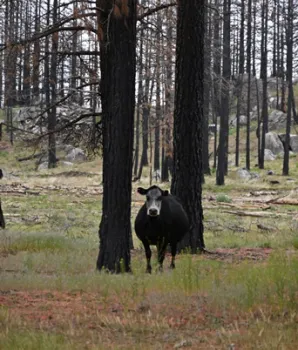
Wildfires can expose livestock to injury through direct burns or inhalation of unhealthy air containing smoke and particulates. These particulates can build up in the respiratory system, causing a number of health problems including burning eyes, runny noses and illnesses such as bronchitis. Smoke can also aggravate heart and lung diseases such as congestive heart failure, chronic obstructive pulmonary disease, emphysema and asthma. Livestock that are burned by wildfires may experience shock, pain, and systemic complications.
Because little information is available to livestock producers or even veterinarians on the effects of fire and smoke on livestock, the following suggestions are offered to serve as a general guide.
- Provide plenty of fresh water. The consumption of water keeps the airways moist and facilitates clearance of inhaled particulate matter. This allows the windpipe (trachea), large airways (bronchi), and small airways (bronchioles) to remove inhaled particulate material in smoke.
- If possible, limit exercise during and after (4-6 weeks) unhealthy air quality. Don’t force livestock to perform unnecessary activities or increase exercise that increase the airflow in and out of the lungs. Smoke contains particulates that can alter the immune system. Attempting to handle, move, or transport livestock during this time may aggravate the lungs, delay the healing process, and compromise the performance of livestock for many weeks or months.
- Recent research results indicate that forages affected by wildfire ash deposition are likely safe for livestock to consume. Wildfire ash was not found to increase the deposition of heavy metals in forages in areas relatively close to burned structures containing contaminants from household products, vehicles, businesses and residential chemicals.
Can You Graze After a Wildfire?
Determining when to graze livestock after a fire can be a controversial and difficult decision. Much of the post-fire consideration depends on local site characteristics (percent slope, soil type), plant species composition, and intensity of the fire. After a fire has removed all vegetation, forage production will be about 50 to 70 percent of the amount on an undisturbed site in the following season; and down about 20 percent the second year. Only in the third year will the forage return to previous production. After a high-intensity fire that leaves white ash, less than 25 percent as much forage will be produced on the burned site than on an unburned site for each of the next 3 years.
Knowing that forage production will be reduced after a fire, the following grazing management practices applied can help buffer the consequences of an unintentional fire:
- Monitor burned areas to prevent overuse of vulnerable plants when they are trying to recover from wildfire. Newly germinated plants, or existing ones putting out new foliage, need to collect and store enough energy to develop healthy root systems.
- If economically possible, delay or limit grazing in burned areas as needed. Limiting grazing to light or moderate levels after fire will ensure there is adequate plant material (stubble) for continued growth in following years. If a pasture has been burned, letting it rest from germination through seed-set will help improve plant vigor and restore the seedbed and litter.
- In unburned areas, maintain stubble to keep soils from washing away during the winter and early spring rains. This is particularly important in areas near streams and rivers to prevent soil and manure from washing into riparian areas. Retaining residual cover will also provide a nursery to the following year’s grass crop and provide additional forage there than in areas where all vegetation was removed.
Additional Resources
Check out these post-fire livestock and rangeland recovery-related resources from the UC ANR Fire Network and our colleagues!
- Watch our Disaster Preparation for Commercial Livestock Operations webinar to learn about disaster preparation for commercial-scale ranches. The webinar was recorded in July 2025.
- Watch a video about human-wildlife interactions post-fire to learn about direct and indirect impacts on wildlife and how significant wildfires can be for different wildlife species. This video was recorded in November 2020.
- Watch our Impacts of Fire on Rangelands, What to Expect and What to Do webinar to learn about anticipated impacts of wildfires to California's rangelands. This webinar was recorded in September 2020.
- Watch our Survey of Wildfire Ash Impacts on California's Forage Crops webinar to learn about impact of wildfire ash on feed quality and safety. The webinar was recorded in November 2020.
- Watch our Wildfires and Cattle Health webinar to learn about health issues in cattle after wildfires. This webinar was recorded in November 2020.