
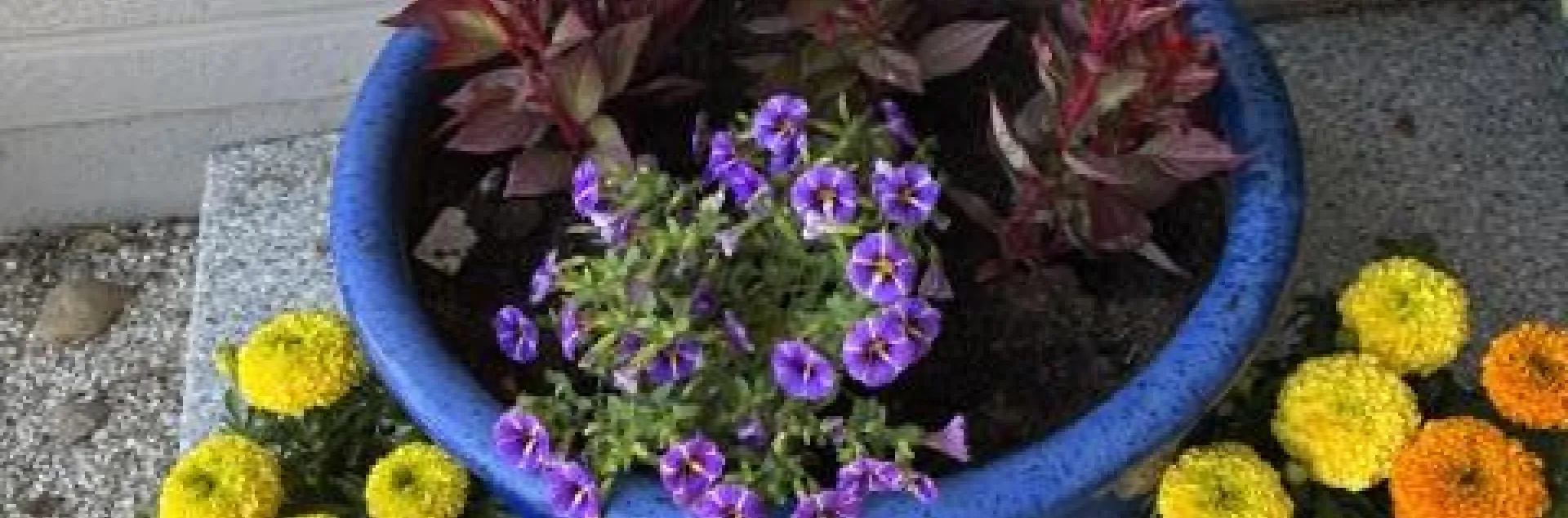
Pick Me! Celosia and Marigolds
By UCCE Master Gardener Julie Silva
You have seen it while standing at the nursery in spring, staring at flats and flats of color. What you should really be staring at are the two grey-haired ladies with over-filled carts, thrashing around on the ground. Between them is a now decimated canna, each lady with a hand firmly grasping the black nursery pot. The bright red flowers are gone and the large leaves are shredded. No one is giving up, including the canna. After all, they are tough.
The garden frenzy begins all the way back in February, when garden hunters are willing to risk it all for an early favorite tomato. People want their gardens to be a sight to behold. They want big, bright flowers and tasty tomatoes.
A trip to the nursery can be daunting. Just in annual color alone, there are flats after flats, loaded with 48 flowers each, on rack after rack. Shade plants, sun plants, new flowers for 2026, and old-time favorites fill the nursery. Flowers your Aunt Glendora always had on her kitchen table in a vase. Flowers that are a siren call to bees and butterflies throughout the neighborhood.
By now, the two grey-haired ladies have stood up, brushed off and grabbed a hot lips salvia instead. You probably wish it was that easy for you. Instead, you focus in on two very different, but very beautiful plants. One is a marigold and the other a celosia. What makes them so special? Which to choose?
Celosia comes in striking colors and three stunning, distinct flower shapes. The cockscomb celosia has a flower that looks like the top on a rooster’s head, with wavy and wrinkled blooms. This variety often needs to be staked due to the weight of the flower. Plume celosia has upward growth spikes, thick like a grey squirrel’s tail pointing upwards. Wheat celosia looks like wheat spikes, only pointy. All varieties like well-drained soil, water when dry, and lots of nutrients for flower production.
Plume and cockscomb have red, orange, yellow, pink, and magenta flowers. The color is intense with the flower lasting up to a month. Dead heading will increase flower production and staking may be required. As with any other intensely colored flowers, large blocks or mass planting will be breathtaking.
If creamy white, burnt red, bright orange or yellow sunlight fits your color choice, then grab a flat of marigolds. Marigolds come in different heights, different flower sizes, and different levels of fragrance. American, Mexican, and African marigolds are flower body builders, taller with large flowers. French marigolds are bushier, under two feet, and more compact.
Marigolds like lots of sunshine and require less fertilizer than most. In fact, too much fertilizer creates larger plants and fewer flowers. As with almost every annual plant, soil should be well draining.
Marigolds provide more than bright colors and tough plants. They are stinky to insects and a natural deterrent to a bug’s life. Planted in your vegetable garden they will chase away nematodes and white flies. Marigolds are also known as a ‘trap crop’ to pull aphids away from other vegetable plants.
Marigolds hold several claims to fame. Farmers use marigold petals as an addition to chicken feed to darken the yellow color of egg yolks. Marigolds are also added to the herb mixture in nest boxes to deter mites. Besides being the chicken’s favorite, marigolds are the birth flower for October babies and the Crackerjack variety is used in Dia de los Muertos celebrations.
As you wander through the nursery, skirting the wild-eyed, grey-haired ladies, take a look at celosia and marigolds. Both would be great to bring home, especially if you cannot decide on just one.
Jim Bliss is a University of California Cooperative Extension Master Gardener of Tuolumne County. UCCE Central Sierra Master Gardeners can answer home gardening questions, from rainwater tanks to drought-resistant plants. Call 209-533-5912 in Tuolumne County, 209-754-2880 in Calaveras County or fill out our questionnaire at (ask garden questions). Check out our webpage at https://ucanr.edu/site/uc-master-gardeners-central-sierra You can also find us on Facebook and on the radio at kaad-lp.org or 103.5 FM on Motherlode Community Radio.