

About the Central Coast
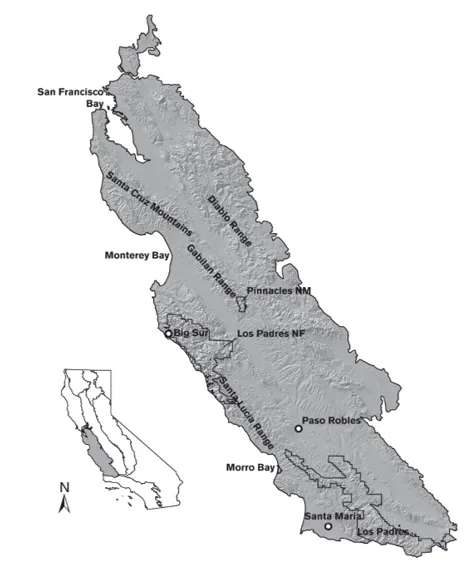
The Central Coast is comprised of several rugged mountain ranges that allow for large valleys between, such as the Salinas Valley, a major agricultural area. This varying topography, ranging from sea level to nearly 6,000 ft, supports complex and diverse vegetation mosaics, which also supported historic fire boundaries. If one vegetation type was dry enough to burn, the adjacent one often wasn’t. Low and mid-elevation coastal areas support coastal prairies, maritime chaparral, and Monterey cypress and Monterey pine forests while higher elevations support hardwoods and conifers. The interior valleys and foothills (southern Sierra adjacent) support annual grasslands, oak woodlands, and chaparral.
The climate of the Central Coast is Mediterranean, with warm, wet winters and hot, dry summers. The coastal ranges receive the most precipitation and can cause a rain shadow effect with significantly dryer conditions on the east side of a range.
Low clouds or fog, often referred to locally as the marine layer, is formed due to interactions between cool ocean currents and a warm atmosphere and travels a short distance inland, farther where river valleys allow. This fog, especially during the dry season, is important in terms of the vegetation types that occur.
Fuel moisture is typically lowest in September and October and human caused fire can spread quickly even without high winds. The incidence of summer lightning storms in the Central Coast is very low, the lowest in the state in fact. Although lightning occurrence is rare, it can be an impactful ignition source. When lightning storms do occur, they often cause fires.
Fire History of the Central Coast
Indigenous Burning
Historically, intentional ignitions from Indigenous people contributed to the frequent presence of fires in these landscapes. The Central Coast region is the ancestral lands of many Indigenous tribes that still steward these lands today, including the Amah Mutsun, Chumash, Esselen, and Salinan tribes to name a few. Tribes burn for many reasons, including: general land stewardship, cultivation of food and medicine plants, cultivation of basket weaving materials, safety, and cultural and ceremonial purposes. To learn more about other Indigenous tribes in the Central Coast region, visit https://native-land.ca/.
Historic Fire Occurrence
Because there is a low incidence of lightning in the Central Coast region, we can infer from past fire history studies in the region that most fires were caused by the Indigenous human populations living in the region. Generally, fire frequency was highly variable among ecosystems due to local topography, climate variation, vegetation types, and local Indigenous populations.
Following Euro-American settlement, fire regimes changed drastically due to the removal of Indigenous fire practitioners and changes in land use. For example, burning in coastal prairie and oak woodlands lessened but fire activities in chaparral increased to increase rangeland area for introduced livestock and to improve travel for Euro-American activities. After the removal of Indigenous peoples, some fire was reintroduced into the coast redwood range due to historic logging practices in the area. However, historic logging practices changed fire regimes by removing large trees, which led to the creation of forest stands with high densities of young trees. Changes in forest structure coupled with the removal of recurring fires have led to greater than historic fuel loads.
Though many areas within the bioregion are heavily urbanized, there is still a significant proportion of wildland vegetation (shrublands, grasslands, forests). Fire suppression has successfully controlled most wildfires in the region, however, changes to climate and human ignition patterns have influenced fire occurrence in the region. Because of past management and climate change, in areas where low- to moderate-intensity surface fires were more frequent and extensive, fires are now either suppressed when they are very small or become large, mostly high intensity fires, outside of historic norms.
Fire Ecology of the Central Coast by Ecoregion
Fire in the Coastal Prairie
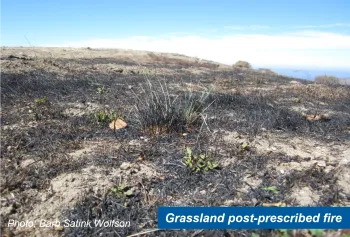
Historically, fire in coastal prairies occurred every 1-5 years. Grasses and some herbaceous species often grow back while the ground is still black. Specifically, fire can increase the competitiveness of native perennial grasses. Because the plant is only top killed, they pull from carbohydrate stores underground and can respond to fire immediately, rather than waiting for their seed to regenerate during the rainy season like annual grasses.
Fire in Coast Redwood and Douglas-Fir Forests
Redwood forests have a complex fire history, typically burning across a wide range of conditions over space and time. Generally, fire regimes were characterized by surface fires mixed severities and intensities. Fires typically occurred in the late summer/early fall. The fire return interval was highly variable (1-500 years) depending on climate and fuel conditions and proximity to Indigenous villages, hunting areas, travel routes, etc. However, research looking at fire scars in the Santa Cruz Mountains determined that fires recurred about every 10-16 years. This is mostly due to Indigenous burning throughout the region.
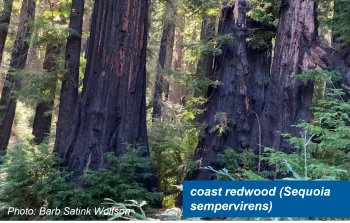
Douglas-fir forests likely experienced more frequent fires due to their warmer, drier, inland locations. Fire sizes, intensities, and severities were highly variable, with areas near Indigenous sites experiencing more low to moderate intensity surface fires while other regions experienced more mixed-severity fires (with crown fires). Fire return intervals were likely every 10-16 years.
Since Euro American settlement, both coast redwood and Douglas-fir forests have been modified through the absence of fire. The most significant changes in old and secondary growth forests is the increase in density of understory shrubs and trees creating greater vertical fuel continuity, increasing the likelihood that fire can burn into the crown of dominant trees. The densification of these forests has significantly modified modern fire regimes.
Fire in Closed-Cone Conifer Forests
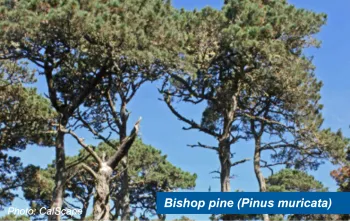
The Central Coast has eight closed-cone conifers: 4 pines and 4 cypresses. The four pines are Bishop pine (Pinus muricata), knobcone pine (P. attenuata), Monterey pine (P. radiata), and Torrey pine (P. torreyana). The four cypress species are Monterey cypress (Hesperocyparis macrocarpa), Gowen cypres (H. goveniana subsp. goveniana), Santa Cruz cypress (H. abramsiana), and Sargent cypress (H. sargentii). Seven closed-cone conifers are patchily distributed along the coast and Coulter pine is the only one that extends inland.
The term “closed-cone” generally means the cones require heat to open and reproduce. These cones are considered serotinous and the extent of serotiny among species varies. For example, they require varying temperatures to open, and some may be opened by small animals seeking food in addition to being opened by heat. Seedling establishment after fire is typically high when ground fuels are consumed by fire and/or overstory trees have been killed, leaving mineral soil with significant light exposure. It should be noted that Monterey pine is considered to be less serotinous than other species – can frequently release seed under other environmental conditions in the absence of fire.
Historic fire occurrence is highly variable among these species depending on location, site conditions, and likely the human populations that existed nearby. For many species, fire regimes were likely characterized by infrequent, moderate- to high-intensity fires that likely occurred in the late summer/early fall. In the case of Coulter pines, fires were likely stand-replacing when the understory had a large shrub component.
Fire in the Interior Coast Ranges
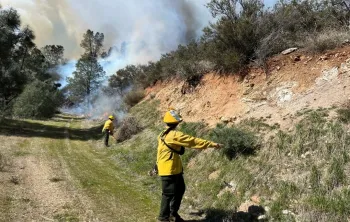
Interior Coast Ranges feature diverse species groups that vary in which species is dominant. They tend to form mosaics based on slope, moisture availability, and elevation. Some of these species associations include annual grasslands, buckwheat, blue oak (Quercus douglasii), blue oak-foothill pine, and chamise chaparral.
Historic fire regimes are not well documented for this region, however fire regimes likely varied by vegetation type. Blue oak-dominated areas and grasslands likely experienced frequent (8-10 years) low- to moderate-intensity surface fires. Fires were likely fueled by perennial bunchgrasses, forbs, and downed wood debris from individual trees. Fires also likely burned in late summer/early fall when fuel moistures were low.
Fire in Maritime Chaparral
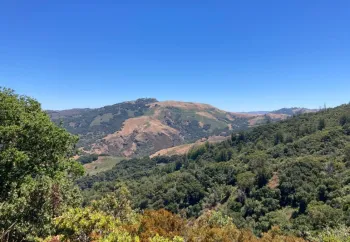
Maritime chaparral occurs from Mendocino County to northern Baja, but is the most biodiverse in the Central Coast region. Compared to inland chaparral ecosystems, maritime chaparral has more than double the number of shrub species, most of which are endemic. Many of these endemic shrub species are fire dependent, meaning they cannot effectively regenerate without fire. Post-fire regeneration of shrubs occurs by resprouting or recruitment from the soil seed bank, with shrub canopies often closing between 5-10 years after burns occur.
Historically, fire occurred about every 10-100 years (more frequently near Indigenous populations), but this is not well documented. Today, human-caused ignitions are frequent in this ecosystem type, but ignitions are often quickly stopped by suppression activities. Shortly after fires, annual plants quickly emerge, taking advantage of the open growing conditions in the absence of slower-growing perennials. If fire occurs too frequently (in cases where suppression is ineffective) ecosystems may slowly transition from shrub-dominated to herbaceous or annual grasses in the coming decades. In contrast, research suggests that in the absence of fire, maritime chaparral communities would eventually be replaced by coastal oak or pine forests.
Fire in Oak Forests and Woodlands
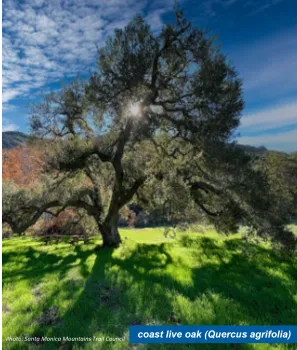
There is limited information on historic fire regimes in this region, however fire regimes are thought to be characterized by frequent (10-30 years), low- to moderate-intensity surface fires. As indicated earlier, due to the low incidence of lightning, most historical fire was likely due to Indigenous land stewardship.
Coast live oak forests often have a deep litter layer. For most of the year, fuel moisture of shrubs and litter is high and conditions are not conducive to surface fire ignition and spread. However, forests are susceptible to burning during the late summer/early fall after a long dry summer. The range of coast live oaks appears to be declining due to tree removal and low recruitment of individual trees due to drought and herbivory. In areas where oak woodlands abut chaparral or scrub, the presence of coast live oaks depends on whether sufficient time has elapsed since fires for oaks to establish and grow large enough to endure high-intensity fires commonly associated with chaparral communities.
Additional Resources
Check out these resources below to learn more about fire ecology and history in the Central Coast!
- Brochert, M.I. and F.W. Davis. 2018. Central Coast Bioregion. In van Wagtendonk, J. W., N. G. Sugihara, S. L. Stephens, A. E. Thode, K. E. Shaffer, J. A. Fites-Kaufman (Eds.), Fire in California’s Ecosystems. 299-318.
- van Wagtendonk, J. W., N. G. Sugihara, S. L. Stephens, A. E. Thode, K. E. Shaffer, J. A. Fites-Kaufman. 2018. Fire in California’s Ecosystems (2nd ed.). University of California Press. https://www.ucpress.edu/books/fire-in-californias-ecosystems/hardcover.