
Signs of spring are everywhere we look: trees and shrubs are full of blossoms, flowers are bursting into bloom, bees are buzzing all around, and aphids are stacking up on rose buds. What to do?
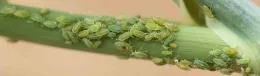
Aphids are a common occurrence in the spring. They rapidly appear in large numbers when the weather starts to warm and are most prevalent between 65 and 80 degrees. Look closely at many plants, and you'll notice that aphids come in a variety of colors—green (most common), yellow, brown, red, and black. They are small, soft-bodied insects with mouths like skinny straws that pierce leaves and green stems, then suck out the plant's fluid.
Plants can tolerate some aphid feeding with no apparent damage. However, aphids also have the ability to carry plant viruses from an infected plant to a non-infected plant. In ornamental plants, most plant viruses are cosmetic, but in vegetables like squash and tomatoes, these viruses damage the produce.
All of that ingested plant juice has to go somewhere, and since aphids don't swell up to the size of a balloon, they excrete the sugary sweet plant sap right back onto plant leaves. This digested substance is called "honeydew," and it is easily seen glistening on plant leaves. Honeydew is sticky and attracts sooty mold spores from the air. Sooty mold is a fungus that lives off of the honeydew, and as it grows, it becomes black, hence the name. Besides blackening the leaves and creating a mess, if it covers the leaves too thickly, it can deprive the leaf of maximum light for photosynthesis, and the plant can be weakened.
Ants climbing up and around your plants are a sign that honeydew is around. Ants feed on honeydew for nourishment and will protect the aphids from natural predation in order to keep feeding on their honeydew. There are several beneficial insects that prey on aphids, including ladybugs, lacewings, damsel bugs, and hoverfly larvae, which can all significantly reduce an aphid population. When ants succeed in warding off beneficial insects, the good bugs can't do their job of keeping aphids under control. Controlling the ant population will help control the aphid population.
Roses are particularly susceptible to springtime aphids, and it is very common to see aphids in late March and throughout April, when the bushes have
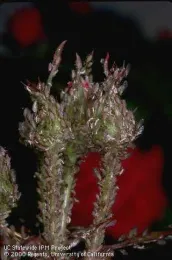
started to leaf out and send up their first blooms. A question heard over and over again in the spring is: "My rose buds are covered with aphids, what should I do"?
With aphid control, timing is everything. Different aphid species feed on different plants, but species identification is not needed when it comes to trying to control them in your garden.
Reaching for a broad-spectrum insecticide is the last choice and can do more harm than good because beneficial insect populations that might control the aphids are also harmed. It is better to suffer a little aphid damage in the spring and let the beneficial populations build up by preying on the aphids. This will keep more insect pests under natural control (also called biological control) throughout the summer.
Does that mean you don't do anything in the springtime? Not at all. First thing to do is check the plants daily during this time of rapid new growth. As aphids build up, spray the plant with a strong spray of water to knock off the insects from the buds and leaves. For heavy infestations, I hold clusters of buds in one hand and the spray nozzle in the other.
Certain measures will help with prevention. Don't over-fertilize in the spring, since aphids love that new lush growth. When you do fertilize, use a slow-release or organic fertilizer or compost. Prune out heavily infested leaves and stems. Ladybugs and lacewings will naturally appear in your garden and will gradually reduce the aphid populations.
If you are unable to control the problem by hosing off the plants and allowing for beneficial insects, then try the least toxic insecticides. Insecticidal soaps, soap pyrethrum mixtures, and neem oils are a safe alternative that work by smothering the insect. Make sure you have complete coverage by spraying with a high volume of water and target the underside of the leaves, as well as the tops. These products only kill insects that are present and do not have residual activity. Always follow the directions on the container and use it when the temperature is below 90 degrees.
Systemic products are a final control possibility, particularly for rose bushes. They should never be used on garden vegetables or fruit trees. This should be your last resort choice, since they are toxic to almost all insects. Most systemic products are actually 3 products in 1 container: a fertilizer, a broad-spectrum insecticide, and a fungicide for some disease control. Never use more often than every 6 weeks, and it is of utmost importance to strictly follow the application amounts detailed on the product label. These products are available in a liquid form to be sprayed on the plant or as a granular form that is applied at the base of the plant and watered into the soil.
So remember when considering different control tactics for aphids, choose the methods that moderate aphid populations and do not
disrupt the natural population of beneficial insects. You're in for a constant battle with bugs if you do