
Resprouting Hardwoods and Disturbance
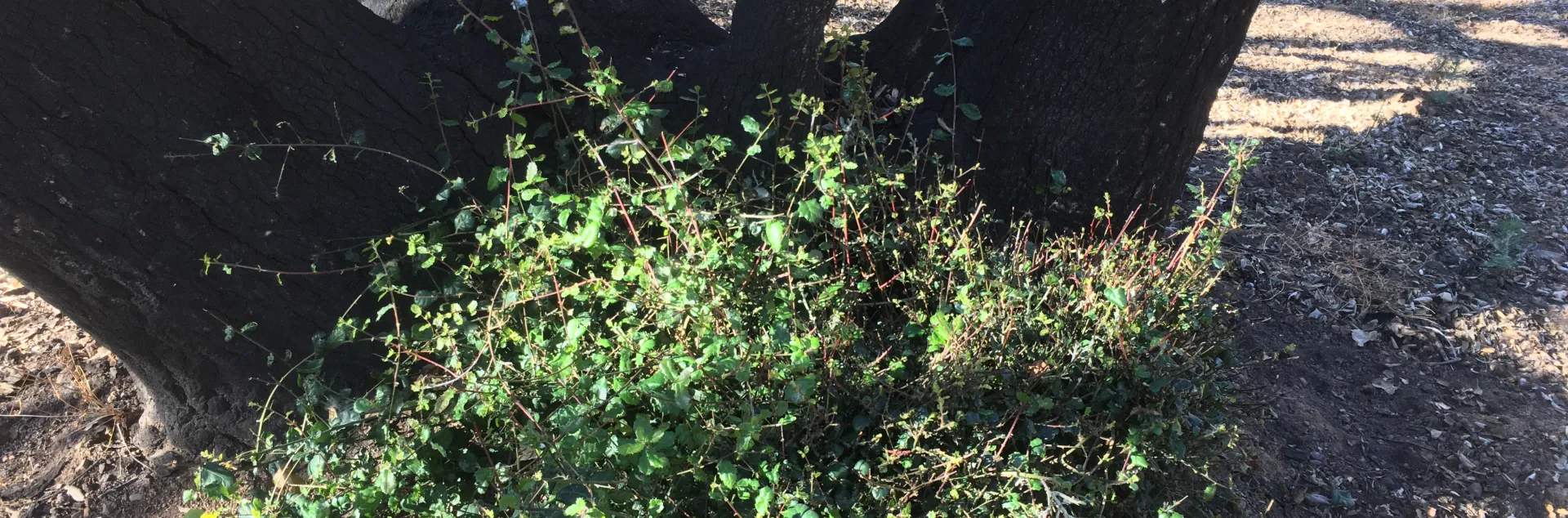
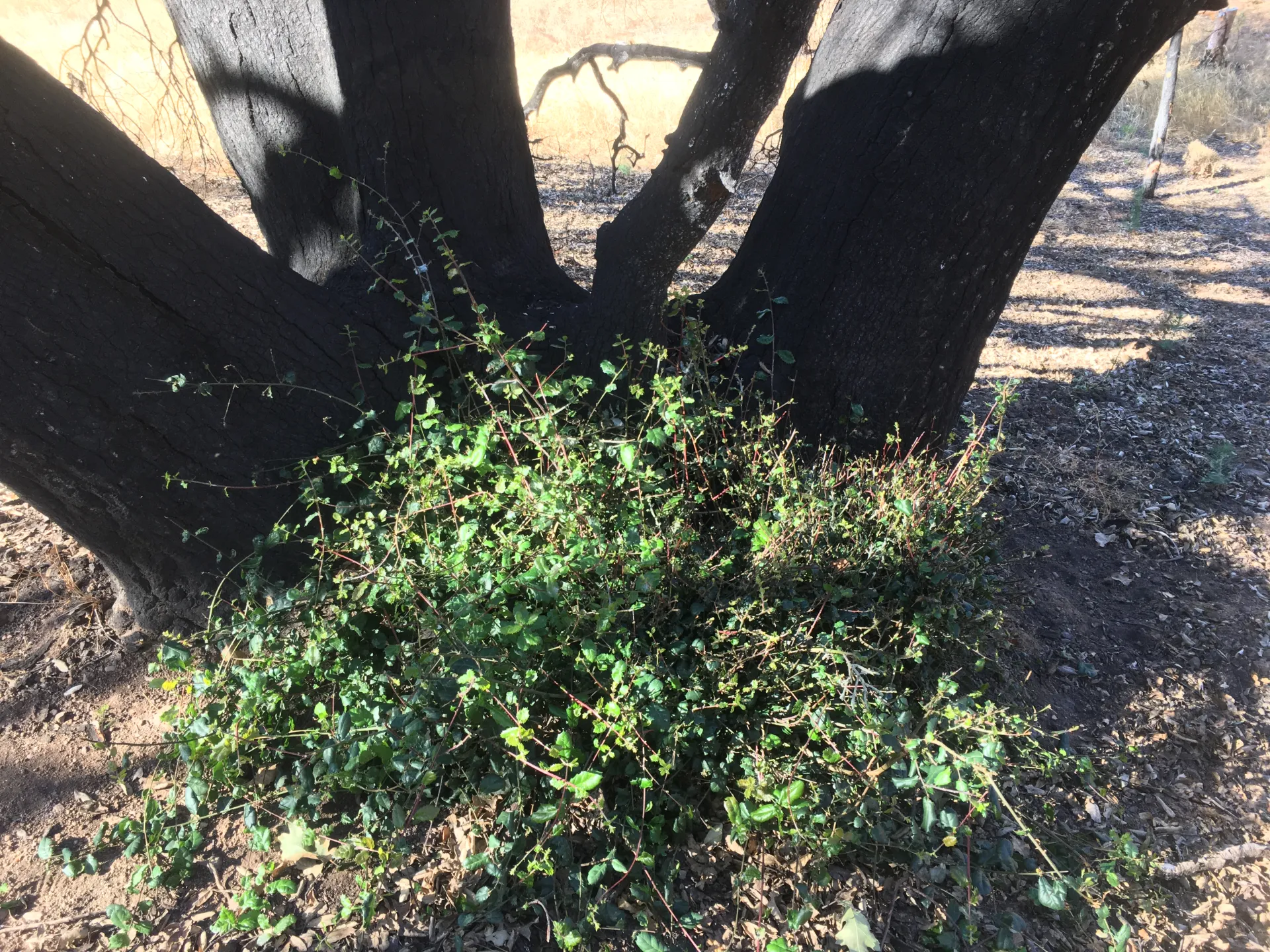
Disturbance (e.g., caused by wildfire, weather, insects/disease, etc.) is a temporary change in environmental conditions that causes a pronounced change in an ecosystem. It is an important part of healthy and diverse forests. However, disturbance events can sometimes result in topkilled trees that vigorously resprout. (Fig. 1).
Thinning Oak and Hardwood resprouts
Both the initial disturbance and the growth of resprouts can result in substantial changes in forest stand structure, species composition, wildlife use, accessibility, aesthetics, and fuel loading, among other ecological impacts. While these changes are not inherently good or bad, resprout growth can be abundant leading to trees with dense shrub-like forms that may present challenges to post-disturbance forest stewardship. Thinning (or pruning) resprouts can facilitate the response of trees and forests post-disturbance and help ensure the forest recovery is consistent with desired goals and objectives.
When to thin resprouts
Thinning should be conducted once resprouts are well-established, healthy, and foliage is above browse height and pruning will not remove more than 1/3 of the foliage on retained resprouts. Thinning should ideally be conducted when trees are not actively growing and pathogens are least active, typically during dry seasons (e.g., avoid thinning in the spring).
Choosing which resprouts to keep
Choosing which resprouts to retain and how many will vary based on the overall goals and objectives for an area or forest stand.
Generally, retain resprouts with the best growth form (e.g., emerging from the root crown at the ground, straight stem, single top, most vigorous, etc.), and that are free of damage. Resprouts should be spaced out to provide growing room and reduce pest pressure. More than one resprout (at least two) per topkilled tree should be kept initially to help suppress growth of additional resprouts and account for potential mortality. Resprouts can be removed as they continue to grow and need more space.
Where on the landscape to thin
Thinning all topkilled trees within a stand impacted by disturbances can be an overwhelming and potentially expensive task. Consider concentrating on high value areas or strategically treating areas in different years (see Appendix A).
Dealing with cut and dead biomass
The biomass created from thinning resprouts and cutting dead material can accumulate around resprouting trees, adding to fuels or making future access difficult. Some options for reducing trimmings are to pile and burn, lop and scatter, or use larger pieces to create caging around young trees. However, reducing, rather than removing all biomass left from thinning may be beneficial as a mulch, shading soil, protecting regeneration, suppressing the growth of competing vegetation, or adding habitat complexity.
Dealing with competing vegetation
Competing vegetation can increase stress (i.e., competition for space, water, and nutrients) of high priority trees or desired species. Managing competing vegetation within the proximity (e.g., the dripline of the original tree canopy) of high value trees or desired species can be beneficial.
However, competing vegetation can also help shade the soil which might help suppress additional growth and resprouting, maintain soil moisture, and protect regeneration desired individuals. Therefore, be strategic in the removal of competing vegetation and consider retaining at least stem from root crowns of some resprouting competitors for these benefits.
Maintenance
Maintenance will be required as resprouts and competing vegetation continue to grow or new sprouts emerge. The frequency of follow-up management will depend on the goals and objectives defined for the forest stand or landscape. Multiple tools can be employed for follow-up maintenance, including mechanical thinning, grazing, prescribed fire, or chemicals.
An important part of maintenance is to use proper tools and pruning techniques. Chainsaws may be helpful for increasing capacity, but pruning shears, loppers, handsaws, or pole pruners offer the best option for more precise cutting and reduced risk of causing unintentional wounds.
Landscape Appendix A: Resprout Management Checklist
The checklist below can be used to determine if or when to manage resprouting oaks and hardwoods for a given stand.
| Before thinning resprouts in a stand, consider: | |
Reason for thinning?
| Benefit of thinning resprouts?
|
| If thinning might be required, consider: | |
Is it the right time to thin?
| What resprouts should be retained?
|
| During and after thinning, consider: | |
| |
Further Reading and ResourcesHolmes, K.A., K.E. Velben, T.P. Young, and A.M. Berry. 2008. California oaks and fire: a review and case study. In Proceedings of the sixth California oak symposium: today’s challenges, tomorrow’s opportunities. USDA Forest Service, Pacific Southwest Research Station, Redding, CA. PSW-GTR-217. McCreary, D. and G. Nader. 2011. Burned oaks: Which ones will survive? UC Ag and Natural Resources Publication 8445. McDonald, P.M. and N.R. Vaughn. 2007. Growth of thinned and unthinnned hardwoods stands on a good site in northern California. USDA Forest Service Pacific Southwest Research Station General Technical Report 204 (PSW-GRT-204). Plumb, T.R. and A.P. Gomez. 1983. Five Southern California Oaks: identification and postfire management. USDA Forest Service, Pacific Southwest Forest and Range Experiment Station General Technical Report 71 (PSW-GRT-71). Ritchie, M., Berrill, J. P., Hammett, E., & Long, J. W. (2024). Early Responses to Crown Modification of California Black Oak Sprouts Initiated by High-Severity Wildfire. Journal of Forestry, 122(1), 70-78. |
Find the printable version of this fact sheet below. Note that the pdf is for print purposes ONLY.
