
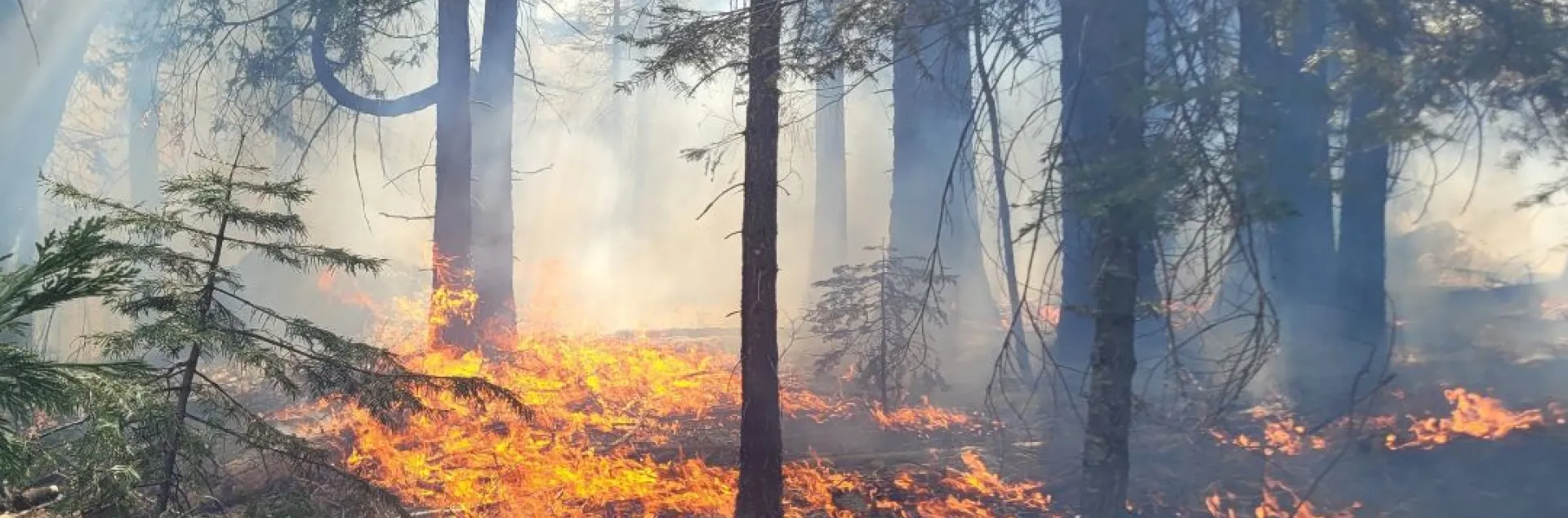
Prescribed Fire’s Role in Reforestation
With an increase in high severity wildfire, planted young conifer trees are increasingly common across the landscape. Since these young stands are vulnerable to additional high severity fire, managers need to develop innovative strategies to help them thrive and mature (York et al. 2022a). Prescribed fire is one tool that can be used to help reduce fuel loads, promote biodiversity and enhance ecosystem health, making young forests more resistant to future wildfires.
Although restoring beneficial fire as a natural process enhances future forest resilience, it is challenging because of the high tree density and fuel loads found in today’s forests. Todays’ fires kill more trees over larger areas than would have happened historically (Williams et al. 2023). When fire-killed trees fall to the ground, high fuel loads lead to more high severity fire behavior and effects at a landscape scale.
Broadcast burning can reduce heavy fuel loads, reducing the risk of future high severity fire. Since young trees are especially vulnerable to prescribed fire effects, it’s important to use reforestation practices designed to reduce the risk that prescribed fire will kill young trees.
Reforestation to Promote Prescribed Fire
Practices before, during and after planting new trees can be used to promote later prescribed burning.
Before Planting: It’s important to prepare the site for planting by removing dead trees, burning residual woody debris and preventing emergence of vegetation that will compete with seedlings. All of these reduce fuels to decrease the severity of effects from wildfires and from later prescribed burns (Lyons-Tinsley and Peterson 2012).
During Planting:
Species selection: A planting mix that favors long-needled conifers like ponderosa pine whose litter is plentiful and dries easily will help carry future prescribed fires across the site.
Planting design: A traditional grid planting configuration promotes fuel continuity which helps propagate a broadcast burn within the developing stand (See Reforestation Planting Design).
Density: Not planting trees densely and thinning them out at a young age helps create conditions conducive to seedling growth and ensure that young trees develop the vigor and spacing needed to withstand prescribed fires (Noble and York 2024; York et al. 2022a).
After Planting: Reducing woody debris, controlling competing vegetation and thinning and pruning trees can help prepare a young stand for prescribed fire. Practices include:
Pile burning: Collecting and burning accumulated woody debris reduces fuels that can generate excessive heat and kill clusters of trees during prescribed burns.
Mastication: Grinding up excess vegetation alters fuel conditions and creates compact surface fuels beds that may be challenging to burn during the wetter conditions when prescribed burns tend to occur.
Competing vegetation control: Shrubs competing with seedlings reduce their growth and can make stands difficult to broadcast burn. Killing competing vegetation by using herbicide or chainsaws leaves dead plants that can carry a prescribed fire.
Thinning: As stands mature, thinning reduces the density of young trees on site. Along with removing whole trees during later harvest operations, this eliminates the ladder fuels that enable fires to reach canopies (Stephens and Moghaddas 2005).
Pruning: Pruning elevates the bottom (or base) of tree crowns. Together with thinning, this creates a gap in fuels that discourages fire spread into tree crowns and improves tree survival during broadcast burns (Agee and Skinner 2005).
Objectives for Burning Young Stands
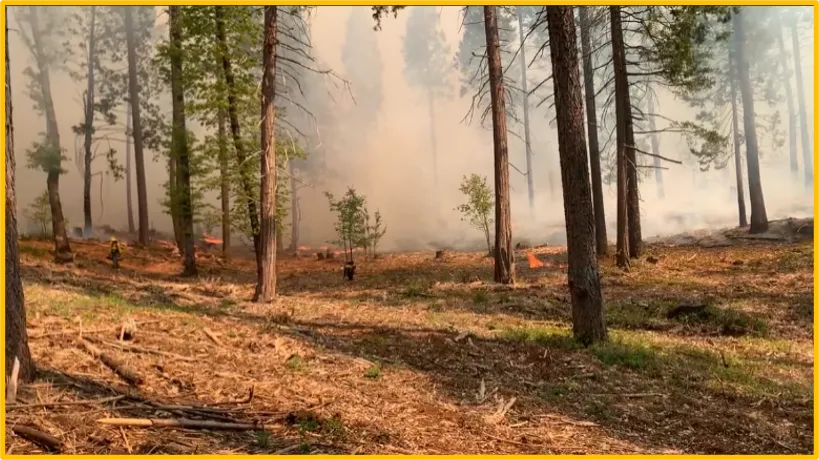
Prescribed fire effects vary based upon many factors and cannot be controlled with precision. Therefore, land managers and landowners must consider their priorities and determine an acceptable range of tree mortality in exchange for overall higher fuel consumption. The challenge lies in identifying when young stands become fire-resilient enough to withstand prescribed burning, and the conditions under which burning will meet objectives. Managers must balance fuel reduction benefits with the likelihood of mortality in the youngest stands. Although some amount of tree mortality may be desirable to reduce tree density.
Research done at UC Berkeley’s Blodgett Forest included burning young forest stands under very dry conditions (ten-hour fuel moistures of 5% to 6%). The youngest stands experienced the highest tree mortality with twelve year-old stands suffering 69% mortality after two years, while 22 and 32 year-old stands had 37% and 22% of trees die respectively (York et al. 2021b). In a different study, lower rates of tree mortality occurred when burning similar aged stands but at higher fuel moisture levels. Mortality ranged from negligible to 24% of the total trees (Bellows et al. 2016). While burning under higher fuel moisture conditions protects young trees, fuel consumption is typically also less.
Prescribed Fire Implementation
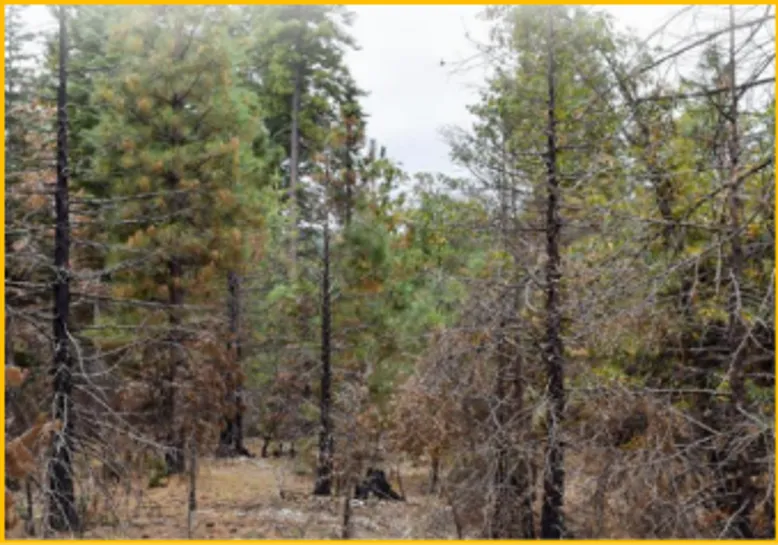
Successfully implementing a prescribed burn requires taking advantage of weather windows during which conditions allow for burning, as well as securing resources, personnel, and supplies. Knowledge of the units to be burned is extremely important because site-specific factors, like south facing aspects, can provide extended burning windows.
The cost and effort associated with prescribed fire preparation can be reduced by taking advantage of previous treatments and by planning ahead. Adjacent areas previously burned can offer a natural containment line for future burns. Additionally, containment lines for prescribed fire can be constructed during post-fire salvage harvesting while equipment is onsite.
Landowners without knowledge or experience in use of prescribed fire are encouraged to reach out to professionals, including CalFire, prescribed burn contractors and prescribed burn associations (at Calpba.org). They can help provide operational resources and educate private landowners on use of prescribed fire as a land management tool.
Find the printable version of this fact sheet below. Note that the pdf is for print purposes ONLY.
