
by Katie Yamashita, Los Angeles County, Online Master Food Preserver Volunteer
For thousands of years, chili peppers were cultivated only in the Americas. Then, beginning in the late fifteenth century, Spanish and Portuguese traders carried them around the world as part of the Columbian Exchange. Within a century, they were being cultivated across Europe, Africa, and Asia. As chili peppers became part of cuisines around the world, one idea emerged again and again: a dried chili wasn't simply a preserved version of the fresh pepper. It was something different.
Chili pepper names are steeped in history and tradition
Nowhere is the distinction between fresh and dried chili peppers more fully developed than in the culinary traditions of Mesoamerica. Long before European contact, Indigenous peoples throughout the region cultivated an extraordinary diversity of chili peppers and developed equally rich traditions for using and preserving them. Many of the names still used today, particularly those derived from Nahuatl, an Indigenous language spoken across what is now central Mexico, reflect a long tradition of treating dried peppers as distinct culinary ingredients rather than simply preserved versions of fresh ones. This tradition long predates the modern nation of Mexico and remains central to Mexican cuisine today.
Some of the most common fresh-to-dried name pairs include:
Fresh Pepper | Common Dried Name |
|---|---|
Poblano | Ancho |
Jalapeño | Chipotle (smoked) |
Mirasol | Guajillo |
Bola | Cascabel |
The table above captures only the most familiar pairings. The naming tradition goes much deeper than that. Chipotles, for example, include both chile morita and chile meco—different styles of smoked jalapeños distinguished by their drying and smoking methods. The names describe not just the pepper itself, but how it was processed and how it behaves in the kitchen. From a cook's perspective, an ancho isn't simply a dried poblano. It's a different ingredient.
Elsewhere, cultures often reached the same practical conclusion: drying changed peppers so dramatically that the dried forms developed their own culinary identities, even if they didn't always receive entirely new names.
India
India quickly embraced chili peppers after their introduction by Portuguese traders. Today, dried varieties such as Kashmiri, Byadagi, and Guntur are prized for their distinctive combinations of color, heat, and flavor, with cooks selecting different peppers for different culinary purposes.
Spain
Spanish cuisine gave the world pimentón, a spice made from dried peppers. In the La Vera region, those peppers are traditionally dried over oak fires to produce the distinctive smoked pimentón de la Vera. The resulting spice has an aroma and flavor unlike anything found in fresh peppers.
Hungary
Hungarian paprika, ground from specially grown dried peppers, is so central to the country's cuisine that it is treated as a distinct ingredient rather than simply dried peppers. The drying and grinding process produces a spice with deep, sweet, sometimes smoky complexity that simply does not exist in the fresh fruit.
Korea
Chili peppers arrived in Korea relatively recently. Most likely introduced via Japan during the Japanese invasions of Korea in the 1590s, having traveled from the Americas through Portuguese trade routes. Over the centuries that followed, they became so central to Korean cuisine that it is difficult to imagine the food without them. In Korean cuisine, gochugaru, coarsely ground dried red pepper flakes, became a foundational ingredient in kimchi, gochujang, and countless other dishes, and is treated as entirely distinct from the fresh pepper it came from.
Why the Flavor Changes So Dramatically Upon Dehydration
The near-universal human decision to distinguish dried peppers from their fresh counterparts is not arbitrary. It reflects real and significant physical and chemical changes. Several things happen simultaneously as a chili pepper is dried, and in some cases, smoked.
A fresh chili pepper is 80 to 90 percent water. When that water is removed during drying, sugars, capsaicin, acids, and flavor compounds become much more concentrated. The dried pepper is not simply a smaller version of the fresh one; it is a more intense, more complex version in which every component is amplified.
During drying, the pepper's chemistry continues to change. Aromatic compounds break down and transform, pigments oxidize, and the balance of flavors shifts. In smoked peppers such as chipotles, the combination of heat and smoke creates additional flavor compounds that give them their distinctive roasted, smoky character. It is not just that the original flavors have intensified; genuinely new flavors have developed. They are the same plant. They are not the same ingredient.
Dehydrating Peppers at Home
You, too, can dry chili peppers! Drying chili peppers is one of the simplest preservation methods available. While a food dehydrator produces the most consistent results, peppers can also be successfully dried using an oven, by air-drying, or, in the right climate, by sun-drying. Whichever method you use, start with firm, fresh peppers free of blemishes or damage. When working with hot peppers, wear gloves as the oils can cause skin irritation and burns.
Sun-drying works best when daytime temperatures are consistently above 85°F. Cut large peppers in half and remove seeds, stems, and membranes. Small peppers can be left whole but should be slit to speed drying. If night temperatures drop enough to cause dew, bring the peppers indoors. Peppers dried this way should be pasteurized when finished either by freezing at 0°F or below for 48 hours, or placing in a 160°F oven for 30 minutes, to eliminate any insects or insect eggs.
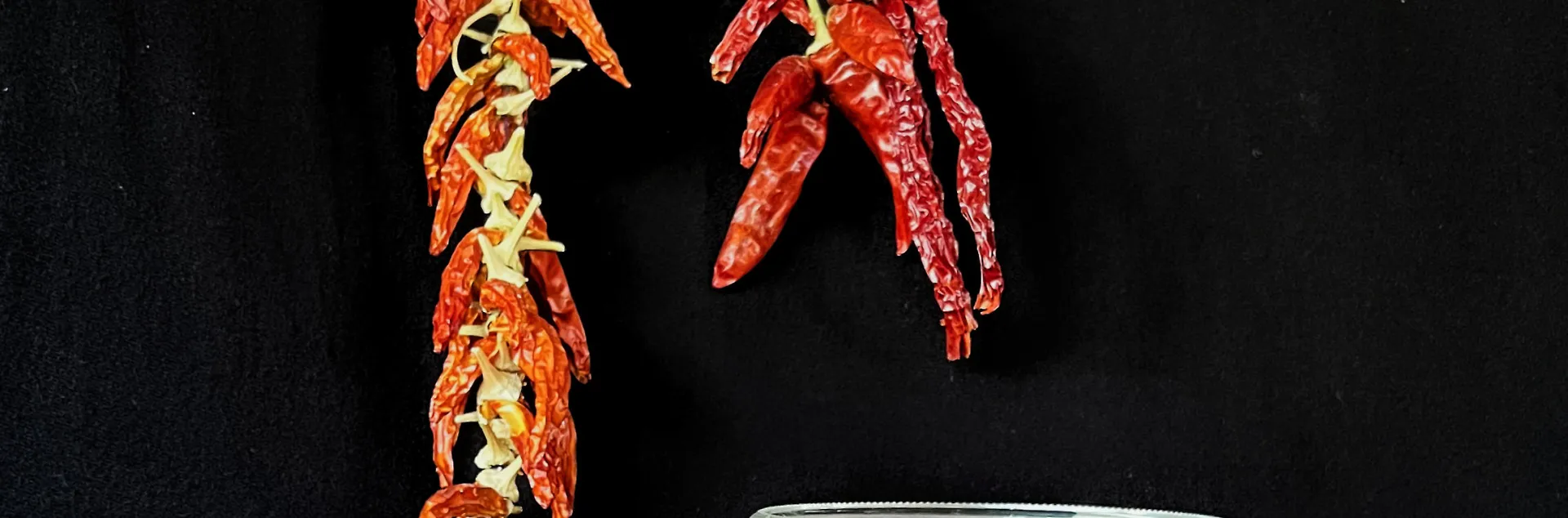
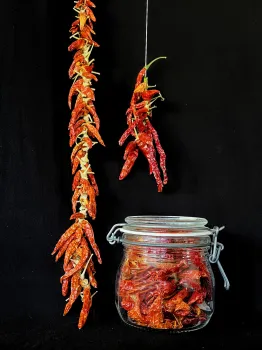
Air-drying is the most traditional method. Slit each pepper, thread a heavy needle through the stems, and hang the string of peppers in a well-ventilated room. High humidity can cause spoilage before drying is complete, so choose a dry location. This method takes three to four weeks.
Dehydrator or oven drying is the most reliable method for consistent results. Keep temperatures at or below 140°F. Higher temperatures will cook, rather than dehydrate, the peppers. For large peppers, cut in half and remove seeds, stems, and membranes before slicing or cubing. A dehydrator typically takes 8 to 12 hours; an oven will take roughly twice as long because of the decreased air flow.
Peppers are fully dry when they are leathery to brittle, with no remaining pockets of moisture. Store dried peppers in airtight, moisture-proof containers such as glass jars in a cool, dark place, where they will keep for several months. Dried peppers can be rehydrated by soaking in water, crumbled into flakes, or ground into powder.
Source: Harris, L.J. Peppers: Safe Methods to Store, Preserve, and Enjoy. UC ANR Publication 8004. https://ucanr.edu/sites/default/files/2020-09/335678.pdf