
Ryan Hill

Ryan Hill

Agronomy & Weed Sciences Advisor

M.S. Horticulture / Plant breeding and genetics, Oregon State University. 2020
B.S. Biology, George Fox University. 2014
Weed management in orchards and forage crops.

Peer-reviewed publications:

Davy, J., Hill, R.J., & Forero, L. (2025). Herbicide Applications in California Dryland Perennial Grasses Improve Forage Yield and Crop Coverage. Rangeland Ecology & Management, 103, 78-82. https://doi.org/10.1016/j.rama.2025.07.009

Hill, R.J., Nackley, L., Moretti, M.L. (2025). Mustard Seed Meal and Mulches for Weed Control in Greenhouses. Journal of Environmental Horticulture, 43(1), 41-48. http://doi.org/10.24266/0738-2898-43.1.41 

Hill, R.J. & Moretti, M.L. (2024) Herbicide Formulation Affects Weed Control and Crop Tolerance in Greenhouse Ornamentals. HortScience, 56(11), 1629-1633 http://doi.org/10.21273/HORTSCI18159-24 

Hill, R. J., King, D. R., & Moretti, M. L. (2024). Evaluating tiafenacil and tolpyralate for weed control and basal foliage removal in hops. Crop Science, 64(6), 3541-3551. https://doi.org/10.1002/csc2.21322 

Hill, R.J., King, D.R., Moretti, M.L. (2023). The prevention of injury to hazelnut trunks. Acta Horticulturae. 1379, 499-502.  

Hill, R.J., King, D.R., Zollinger, R., Moretti, M.L. (2021). 1-Naphthaleneacetic Acid (NAA) Reduces Sucker Growth in European Hazelnut (Corylus avellana L.). HortScience, 56, 1594–1598. https://doi.org/10.21273/HORTSCI16176-21 

Hill, R. J., Baldassi, C., Snelling, J. W., Vining, K. J., and Mehlenbacher, S. A. (2021). Fine mapping of the locus controlling self-incompatibility in European hazelnut. Tree Genet. Genomes 17:6.
What pre-emergent activity does rimsulfuron have on established johnsongrass?

Body

To provide better recommendations on how to best use rimsulfuron and other residual herbicides to target johnsongrass I established a set of trials in Shasta and Tehama county prune and walnut orchards in winter and spring of 2025. I had two primary goals: first, to test if early spring rimsulfuron applications were effective for control of johnsongrass and second, to determine whether treatments were primarily affecting seedlings or established populations. 

In winter (early February) I applied pre-emergent herbicides including either fluridone (Brake On!, 43 fl oz/A [not registered in CA]) or oxyfluorfen (Goal 2XL, 5 pt/A), along with an untreated control, to account for any seedlings that might germinate through the duration of my trials. In spring (early March) I applied either rimsulfuron (Revolt, 2 or 4 oz/A) or glyphosate (Roundup Powermax 3, 2 pt/A) just before or after shoot emergence from underground rhizomes. Glyphosate was used as a control treatment to account for any post-emergent activity of rimsulfuron on emerged shoots in order to evaluate only the soil residual effects of rimsulfuron. Very little plant material was available for direct absorption of herbicide through leaf tissue at the spring timing, so this is not a preferred use of glyphosate but was simply used as a more suitable control than untreated johnsongrass. Glyphosate can be very effective in the spring but requires adequate leaf material for absorption into the plant. All together four trials were installed, at three different locations. All treatments were accompanied by a half inch of rain within a week of application, washing the herbicide off thatch and leaves and down into the soil.

Image
Johnsongrass coverage is affected by rimsulfuron treatments applied pre-emergence
These pictures, taken in April 2025, are 45 days after rimsulfuron and glyphosate treatments and 75 days after oxyfluorfen (Goal 2xl) and fluridone (Brake On!, not registered in CA) treatments. Rimsulfuron (4 oz/A) is shown here exhibiting a strong suppressive effect on perennial johnsongrass when applied soon before or just after the resumption of growth from below-ground rhizomes. Preemergent treatments applied in winter show no added benefit in this field, suggesting the majority of the effect here is on established johnsongrass, not seedlings.

In all cases the rimsulfuron treatments were responsible for most of the weed control in my plots. Plots that received winter preemergent treatments were only marginally different from plots that were untreated in the winter, if followed by glyphosate in the spring. Only plots that received rimsulfuron in spring had any significant reduction in johnsongrass coverage or biomass. This suggests that the effects of rimsulfuron observed on johnsongrass populations were not primarily from soil residual effects on seedlings but that the perennial rhizomes themselves were affected. Winter treatments added additional johnsongrass control when combined with rimsulfuron only in two of my four trials, and this effect was seen later in the spring as seedlings began to germinate. 

The primary takeaway from this research was that rimsulfuron applications in early March resulted in a 40-90% reduction in johnsongrass weed coverage and biomass that lasted past the end of the study, which was in early May. This was a reduction relative to the control treatment with glyphosate alone, suggesting that post-emergent absorption of rimsulfuron is likely not the primary mechanism of control, but rather activity in the soil. Rates of 4 oz/A were much more effective than 2 oz/A and the addition of glyphosate to the tank mix seemed to slightly increase efficacy. 

Further reading on my research:

Progressive Crop Consultant: click here

Sac Valley Orchards: click here

UC Weed Science (weed control, management, ecology, and minutia)
Primary Image
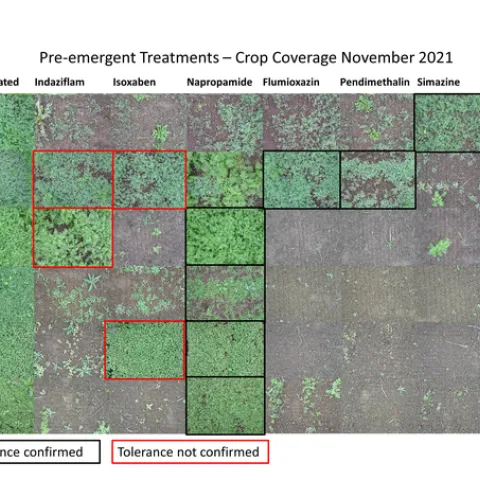
Pollinator habitat coverage in response to herbicide treatments
UC Weed Science (weed control, management, ecology, and minutia): Article

Weed control during pollinator habitat establishment.

May 20, 2024
By Ryan Hill
Introduction: Pollinator insects are essential to produce many economically and nutritionally important crops grown in the western USA. These crops include blueberries, almonds, sunflowers, cucurbits, and many others.
View Article

Protecting hazelnut trunks from herbicide injury

Primary Image
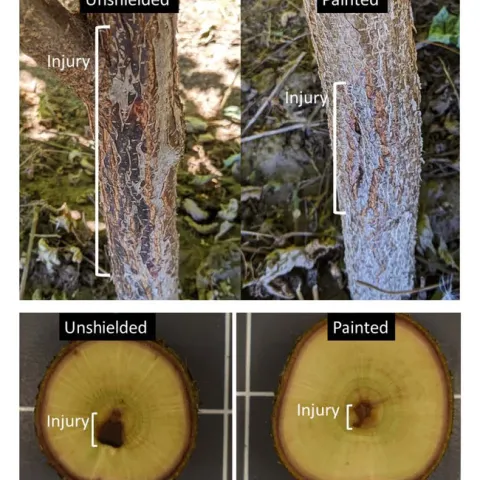
Figure 3: External (top photo) and internal (bottom photo) injury was measured in unshielded and painted hazelnut trunks, showing a reduction of injury in painted trunks. The trees pictured were sprayed with 224 fluid ounces per acre of glufosinate (4x the legal label rate).
Body

Figure 1: Herbicide-induced trunk injury in a young Willamette Valley hazelnut tree.
Sucker control in Oregon hazelnut orchards is a season-long struggle against the tree's natural growth habit. Hazelnut trees grow naturally as a multi-stemmed bush, but in Oregon, hazelnuts are trained as a single-trunk tree to facilitate mechanical maintenance, harvest, and reduce pathogens. In Willamette Valley orchards sucker, or basal sprout growth begins in April and ends in September or October. Managing sucker growth requires multiple applications per season, and hand pruning may be required as well.

Sucker control practices place very young orchards at risk of herbicide injury, because trees from zero to three years old are more susceptible to herbicide damage (Figure 1). Trunk guards and latex paint are used to shield hazelnut trunks from sunburn, but it has remained unclear whether latex paint protects young trees from herbicide injury. Carefully weighing the pros and cons of each option must be considered before adopting either of these practices.

Many postemergence herbicides are used for sucker control in hazelnuts. We studied the effects of glufosinate (Cheetah, Forfeit 280, Reckon 280 SL, Rely 280, and others) on layer-propagated ‘Jefferson' hazelnuts 0, 1, and 2 years after planting to understand how to better protect young trees from herbicide injury. While the activity of other herbicides can also induce trunk damage, we focused on glufosinate alone to determine its potential for young hazelnut injury from this commonly used herbicide. Tree trunks were unshielded, painted, or shielded by an opaque plastic trunk guard (Figure 2). Trunks were painted once or had trunk guards installed at planting. In addition, we studied the effect of herbicide rate and the number of applications. We applied glufosinate at the label (56 fl oz/acre, 1x), at double the legal label rate (2x), or at quadruple the legal label rate (4x). Each rate was applied one, two, or three times per season. All treatments were repeated the following year. Trees were cut down to evaluate any damage to the tree cambium in the third year. We included off-label rates (2x, 4x) to compare the effect of trunk protection.

Figure 2: Study site on an Oregon State University research farm. Hazelnuts with trunk guards, latex paint, or no trunk protection were subjected to herbicide treatments to determine the efficacy of trunk protection to protect young trees from glufosinate damage. Glufosinate is commonly used in Oregon hazelnut orchards to suppress sucker growth.

In our trials, the 1x label rate stunted the growth of newly planted trees (<1 year-old). We expected this negative response as the label warns against treating plants less than one year old with glufosinate. As the trees matured, they tolerated higher application rates; one-year-old trees suffered trunk injury only at the 4x legal label rate. Trunk injury as applications increased from one to three times per year only occurred at applications above the label rate, suggesting that herbicide rate is more important than the number of applications. At any age, no trunk damage was observed at the label rate. This finding underscores the importance of proper sprayer calibration to deliver the correct herbicide rate and reduce trunk damage.

The bark confers protection.

An additional treatment was included where the bark was scraped prior to herbicide application at the 1x rate. The newly planted trees (<1-year old) all died when subjected to this treatment and injury was detected consistently at older ages as well. This was the only instance when the injury was detected when following the herbicide label, suggesting that bark integrity is essential to the prevention of herbicide injury.

Latex paint.

Latex paint effectively protects trees of any age. Paint reduced stunting in newly planted trees compared to unshielded trees at the 1x and 2x legal label rates. Painted trees survived the 4x legal label rates (85%) more than unshielded trees (41%). Across all ages painted trees were 12% greater in trunk cross-sectional area than unshielded trees. Latex paint halved the injury of 1- and 2-year-old trees, when measuring external and internal injury (Figure 3). Tree injuries were photographed one year after the final herbicide exposure.

Figure 3: External (top photo) and internal (bottom photo) injury was measured in unshielded and painted hazelnut trunks, showing a reduction of injury in painted trunks. The trees pictured were sprayed with 224 fluid ounces per acre of glufosinate (4x the legal label rate).

A tree can recover from trunk injury and produce for many years. Still, injury affecting trunk heartwood and pith can leave a tree structurally unsound and may reduce its longevity.

Trunk guards.

On average, trees with painted trunks were 12% larger than trees with unshielded trunks, but trees with trunk guards surpassed the growth of painted trees by a further 10%. The trunk guard prevented any herbicide injury to trees.

In our study, hazelnut trees grew well in trunk guards, although concerns have been raised about the quality of the wood and bark following trunk guard use. Wood density was reduced in our trunk guard treatment compared to the unshielded and painted trees. We cannot predict whether reduced wood density will recover as the trees mature. In general, greater wood density indicates stronger wood.

Removing trunk guards.

Bark grown under trunk guards may be more sensitive to sunburn and herbicide injury when the guard is eventually removed, compared to painted or unshielded trees. In the fourth year of this study, we removed the trunk guards. Herbicide applications after the trunk guard removal doubled the injured surface area compared to trees that were grown with unshielded trees (Figure 4). The depth of these injuries was not doubled, however, likely due to the increased size of the trees. Herbicide injury following the removal of trunk guards only occurred at high rates (2x or 4x legal label rates).

Figure 4: The area of external injuries doubled in size from herbicide applications after removing trunk guards, relative to unshielded trees. The trees pictured were sprayed with 224 fluid ounces per acre of glufosinate (4x the legal label rate).

Our results clarify the role of trunk protection in protecting young hazelnut trees from herbicide injury. Following label recommendations and proper sprayer calibration are important factors in reducing herbicide injury to tree trunks. In this study, 1- and 2-year-old trees were injured only when off-label rates were applied to them. Older trees are more tolerant of herbicide as a sucker control strategy.

Trunk guards and latex paint effectively protected young hazelnut trees from herbicide injury and increased tree trunk growth. The reduced wood density and increased bark sensitivity resulting from trunk guard use may reduce their use in young hazelnut plantings, but their benefits cannot be ignored. Latex paint is a promising alternative to trunk guards and effectively reduces herbicide injury and encourages growth in all cases observed.

DISCLAIMER: The information contained in this article is for experimental purposes only. You must not rely upon the material as a basis for making a pesticide recommendation. Follow the label instructions!

We thank the Oregon Hazelnut Commission, Christensen Farms, Birkemeir Nursery, and OO Agriculture for collaborating and providing financial support to this project.

Ryan Hill and Marcelo Moretti are with the Department of Horticulture at Oregon State University.

Original source: Weeders of the West blog :: Jan. 26, 2023

UC Weed Science (weed control, management, ecology, and minutia)