
It's "Fly Day Friday"--or "Friday Fly Day!"
That's when entomologists or bug enthusiasts post images of flies on their social media accounts or on Flickr.
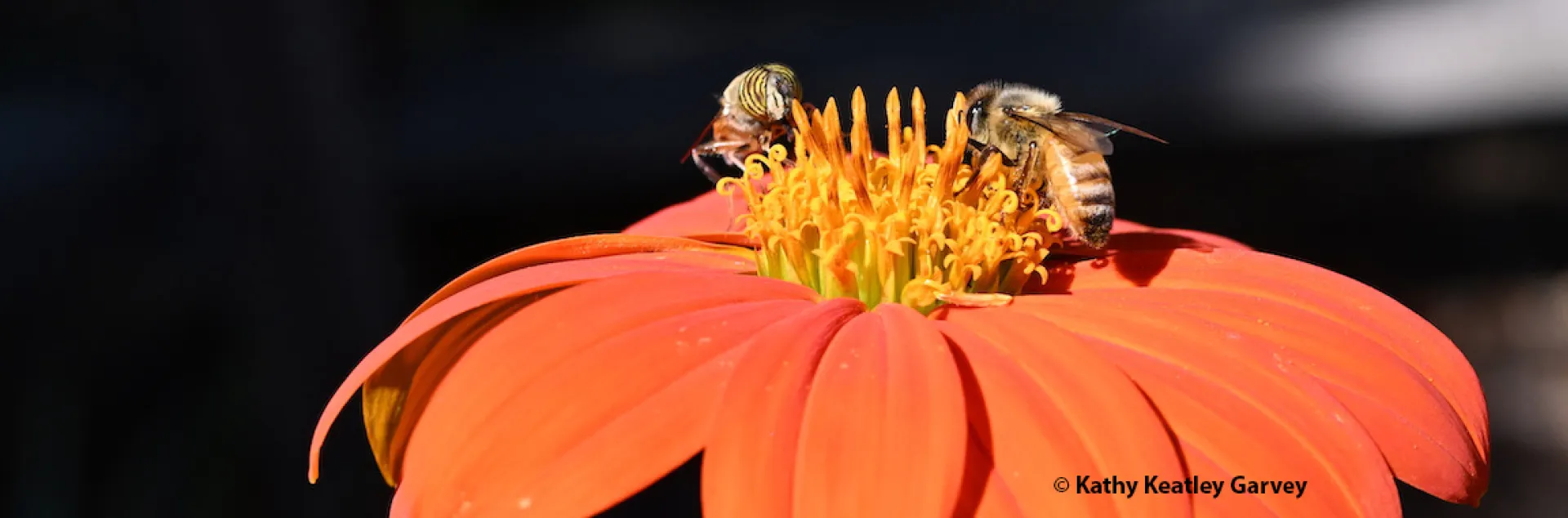
Today, a drone fly, Eristalinus taenliops, a species of hoverfly from Africa that resembles a honey bee, appeared again in our pollinator garden. Yay!
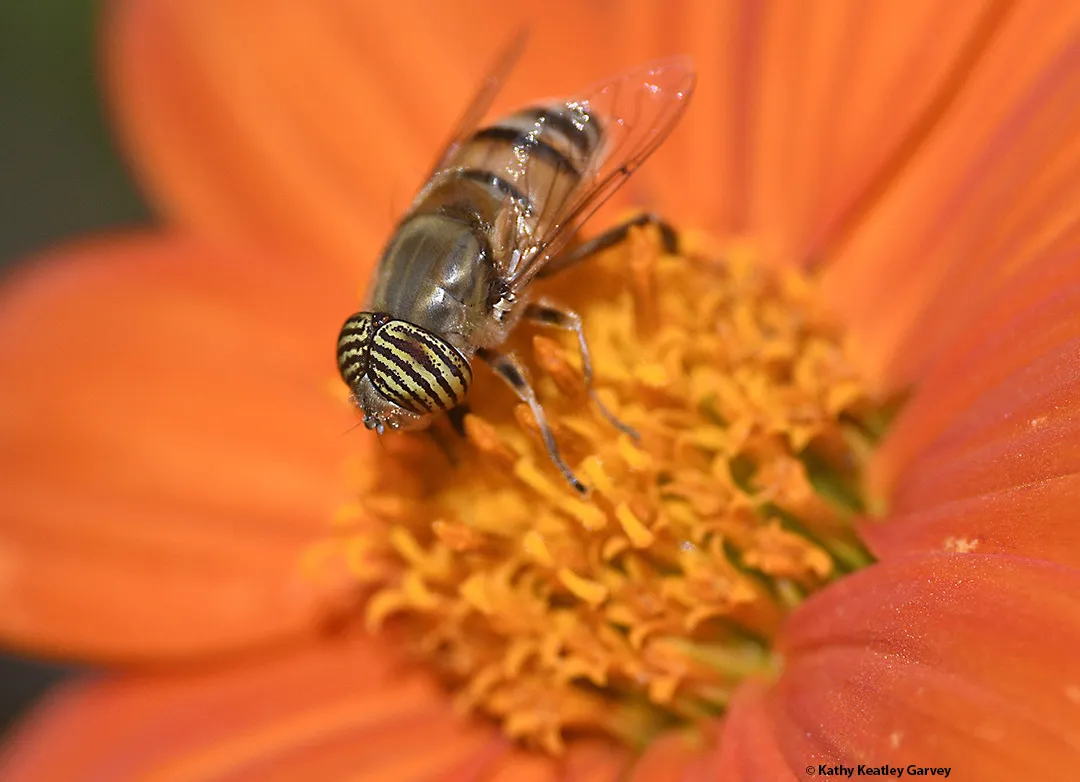
This fly, with its mesmerizing zebra-like eyes, is also known as "the striped-eye lagoon fly," "striped-eyed flower fly," and "band-eyed drone fly." In its adult stage, it's a pollinator. In its larval stage, it's a rat-tailed maggot.
What's the origin of the genus name? It's a diminutive form of Eristalis, the genus of hoverflies known as "drone flies" because they closely mimic the appearance of drone honey bees. The root word Eristalis originally referred to an unknown precious stone in New Latin.
And the species? This translates directly to "ribbon-eyed" or "band-eyed." It is a combination of the Greek words tainia (meaning ribbon or band) and ops (meaning eye).
So there we have it: Eristalinus taenliops. Look closely at its eyes and you'll see five distinct, vertical dark stripes. Maybe it should have been called a "zebra fly?"
In our garden, these drone flies definitely prefer our Mexican sunflower, Tithonia rotundifola, as their main nectar source, but sometimes they'll consider the African blue basil or the snapdragons, only to return to the "T."
The monarch butterflies visiting our yard consider Tithonia their main flight fuel. They "brake" for Tithonia. It's a great pollinator plant.
Cover image: A fly (Eristalinus taenliops) and a honey bee (Apis mellifera) sharing a Mexican sunfower, Tithonia rotundifola. (Photo by Kathy Keatley Garvey)