
A landscaping opportunity arose 6 years ago with a garage addition. We removed all the front lawn, saving the large shrubs (Nandina, Pineapple Guava, Razzleberry (Loropetalum "Razzleberri "), and trees (Crape Myrtle, Chaste, Desert Willow, Red Maple, and Flowering Plum). These trees and shrubs provide the backbone of the garden, plus take a long time to grow. Saving them was a top priority. I wanted my yard to have the English cottage-style garden feel, not a desert landscape.
Working with a landscape designer, many colorful, drought-tolerant plants were selected to spread among those trees and shrubs. Among the plants selected were Purple Hopseed Bush, Spirea, Lomandra, and Artemisia. But my favorites by far are many colorful, aromatic, butterfly- and bee-attracting Salvias, or sages.
Salvias are a large group of garden plants that includes annuals, perennials, and evergreen or deciduous shrubs. The genus Salvia (in the Lamiaceae, or Mint Family) offers Central Valley gardeners one of the largest and most versatile groups of plants available for water-wise gardening. The name Salvia is derived from the Latin word salver, meaning "to heal." Salvias have been used for herbal and medicinal qualities since ancient times. Flowering salvias produce spikes of small, densely packed flowers atop aromatic foliage. These drought-tolerant beauties bloom from early spring to late summer in shades of blue, violet, red, pink, and white. Some varieties grow in all conditions, from full sun to full shade. Plants grow 12 inches to 5 feet tall.
So, you may ask, what is my problem? My salvias are now well-established plants, and they bloom in full splendor through the spring and early summer. Bees and butterflies are abundant. But, in the hot summer months, these same plants look leggy with spent blooms on the ends of stems. Do I prune? If so, when? How much? How about irrigation? These are drought-tolerant plants. Does that mean they need no water, little water, or more water as they get bigger? Time for some research. Here is what I found.
Deadheading (removing faded blooms) is the most basic pruning practice that improves the health and appearance of any Salvia. You can do it as needed. But cutting back stems for healthy plant growth and good bloom requires knowledge of the main types of Salvias.
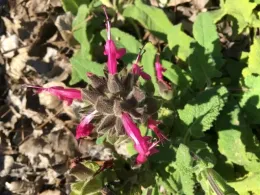
Rosette types, such as Hummingbird Sage (Salvia spathacea), produce erect flower stems surrounded by low mounds of foliage at the base. During bloom time, completely remove any flowering stems after they become spent. They may flower again. In our area, in late fall, when growth stops, cut any remaining flower stems close to the ground. This pruning will strengthen roots for the next growing season.
Soft-stemmed deciduous sages have no woody growth. Most are winter hardy, returning year after year. Mexican bush sage (Salvia leucantha) is an example of this type. During the growing season, you can cut unsightly stems that have finished blooming to the ground. When the plant's appearance becomes messy, it is okay to give these sages a "haircut", trimming to 6-12 inches above the ground. You can expect fresh growth and new flowering. In the late fall, completely prune off the spent stems close to the ground (3-4 inches). This severe pruning prevents a tangled mess next spring and helps control pests over the winter.
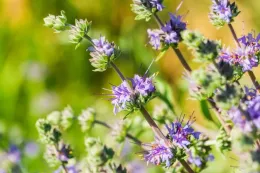
Pruning for the larger, woody Salvias is similar to that of the smaller ones. Autumn sages (Salvia gregii species) and the popular Cleveland Sage (Salvia Clevelandii) are examples of woody-stemmed Salvias. In our area, they may become shrub-like. During the growing season, removing spent blooms stimulates new growth and flowering. For a tidy fall clean-up following the last bloom, cut the spent stems to 5-6 inches above ground to prepare for the next growing season. Some of these Salvias can grow to be up to 120 inches tall and 48 inches wide. Prune these shrubby Salvias by removing both old wood and crossing branches at any time. Pruning encourages new growth. They can also be pruned to control height, width, and attractive appearance.
It was harder to find information on watering established Salvias. Salvias, like any drought-tolerant plant, need a long drink of water applied to the ground at the edge of its canopy or drip line. In the perennial drought-tolerant garden, it is recommended to water infrequently, slowly, and deeply. I follow the city of Visalia's watering guidelines, watering twice a week in July and August. Since all the plants are drip-irrigated, I set my controller to run for long periods (an hour or longer) to allow deep water penetration. Water may need to sink 24 to 36 inches to feed the roots of well-established perennials. Most drought-tolerant plants, once established, do not need excessive summer irrigation. Even in a hot, dry summer, our monthly water usage has stayed the same or decreased compared with previous years.
Though this article focuses on Salvias, caring for other drought-tolerant plants and shrubs is similar. As with all gardens, maintenance is necessary and ongoing. Remember, low-water-using plants do not necessarily mean low maintenance! I hope this information helps you care for established plants in a drought-tolerant garden.