
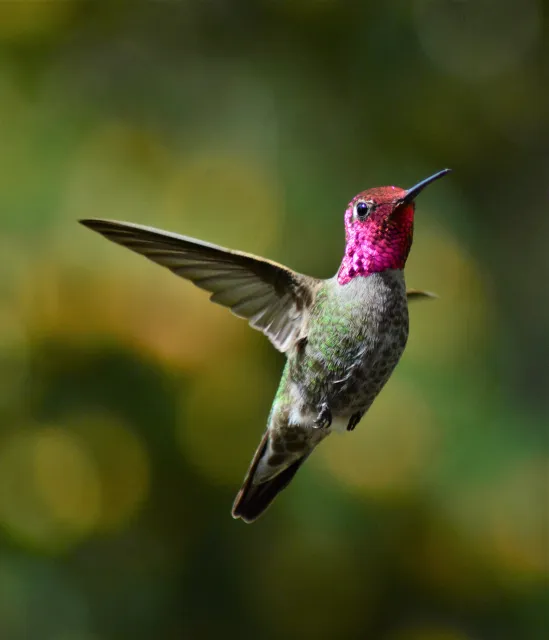
I love all birds, but hummingbirds are up there on my favorites list. They are amazing creatures and such a joy to observe.
The frequency at which they flap their wings and the speed at which they can fly is mind-boggling. Their strong pectoral muscles make this possible. A hummingbird’s pectoral muscles make up twenty-five percent of its body weight compared to human pectoral muscles, which are only five percent of body weight. During a regular flight, a hummingbird will flap its wings seventy to eighty times per second, but during a courtship fight it might flap its wings up to two-hundred times a second.
A hummingbird’s flying patterns are also amazing. They can fly backward, sideways and upside down. Actually, hummingbirds are the only birds that can fly backwards and the only birds with true sustained hovering skills. They hover by rotating their wings in a horizontal figure-eight pattern, and this creates a continuous upward force. This requires not only their strong pectorals but also their very flexible shoulder joints.
Their coloration is dazzling. A hummingbird’s colors are brightest when the angle of light is optimal so that the light reflects off their feathers. When there is inadequate lighting, a hummingbird will appear grey and will be difficult to identify. Anna’s Hummingbird is the most common hummingbird in our area. They have a reddish-pink neck and a green body. The males are brighter than the females, and they also have a reddish-pink feather patch on the front of their neck called a gorget, which they will display and show off to the females when they are attempting to find a mate.
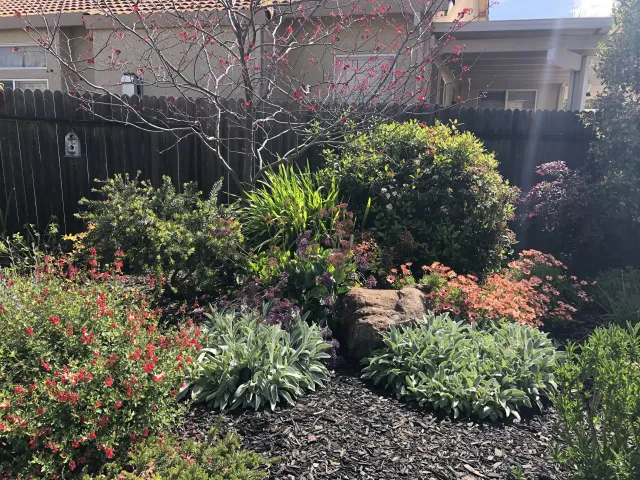
It is instinct for a hummingbird to seek out red flowering plants for nectar, but they learn through experience which plants offer the best nectar and choose accordingly. They prefer plants that bloom during the day and lack landing pads, such as branches, that might attract other animals. They especially favor tubular flowers, including California fuchsia, penstemon, and salvias. Hummingbirds have a bifurcated tongue that rests inside their bill. The tongue has grooves on its side and the design is highly efficient at drawing nectar from flowers. Nectar provides quick energy, but hummingbirds also eat many insects, which supply the protein, fat, and minerals they need. About twenty-five percent of a hummingbird’s diet comes from protein in small insects.
My husband and I have had the pleasure of watching Anna’s Hummingbirds and hearing mating rituals (many) all in our backyard, then twice we witnessed the nesting, hatching, and rearing of chicks and then fledglings in our front yard. The mating ritual involves a rather shrill sound made by the male hummingbird’s wings as he makes a steep, spectacular dive in front of the female. If one concentrates hard enough, you might see the motion of the bird’s dive, but because it is so fast, it is very difficult to see. After mating, the male goes on his merry way, and that is just how the female likes it. The female looks for a place to nest that offers peace and quiet, away from male feeding grounds. She alone builds the nest and feeds and tends to her chicks until they are ready to fly from the nest (it takes about five weeks from the time the eggs are laid until the fledglings leave the nest).
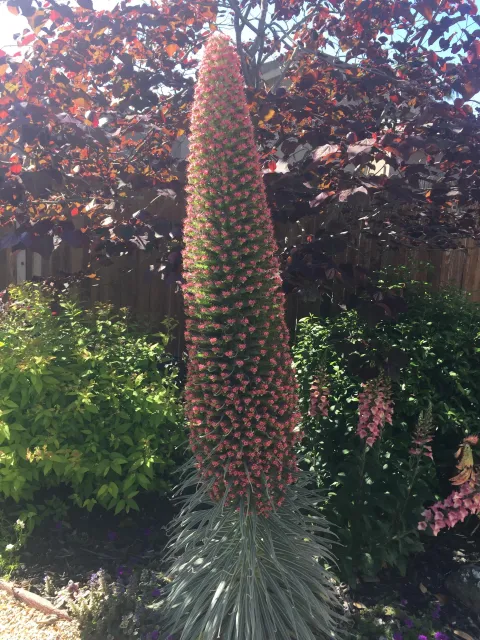
Several years ago in the springtime, a female hummingbird built a nest in the depression of a wind chime that was hanging from our front porch (where it found peace and quiet). She laid two eggs, which is the typical number, and we watched the progression until the two fledglings left the nest. The next spring, the same thing occurred. It most likely was the same mother that came back to use the nest still sitting in the wind chime. She just had to clean it up and rebuild a little bit to make it her home once again. I gather that she returned because she liked the wind chime and familiar environment. However, she seemed awfully angry with me when I swept the porch and gardened around her. Hummingbirds aren’t known to be exceptionally vocal, but she certainly had a voice then. Some pretty intense winds also rocked that wind chime at times, but nonetheless she may have decided there were more pros than cons and that she didn’t mind the audience either.
I was surprised to learn that hummers actually spend eighty percent of their time perching to digest food, groom their feathers, and rest. The remaining time is spent feeding to meet their requirement of six thousand to twelve thousand calories per day. I find having a yard that supports a hummingbird habitat very satisfying. To attract hummingbirds, think red. Not only red flowers and feeders, but red garden furniture or even red surveyor’s tape. A yard space that has both sunny and shady places, a spot to perch, and a water source such as a lawn sprinkler, fountain, mister, or shallow water source (yes, hummers like bird baths to preen their feathers) is a basic requirement. Also, it is critical that pesticides are not used in the yard. Bird feeders can be a wonderful supplement for hummers when needed, although one has to be diligent with cleaning the feeder and replenishing the sugar water frequently; otherwise, the feeder can accumulate mold, which is harmful to the birds.
Photos by Lynn Stanzel unless noted.