
Introduction
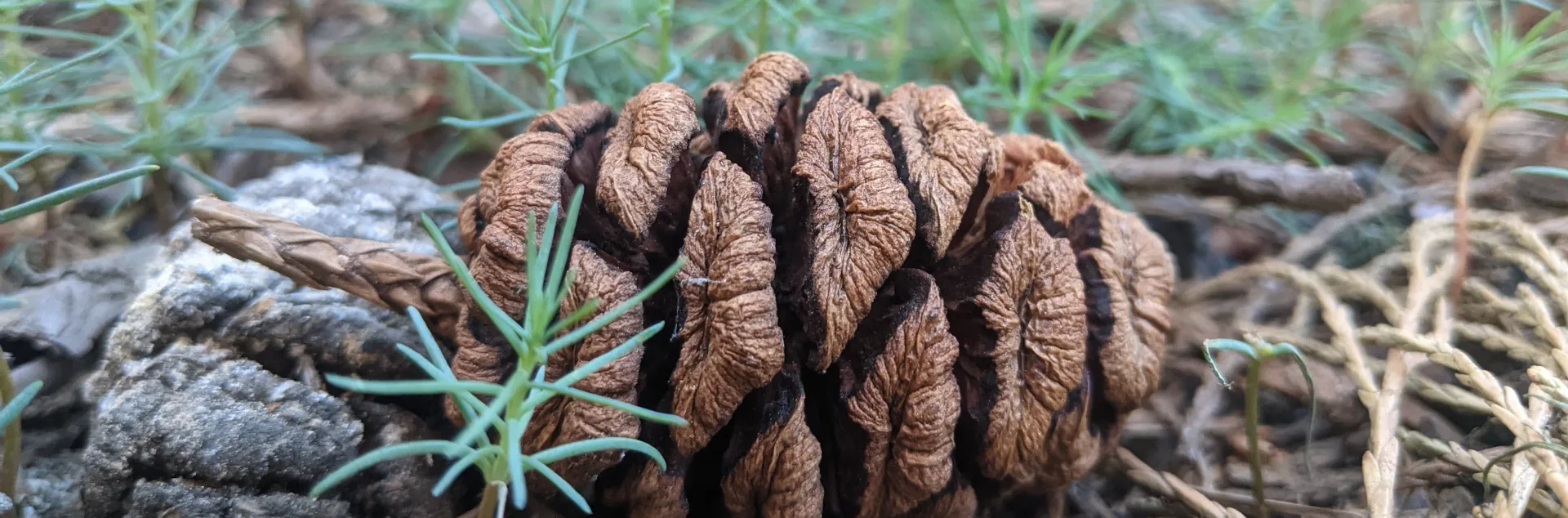
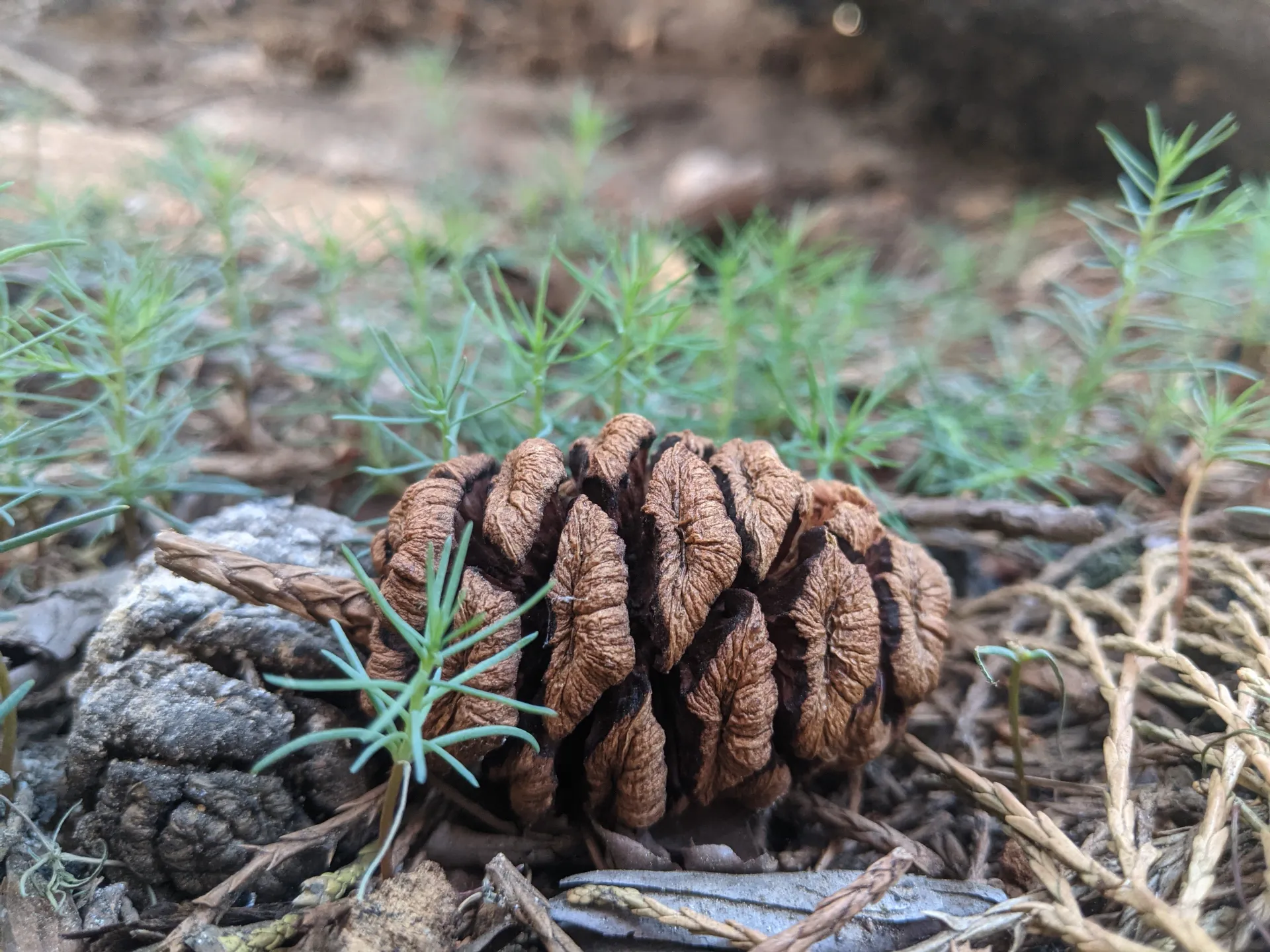
Giant sequoia (Sequoiadendron giganteum) are massive, ancient trees that can live for 2,000 to 3,000 years. They are found at 5,900 to 7,500 feet on the western slope of the southern Sierra Nevada in 70 groves that total only ~25,000 acres (Swetnam 1993). Wildfire is an integral process for giant sequoias, which have self-pruning branches which increases the height to the base of their crowns and thick bark that protects their cambium from heat. Their cones are semi-serotinous, releasing some seeds without fire, but many seeds at once when stimulated by fire, which creates ideal soil and light conditions for seedling growth (see Image 1). Thus, the primary form of regeneration post-fire is flushes of seedlings after fire-stimulated seed release (Shive et al. 2022).
Prior to the era of fire suppression, fire in giant sequoia groves was frequent and burned at low to moderate severity with very small patches (a few hundredths of an acre to a few acres at most) of high severity where most trees died. Recent wildfires in giant sequoia groves have burned large swaths of the forest at high severity, including contiguous areas that are hundreds of acres in size.
The increased area and continuity of high severity fire impacts are the result of modern fires occurring in a hotter, drier climate and of fuel build-up from fire exclusion. Giant sequoias are not well-adapted to the change: these large swaths of high severity have killed roughly 18% of the world’s large giant sequoias and, in many areas, resulted in a lack of regeneration (Shive et al. 2021, Soderberg et al. 2024). Lack of adequate regeneration is a primary post-fire management concern.
Immediately Post-Fire
In the months immediately after a fire, proactive post-fire management involves identification of areas in need of active management. See Post-fire Forest Management Decision Framework.
Like in other mixed-conifer forests, hillslope erosion associated with heavy rainfall can damage giant sequoia groves, which often occur in areas with steep slopes. Management options can be found in Post-Fire Erosion Control: Mitigating Hillslope Erosion.
However, the major concern is the loss of giant sequoia habitat due to mortality and lack of regeneration. Since the extent of giant sequoias in each grove is known and mapped, managers can utilize post-fire aerial surveys and satellite imagery to estimate high severity patches and determine the likely number of giant sequoias killed.
Paired with field surveys, these assessments highlight priority areas to monitor recovery and regeneration. Areas of high severity are of immediate concern, as mortality can range from 75 to 100%.
The First Few Years
In the first years following fire, regeneration is a major concern. Post-fire seedling regeneration often occurs in patches and is most abundant in moderate severity and the low end of high severity – where the heat of hot surface fire kills their needles, but the cones still open and disperse seed (Image 2).
However, in large contiguous areas of very high severity where fire enters the tree crown and consumes the needles, seeds are likely incinerated, leading to very limited sequoia regeneration across the landscape (Soderberg et al. 2024). These areas also lack live tree seed sources for future regeneration events, so there are major concerns out losing this species, which already has a limited distribution, across large areas (Image 2).
Giant sequoia planting: Restoration planting in the first few years following a fire mimics natural regeneration patterns more closely than planting many years later, as the serotinous nature of giant sequoias means that the bulk of their regeneration immediately follows fire.
Seedlings can come in the second year following a fire, but the most abundant response occurs in the first post-fire year if seeds survived and are viable. Thus, planning for planting can start after the first year. Second year seedlings are more likely in areas with first year regeneration and are unlikely in places with limited to no regeneration in the first year.
Competing Vegetation: The survival of planted giant sequoia seedlings faces most of the same challenges faced by other conifer species in the region, especially competing vegetation. Shrubs and other vegetation that naturally grow after high severity fire can compete with seedlings for light and moisture, so managers typically reduce them to ensure that most seedlings survive. Options for managing competing vegetation in a reforestation context are in Managing Competing Vegetation to Inform Reforestation Efforts and Managing Competing Vegetation with Herbicide.
Image 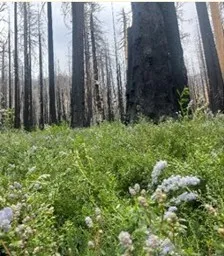 | Image 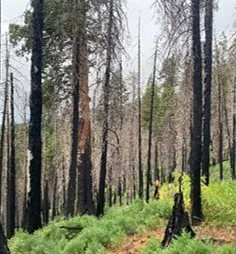 |
| Image 2: High severity burn areas in giant sequoia groves. Left, dominated by shrubs with limited giant sequoia regeneration. Note limited living trees nearby as continued seed source. Right, high severity fire area with high seedling density. Note proximity to living trees which are a future seed source . Photos by Carolyn Welch. | |
Longer Term
After the first few years, management should include monitoring planted seedlings to assess survival. Removal or thinning of shrubs is important to avoid high severity reburns that can occur in recovering high severity areas with dense shrubs and woody fuels from fire-killed trees.
Conversely, areas where giant sequoia seedlings grow in dense patches may eventually benefit from thinning (Forest Stewardship 15: Wildfire and Fuel Management) or prescribed fire (Use of Prescribed Fire in Young Forest Stands) to increase the robustness of the remaining seedlings and reduce high tree densities that promote severe reburning.
Burned areas can also create opportunities for fire use and can be ideal locations to use prescribed fire. Where wildfires burn at low to moderate severity, large giant sequoias generally survive, but some surface fuels are reduced, acting much like a prescribed burn. However, in most fire-suppressed forests, more than one treatment is needed to create resilience to future wildfire. In these areas, giant sequoia managers could apply thinning and/or burning to increase the resilience of surviving forests.
As a fire-adapted system, continued prescribed burns or lower severity fire benefit giant sequoia groves in the long term by reducing fuel loading and preventing loss of giant sequoia from future high severity fire.
Works Cited
Titles listed throughout are UC ANR factsheets that can be found at http://www.ucanr.edu/post-fire-resources.
Find the printable version of this fact sheet below. Note that the pdf is for print purposes ONLY.
