
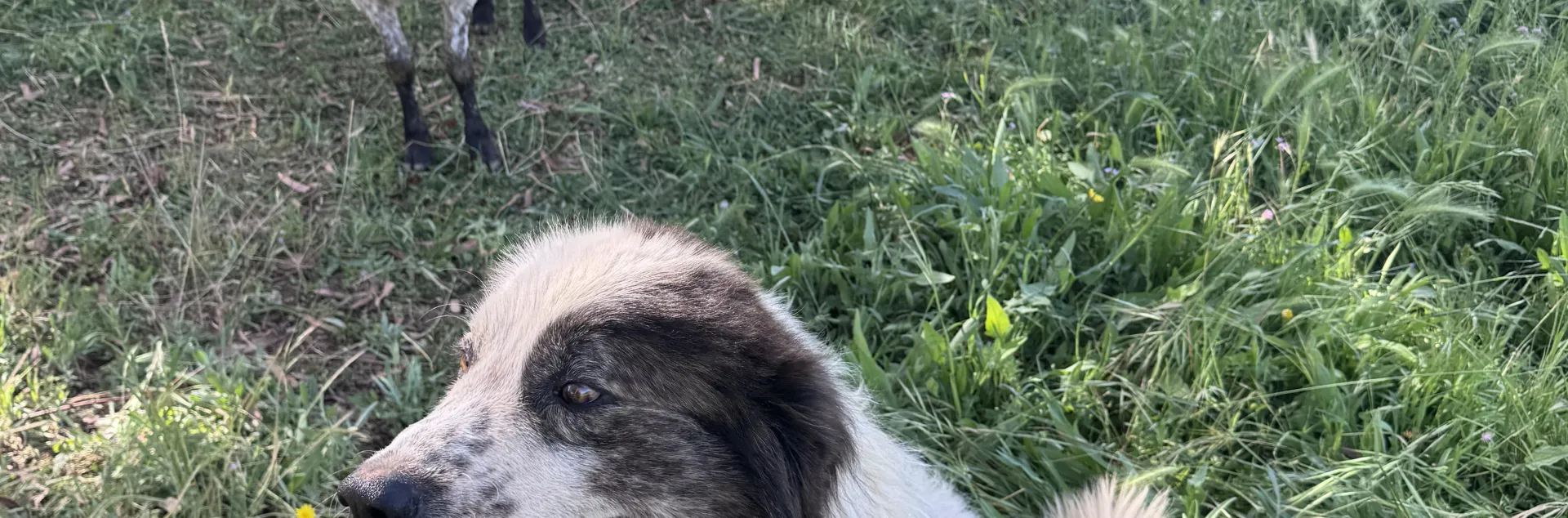
If you’ve been following our work here at UCCE Central Sierra, you’ll likely know that my colleagues Scott Oneto and Brian Allen have been demonstrating a variety of virtual fencing systems in cattle grazing operations for several years now – with great success! They’ve demonstrated the technology’s effectiveness in using cattle for targeted grazing purposes in the foothills, and in replacing physical fences that have been destroyed by wildfire in the high country. More recently, I’ve jumped into the virtual fence space, analyzing the technology as a tool for providing precision grazing on Forest Service allotments. And with Brian’s help, I’ve trialed virtual fence technology with sheep and goats. And with livestock guardian dogs (LGDs).
Physical fences (permanent or temporary electric) are often one element of protecting sheep and goats from predators. Most commercial producers in California also use LGDs. Obviously, a virtual fence won’t deter a mountain lion or a coyote – so LGDs become even more critical! But can virtual fence technology be used on dogs as well as sheep an goats?
Virtual fence technology is similar to the invisible fence systems sometimes used to contain pet dogs. The collars emit a tone when an animal approaches an invisible boundary and deliver a shock once the animal reaches the boundary. Despite their similarity, however, none of the companies currently marketing virtual fence technology market their product for use on canines. But that doesn’t mean ranchers aren’t trying these collars on LGDs!
Critically, we are finding that virtual fence collars do not replace the need for properly bonding LGDs to livestock. Bonding, in my experience over the last 20 years, includes three important elements. A successful LGD must be:
- Trustworthy around livestock and people,
- Attentive to its surroundings, and
Submissive towards livestock
I have found that a dog that displays these behaviors will almost always want to stay with the livestock it’s protecting. Because of this, virtual fence should not take the place of properly bonding a pup, which should begin at 8-10 weeks of age.
But virtual fence can be an important tool in a number of situations. Getting close to real-time location information about an LGD can help producers identify potential predator issues. Keeping an LGD on your property can reduce liability and neighbor complaints. And keeping LGDs away from recreational facilities on public lands can also reduce liability issues and conflict. Finally, virtual fence might be a useful tool in using LGDs with cattle grazing operations – where fences are often not dog-proof!
While the previous trials Brian and I conducted demonstrated the effectiveness of virtual fence in containing LGDs (including the speed at which my LGD learned the system!), we decided this year to evaluate whether the collars cause any other behavior changes in LGDs. Do LGDs show any indications of stress? Do the collars create any physical irritation?
This spring, I’ve been collaborating with sheep and goat producers to collect data regarding these factors – we’ve placed collars with three producers (and a total of 12 LGDs). And so far, none of these producers has documented any evidence of stress or irritation.
Are you interested in trying out this technology? We are looking for commercial producers with well-bonded LGDs who are willing to complete a short observational survey 2-3 times per week (the survey takes about 5 minutes to complete). If you’re interested, give me a shout at dmacon@ucanr.edu!