

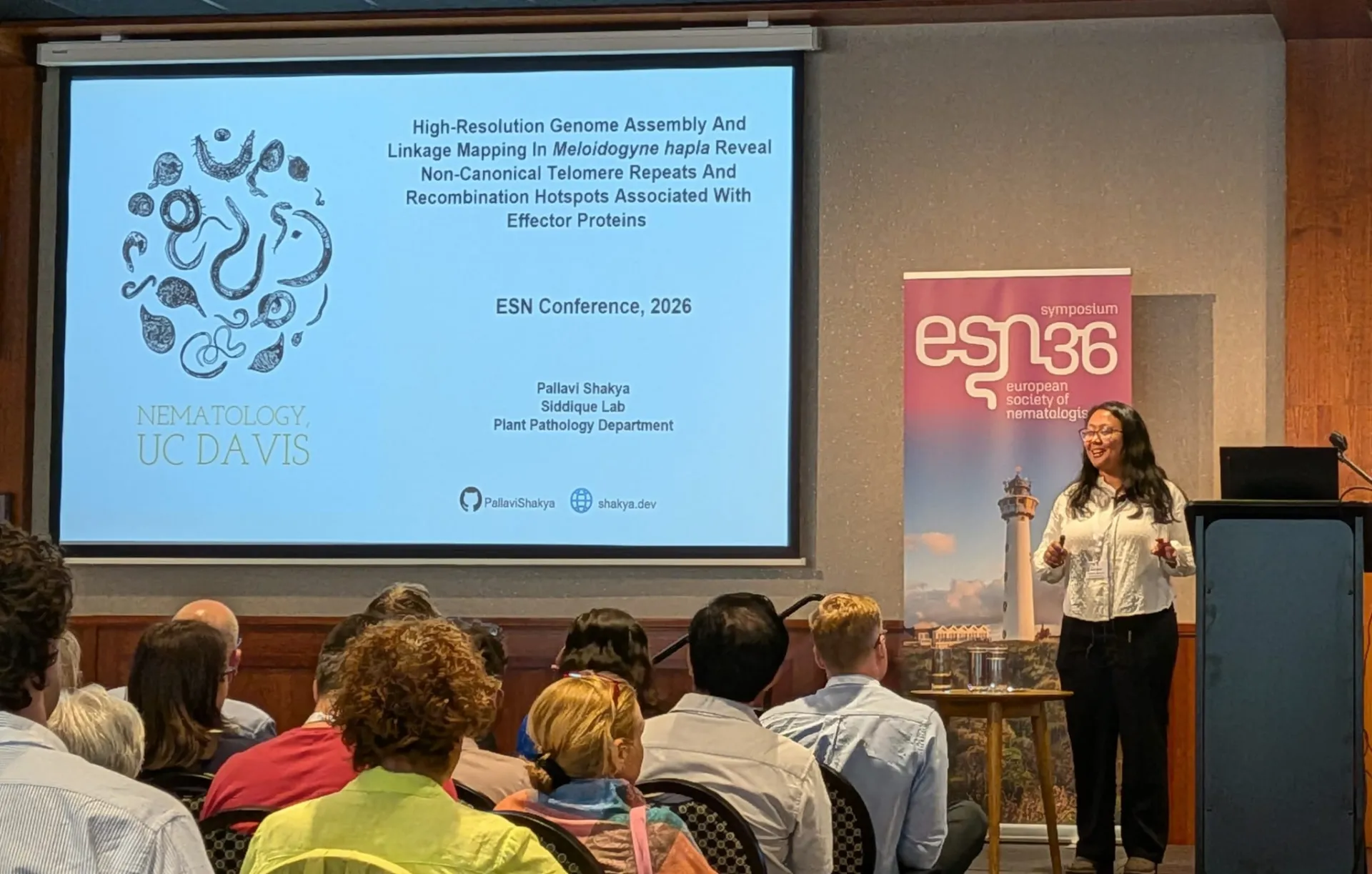
When Pallavi Shakya of the nematology lab of UC Davis Professor Shahid Siddique, Department of Entomology and Nematology, presented an invited lecture at the recent meeting of the Society of Nematologists (SON) in Baltimore, she discussed her highly acclaimed research paper on root-knot nematodes, published in November of 2025 in the journal, PLoS Pathogens.
Shakya is the first author of the paper, "High-Resolution Genome Assembly and Linkage Mapping in Meloidogyne Hapla Reveal Non-Canonical Telomere Repeats and Recombination Hotspots Associate with Effector Proteins," the work of a 15-member international team.
Six other Davis scientists served as co-authors: associate professor Siddique (now professor); professor emerita Valerie Williamson; doctoral candidate Alison Blundell; postdoctoral researcher Dadong Dai, and researchers Jacinta Gimeno and Adam Taranto. Several scientists from The Netherlands, France and Croatia also contributed as co-authors.
Shakya's SON presentation--the same title--drew widespread applause. "I really enjoyed presenting the talk," said Shakya, who received her doctorate from UC Davis on June 11, 2026.
What Is a Root-Knot Nematode?
Want to know what a root-knot nematode is?
"In lay terms: root-knot nematodes are microscopic worms that live in the soil and attack plant roots, causing serious losses in crops worldwide," Shakya related. "The first part of my talk was about building a complete, high-quality 'map' of one nematode's genome, essentially reading out its full genetic instruction manual and organizing it into its 16 chromosomes. Having that map matters because it is the foundation for everything else. You cannot find the gene responsible for a trait until you know where all the genes are. We even turned up a few surprises along the way, like an unusual repeated sequence at the tips of the chromosomes that was not quite like what is seen in other organisms."
"With that map in hand, I went after a specific puzzle," Shakya shared. "Some bean varieties can resist these nematodes, and I wanted to understand what actually happens at the molecular level to make that difference. Working with the resistant snap bean cultivar NemaSnap, I traced the outcome down to a single small region of the nematode's genome and pinpointed one gene the nematode produces. On a susceptible bean, that gene helps the worm feed and reproduce. But on the resistant bean, the plant essentially 'recognizes' it and shuts the nematode down, so it can't reproduce. In other words, the very gene that makes the nematode successful on one bean becomes its downfall on the other."
Shakya earlier presented her research at the 36th Symposium of the European Society of Nematologists (ESN), held June 1-5 in Egmond aan Zee, The Netherlands, and won first place for “Best Student/Early Career Talk."
Siddique Lab in the Spotlight
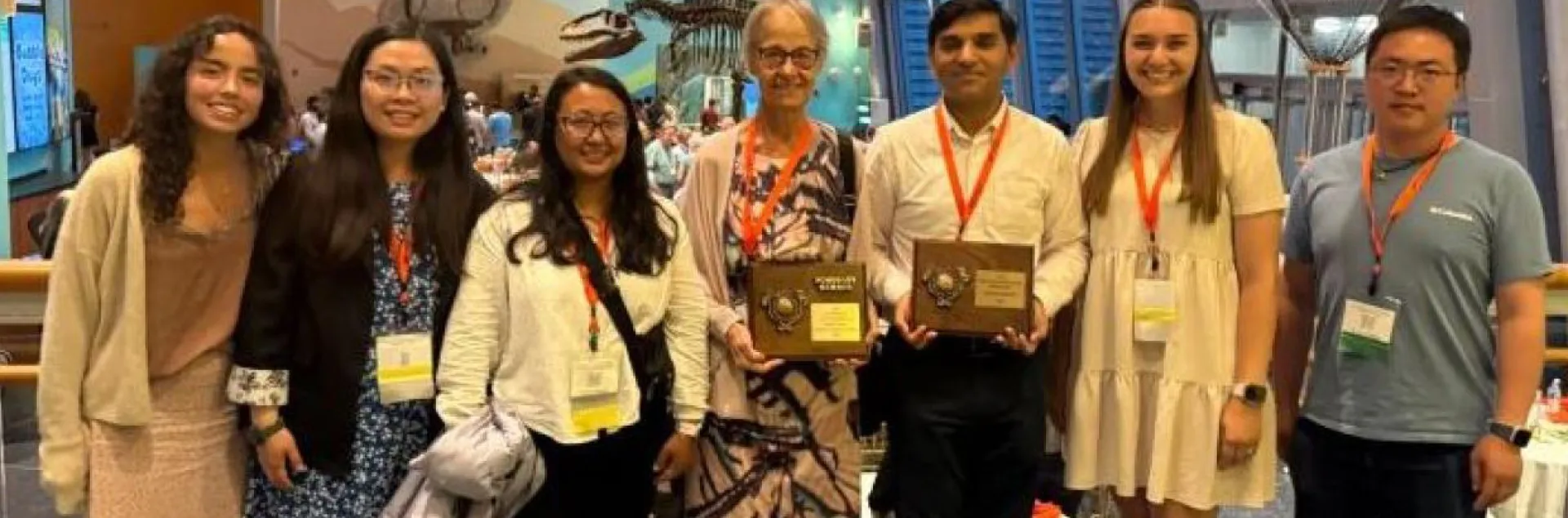
At the SON conference, Professor Siddique received the Excellence in Teaching Award (see news story) and UC Davis Professor Emerita Valerie Williamson, Department of Plant Pathology, received the top honor of Honorary Member (see news story).
In addition to Shakya, the Siddique lab members who delivered research presentations included doctoral student Ching-Jung Lin, doctoral candidate Alison Blundell, and postdoctoral researcher Dadong Dai:
- Blundell presented "Field to Lab: Characterizing Fitness Costs in Resistance-Breaking Nematode Populations."
- Lin discussed "Elucidating the Role of Migpsy Peptides in Plant-Root-Knot Nematode (RKN) Interaction."
- Dai delivered a presentation on "Genomic Chaos Enables Global Success in a Clonal Plant Pathogen."
Also participating was Alison Snyder, a new graduate student in the Siddique lab. who presented a research poster titled "How Root-Knot Nematodes Meet Their Nutritional Needs Across Diverse Plants."
Research in the Siddique lab focuses on basic as well as applied aspects of interaction between parasitic nematodes and their host plants, as related on the professor's website. "The long-term object of our research is not only to enhance our understanding of molecular aspects of plant–nematode interaction but also to use this knowledge to provide new resources for reducing the impact of nematodes on crop plants in California," Siddique says.
Cover image: The Shahid Siddique lab swept the spotlight at the Society of Nematologists' meeting in Baltimore. From left are graduate student Alison Snyder; doctoral student Ching-Jung Li; Pallavi Shakya, who just received her PhD; UC Davis Professor Emerita Valerie Williamson, recipient of the Honorary Member award; Professor Shahid Siddique, Excellence in Teaching Award; doctoral candidate Alison Blundell, and postdoctoral researcher Dadong Dai.