
Introduction
Giant sequoias are a charismatic, long-lived species that grow primarily within isolated groves on public land within a limited endemic range in the Sierra Nevada of California. Their adaptations to fire include thick bark that insulates them from heat damage, height and self-pruning branches that keep fire out of their crowns. Compared to many other conifer species, giant sequoia can sustain more fire damage and survive. So, after a fire it can be difficult to determine the best course of action for giant sequoias that are damaged.
Direct Fire-Caused Mortality
When giant sequoia trees larger than six inches in diameter are damaged by the heat of a fire, they may recover if green foliage remains. Sequoias are killed directly by fire when there is a total loss of photosynthetic tissue – the leaves – in the crown (Hartesveldt et al. 1975).
This can occur via crown scorch, when high heat kills the foliage, leaving it crisp and brown, and crown torch, when fire results in complete consumption of the foliage. Therefore, it is the lack of green foliage following a fire, either from scorch or torch, that indicates the tree has died. However, if a tree still has some green leaves, it stands a chance at recovery.
Delayed Mortality
Giant sequoias can survive extensive crown damage, but they can eventually succumb after a few years if the damage is extensive enough. Once live crown loss exceeds 90%, their survival chances diminish (Stephens and Finney 2002, Shive et al. 2022). This mortality threshold lowers to ~85% if a large giant sequoia tree has a substantial fire scar (Shive et al. 2022). Extensive damage to the cambium, the living tissue underneath the bark, can also contribute to delayed mortality.
In addition, fire damage may weaken the tree, making it more vulnerable to damage from other sources like drought and beetles. In recent years, managers have recorded multiple instances of giant sequoias dying from the top down in the years following a fire (Image 1). This mortality pattern is connected to bark beetle infestation, though the exact combination of factors that cause these trees to die is unknown.
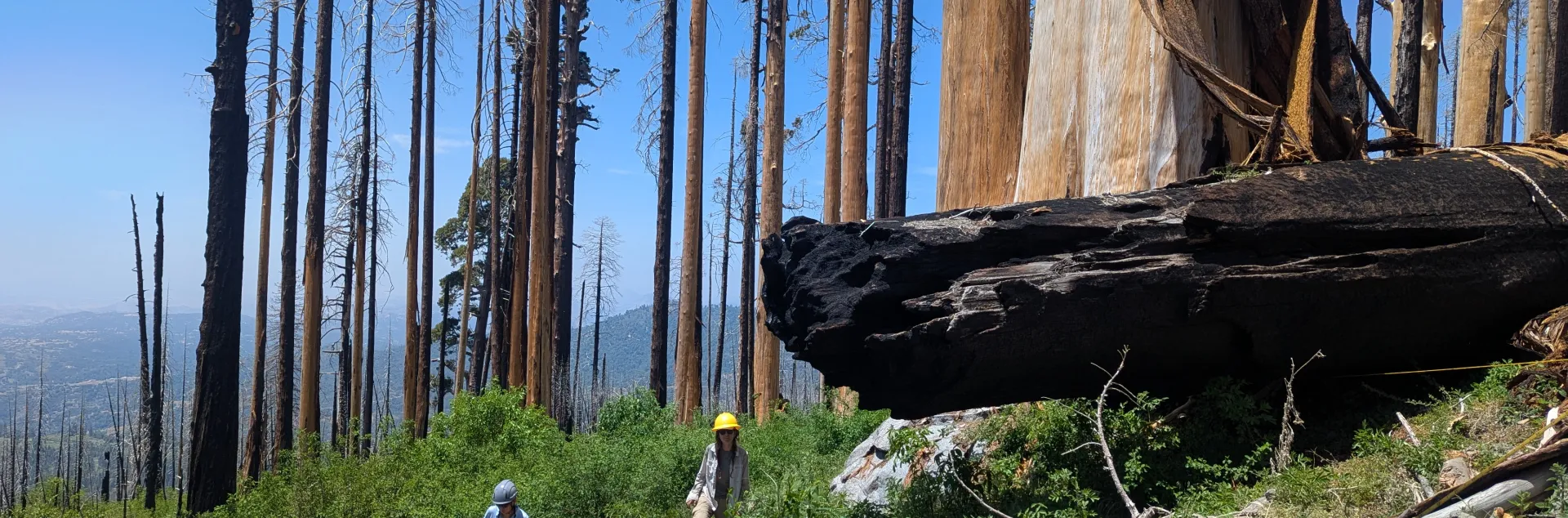
Fire damage can also weaken the tree structurally. Many giant sequoias have hollowed out trunks after millennia of successive fires. Sometimes a recent, additional fire may be the final straw, making the tree unstable. It may then be killed by falling over. This tends to happen more often in high-wind events or when the soil is saturated with water.
This does not mean that all heavily damaged giant sequoias must be removed, rather that monitoring is prudent.
Damage to be concerned about for a giant sequoia post-fire (USFS Region 5) |
Reasons for Removal
The primary reason for removal is where a damaged tree threatens human life or infrastructure. If a giant sequoia has a severely weakened base and is a threat, it may be grounds for falling the tree, either for removal or to leave it on the ground for habitat.
In addition, giant sequoias tend to drop branches after fire. Dropped branches from a mature giant sequoia can be up to 20 inches (50 centimeters) around, the diameter of a moderately sized pine tree.
If a heavily damaged giant sequoia is near buildings or other infrastructure, this may be a reason to consider removal or pruning. The highest risk from falling giant sequoia tops and branches is within 30 feet of the trunk of the tree (USFS Region 5 2025).
Branches are more likely to fall after being damaged by fire more than once. Giant sequoias respond to initial damage to the base of the branch by adding wood to the top of the branch. When another fire damages the bottom of the branch, it further weakens the now top-heavy branch and makes it more likely to break off (USFS Region 5 2025). Thus, there is a higher concern of falling branches if a tree has withstood multiple fires that burned up into the canopy.
Protected Status
Giant sequoias are recognized by the International Union for Conservation of Nature (IUCN) as endangered; however, they are not federally designated as endangered nor considered endangered by the state of California. They are generally protected from logging on public lands by managing agencies. While there are no state level rules restricting the removal of large giant sequoias as hazard trees, there may be local rules. Landowners should consult a Registered Professional Forester before removing a large tree.
Table 1: Immediate Fire Damage and Mortality
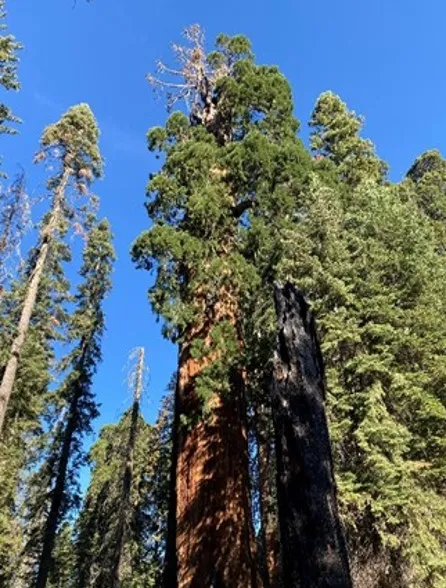
Image 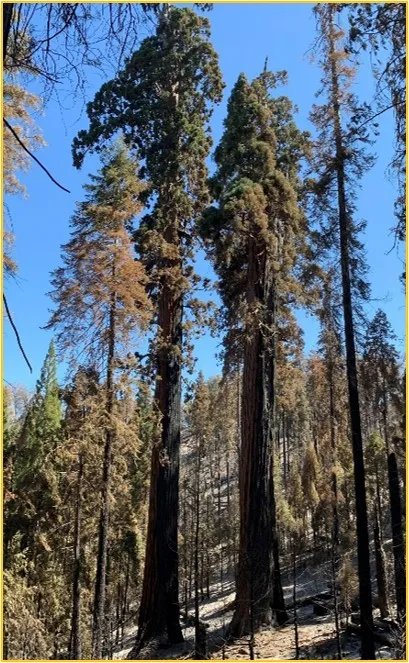 | Giant sequoia with minimal scorch like this individual are unlikely to die following a fire. When a giant sequoia tree is completely scorched, with no green remaining, it is likely dead and will not recover. |
Image 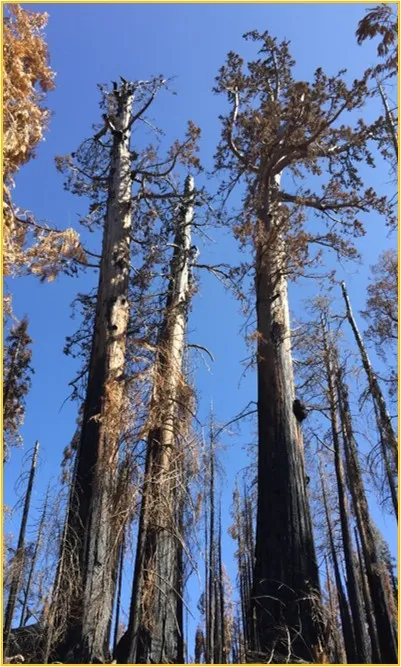 | Scorched giant sequoia with just a small amount of surviving foliage can survive. Some branches will sprout new needles, while others may drop. |
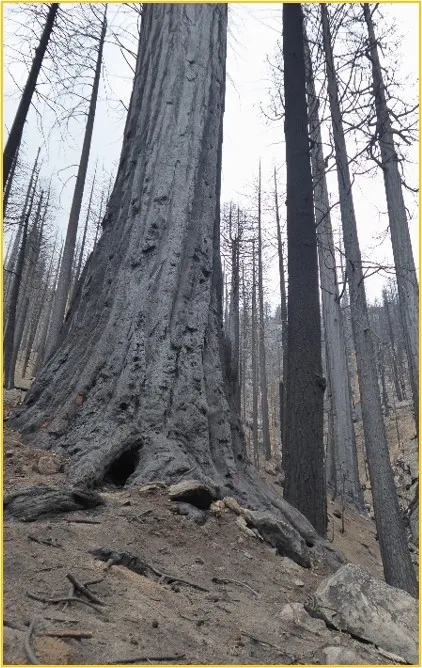 | When a giant sequoia tree is completely scorched, with no green remaining, it is likely dead and will not recover. |
Further Reading and Resources
Hartesveldt, R. J. 1975. The “discoveries” of the giant sequoias. J of Forest History, 19(1), 15-21. Shive, KL, A Wuenschel, LJ Hardlund, S Morris, MD Meyer, and SM Hood. 2022. Ancient trees and modern wildfires: Declining resilience to wildfire in the highly fire-adapted giant sequoia. Forest Ecol & Manag. 511: 120110. 511:120110. Stephens, SL & MA Finney. 2002. Prescribed fire mortality of Sierra Nevada mixed conifer tree species: effects of crown damage and forest floor combustion. Forest Ecol and Manag 162:261–271. USFS Region 5. 2025, February 25. Addendum to R5 Hazard Tree Guidelines: Determining and Abating Naturally Occurring Giant Sequoia as Hazard Trees. |
Find the printable version of this fact sheet below. Note that the pdf is for print purposes ONLY.
