
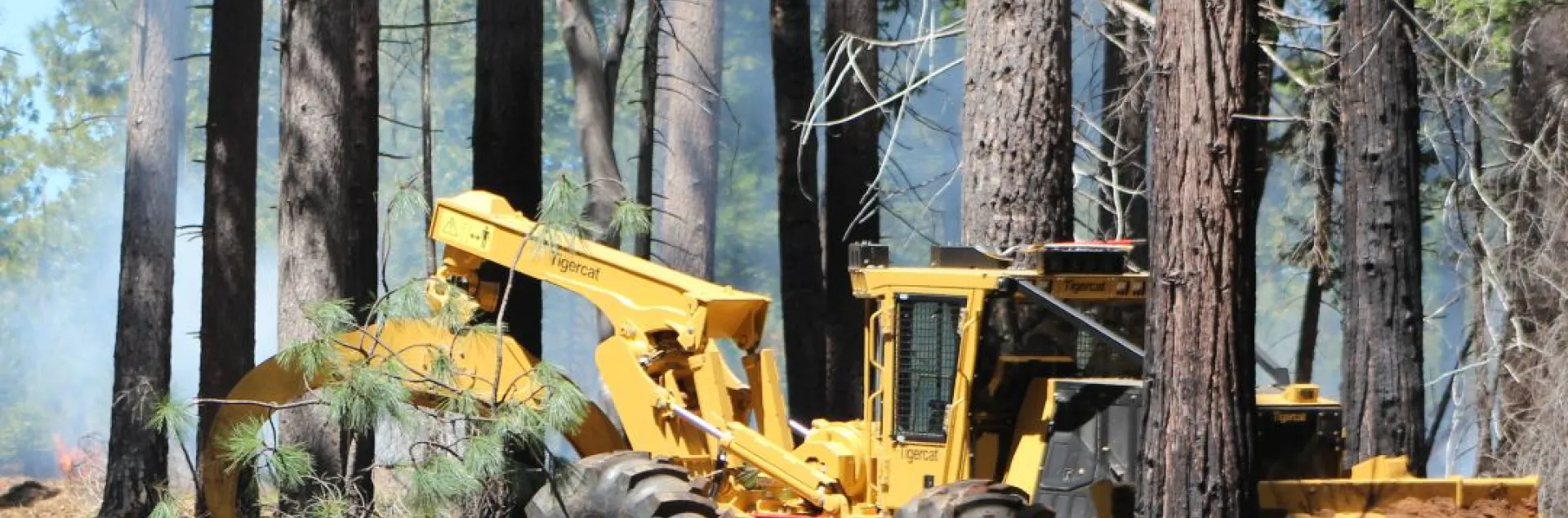
Effective post-fire reforestation relies on investing in management practices that promote resilient forests capable of withstanding shifting climate patterns and future wildfires (Noble and York, 2024). Land managers must contend with hazardous fuel accumulations from dead trees while also managing aggressive shrub competition that threatens seedling survival and contributes to future fire risk. Among available treatments, mechanical site preparation methods—including salvage logging, mastication, and piling—form the critical foundation for preparing sites where seedlings can successfully establish and thrive.
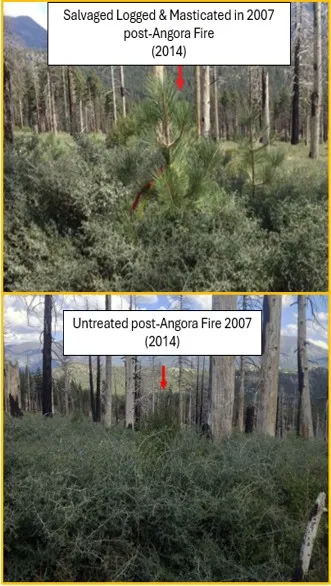
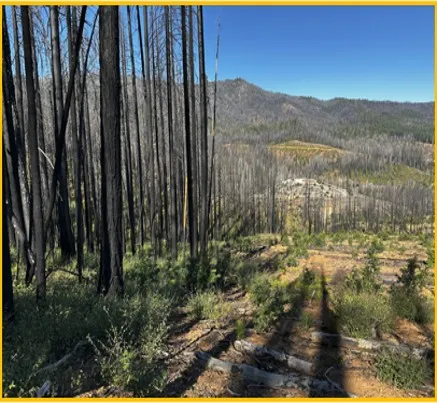
After high-severity fires, significant tree mortality rates create large areas of standing dead trees, commonly known as snags (See Image 1). These snags may present immediate hazards to safety within forested areas, as they can fall unpredictably. As time progresses, these dead trees decay and drop, adding to the overall fuel load and increasing the risk from future wildfires (Knapp, 2015). In addition, competing vegetation, particularly vigorously resprouting shrub species, can impede reforestation efforts by: outcompeting vulnerable planted seedlings for essential resources like soil moisture (Davis et al., 2023) and contributing to fuel loads, whether as live vegetation or dead, that increase the risk of reburning at high severity (Coppeletta et al., 2016; See Post-Fire Competing Vegetation Management Factsheet).
Mechanical site preparation refers to using heavy equipment to systematically remove or modify dead fuels and resprouting vegetation prior to planting trees. It lays the groundwork for newly planted seedlings to grow into a resilient forest by reducing the amount and continuity of post-fire fuel loads and treating competing vegetation prior to planting. It sets up seedlings to thrive during their first five years, their most critical period of growth.
Mitigating fire spread and severity via treatments involves strategically targeting and reducing fuel loads across different fuel types. These include fine surface fuels that carry fire horizontally, ladder fuels that create vertical continuity allowing fire to reach tree crowns, and heavy woody debris, like large-diameter logs, that contribute to fire intensity and duration. Post-fire treatments that reduce standing, fallen, or remaining woody debris enable planted seedlings to develop with a lower risk of mortality from future wildfires (Lyons-Tinsley and Peterson, 2012).
Complementary treatments, including herbicide application for vegetation control or prescribed burning of hand-piled fuels or broadcast burning, can be integrated with mechanical methods to achieve comprehensive site preparation and long-term reforestation success. Mechanical site preparation provides the starting point, first addressing post-fire fuel loads and safety hazards before other treatments can be effectively implemented (See Image1).
Salvage Logging
Salvage logging involves harvesting fire-killed trees that still retain commercial value before they deteriorate, typically focusing on larger-diameter snags that can be processed into lumber or other wood products. When economically viable, salvage logging allows for the recovery of merchantable timber while reducing fuel loads and providing income for landowners to fund future treatments. However, post-fire logging may not be feasible if trees are not of a valuable species, are too small to be merchantable, if the site is too remote or steep, or if there is no sawmill available or willing to purchase the timber.
In order to sell timber products, a registered professional forester (RPF) is required to obtain a permit that satisfies the California Forest Practices Act. While salvage logging removes large diameter woody material, its operation often leaves behind small and accessible fuel, known as slash. The equipment used for tree harvesting can also pile resulting slash, making the combination of salvage harvesting, piling, and burning a highly effective strategy for fuel reduction (See salvage logging fact sheet)
Chipping
Chipping can effectively shred trees and debris into small, uniform wood chips, which is typically deposited near the chipper’s operational site. Chipped material can then be spread across the site to serve as mulch, helping to retain soil moisture, improve soil structure, and somewhat suppress the growth of competing shrubs (McDonald and Henderson, 1990). In some locations, the resulting chips can be marketed as woody biomass for energy production or other uses, providing an economic return. However, in many locations chipping does not produce revenue and the costs must be covered by the landowner or with grant funded chipping program (Check with your local Fire Safe Councils).
Mastication
Mastication involves grinding or chopping live and dead fuels—including small trees, shrubs, downed woody debris, and other materials—using a masticator head mounted on an excavator tractor. What is left is a compacted fuel bed made of dead surface fuels.
When retained on-site, mastication, like chipping, reduces vertical continuity of ladder fuels while increasing the amount of smaller surface fuels (Image 2). Initially, these fuels can increase surface fuel loading and wildfire intensity. However, they also decompose faster than larger fuels and result in lower wildfire intensity compared to doing nothing (Image 3). A heavy and thick masticated or chipped fuel layer can suppress competing vegetation, providing soil moisture and potentially reducing the need for herbicides (Kocher and Wade, 2022). Compared to other mechanical treatments, mastication operations limit soil compaction (Moghaddas and Stephens, 2008).
Image 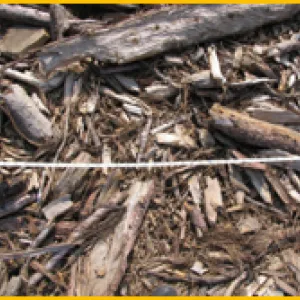
| Image 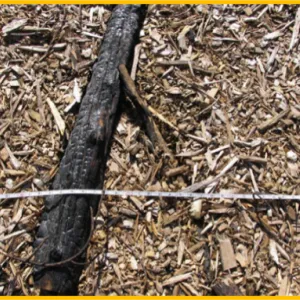
|
Machine Piling and Burning
Piling involves gathering woody debris by using a brush rake mounted on a bulldozer and then placing it into very large piles for later burning. Piles can also be constructed with an excavator equipped with a grapple attachment. Hand piling is an accessible way to dispose of brush and woody vegetation at smaller scales that do not require heavy equipment. Always obtain the appropriate permits when burning piles constructed by machine or by hand (See Guide to Pile Burning.)
Deep Ripping
Deep ripping or tilling involves using specialized equipment to break up compacted post-fire soil layers. This improves water infiltration, reducing surface water runoff and soil erosion. It also breaks up woody debris and incorporates it into the soil, facilitating faster decomposition of the combustible material (Page-Dumroese et al. 2021). Deep ripping may also stimulate the underlying soil seed bed, causing the resurgence of shrub growth and requiring further treatment of competing vegetation.
Management Considerations
Post-fire reforestation success depends on safeguarding the growth of regenerating young trees, where both the timing and sequence of interventions occur at specific times to effectively address fuel loads and vegetation competition. Mechanical site preparation methods can be strategically phased with other treatment methods, with timing driven by ecological, operational, and economic factors (See table below).
A possible treatment sequence could include:
Year 0-1: Salvage logging to capture timber value before decay; mastication or chipping immediately processes slash while equipment remains on-site, vegetation is allowed to grow for one year.
- Year 1-2: Herbicide sprayed to control resprouting brush and other competing vegetation, followed with a pre-emergent herbicide to prevent plant germination. Finally, conifers are planted.
- Year 3-5: Herbicide sprayed if other vegetation is outcompeting the tree seedlings.
- Years 5-10+: Seedlings are thinned out if more are growing than desired.
- Years 10+: Prescribed fires are conducted once trees reach fire-resistant size.
While mechanical site preparation requires an upfront investment, this foundational treatment—when properly timed and sequenced—pays dividends with improved seedling survival, reduced high-severity reburn risk, and long-term forest resilience.
Table: Mechanical Methods to Manage Fuels and Competing Vegetation
Method | Overview | Advantages | Challenges | Timeline |
Salvage Logging | Removes dead trees to recover timber value and reduce fuel loads | Reduces large fuel loads Removes hazard trees May generate revenue | Risk of soil disturbance Safety hazards Depends on log market availability | Immediately to 2 years post-fire |
Chipping | Shreds small wood and slash into chips for mulch or biomass | Conserves soil moisture May suppress shrub growth May improve soil health May generate income | Spreading can be a challenge Soil compaction risk Ability to sell on limited market | 1 to 2 years post-fire, before planting |
Mastication | Grinds brush and trees into smaller pieces left on site. | Reduces standing fuel levels Speeds up decomposition May limit shrub competition | Initially increases fuel load During a fire, potential increase in fire intensity | 1 to 2 years post-fire, before planting |
Machine Piling | Gathers slash into large piles for burning or removal. | Can clear area rapidly Reduces fire risk | Piles may incorporate soil causing smoky burns Intense heat from concentrated fuels can affect soils May result in lack of fuel connectivity for broadcast burns | 1 to 2 years post fire, before planting or after if away from seedlings |
Deep Ripping | Tills soil using shanks to alleviate compaction and prepare for plantin | Improves soil structure Aids water infiltration in post-fire soils | Must be done on contour to avoid erosion Not feasible on steep slopes | 1 to 2 years post-fire, before planting |
Find the printable version of this fact sheet below. Note that the pdf is for print purposes ONLY.
