
By Drs. Monica Palta UC ANR/UCI, Esther Lofton, UC ANR and Chris Olivares, UCI

Nearly half the tap water in the U.S. contains PFAS, but some communities are more affected than others (Pexels/Jynto/Wikipedia/CC0 1.0 ).
If you've been following water quality news, you've probably heard the term "PFAS." These chemicals have become the focus of increasing scientific research, regulatory action, and public concern because of their widespread occurrence in drinking water, groundwater, rivers, lakes, and even human bodies. In this blog post, we will explore what they are, why they are so difficult to manage and what they mean for California communities.
What are PFAS and where do they come from?
PFAS (short for perfluoroalkyl and polyfluoroalkyl substances) are a large family of thousands of synthetic chemicals that were developed in the 1940s. Their unique chemical structure makes them exceptionally resistant to heat, water, grease, stains, and chemical degradation. These properties have made PFAS valuable in thousands of industrial and consumer products, including firefighting foams, food packaging, non-stick cookware, stain-resistant carpets, waterproof clothing, cosmetics, electronics, medical devices, dental floss, and many industrial manufacturing processes.[1,2]
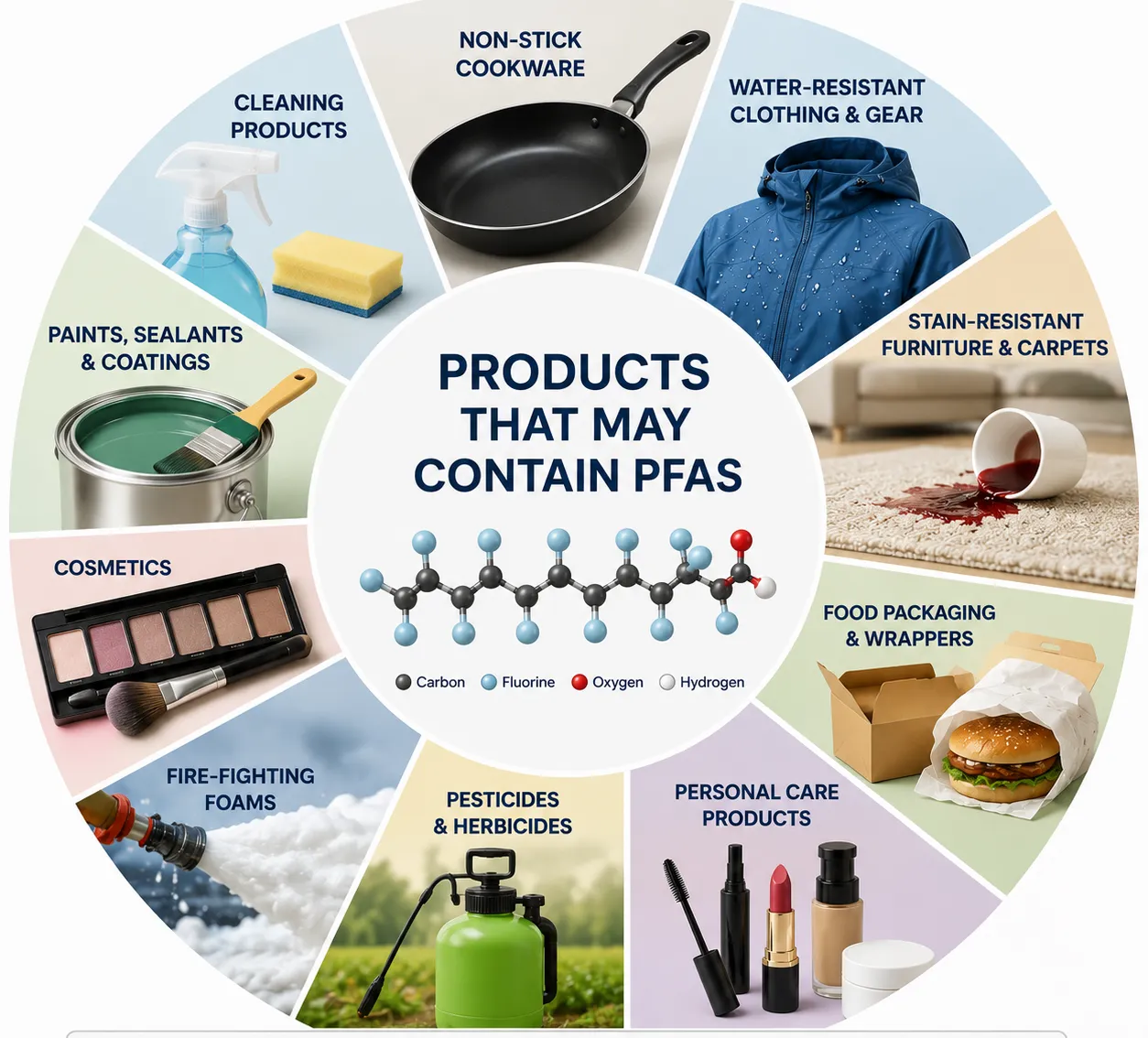
Unfortunately, the same properties that make PFAS valuable in consumer products also make them resistant to breaking down easily in the environment or the human body, which has earned them the designation of “forever chemicals.” Because they do not readily break down through natural biological or chemical processes, PFAS can remain stuck in soils, slowly leak into groundwater, and accumulate in human bodies.[2,3,4] Several decades of research has demonstrated the myriad effects of PFAS chemicals on human health, including increased cholesterol levels, reproductive effects and increased risk of some cancers.[5]
💡 Did You Know?
Scientists have identified more than 10,000 PFAS compounds, yet only a small number have been extensively studied. Researchers continue to discover new PFAS compounds and better understand how individual chemicals behave in the environment and affect human health.
How do PFAS enter drinking water?
PFAS reach the environment through many pathways. Industrial manufacturing, wastewater treatment plant discharges, landfill leachate, application of biosolids as fertilizer, atmospheric deposition, and the historical use of firefighting foams have all contributed to widespread contamination. Once released, PFAS can be transported by stormwater runoff into rivers, lakes, reservoirs, groundwater, wetlands, and eventually drinking water sources.[4,6]
For environmental managers, this means PFAS are not simply a drinking water issue. They are part of a larger watershed challenge that links stormwater, groundwater, wastewater, land use, and long-term water resource management.
How are people exposed?
The general population has been exposed to PFAS by drinking contaminated water and eating polluted food products over decades, but people in occupations involving heavy use or the manufacturing of PFAS products, such as firefighters, military personnel, airport workers, and workers in chemical plants, have the highest exposure risk.[4,5] Communities located near airports, military bases, industrial facilities, or historical PFAS release sites may also face increased risks because of contaminated groundwater or other nearby drinking water sources.[7]
Who is most affected by PFAS?
The good news? The production and use of some PFAS (PFOS and PFOA) have been declining since the early 2000s, around the time that chemical manufacturing companies like Dupont started voluntarily ceasing their manufacturing following mounting evidence from researchers and monitoring agencies that PFOS and PFOA were being detected in drinking water.[8,9] Additionally, in the last few decades, US regulatory agencies have initiated more aggressive PFAS monitoring and regulation. The EPA issued requirements for public water systems to monitor six PFAS compounds (2013-2015) and later 29 PFAS compounds (2023-2025).[7,10] In 2022, the EPA updated drinking water advisories for PFOS and PFOA in drinking water, drastically lowering previous levels at which an advisory would be issued.[11] In 2024, the EPA published new drinking water standards for six PFAS chemicals (PFOA, PFOS, PFHxS, PFNA, GenX, PFBS).[11] California has even broader and stricter regulations on PFAS in consumer products and drinking water than federal regulations (see the section below on PFAS in California, below). As a result of these collective actions, although most people have been exposed to PFAS and nearly all people in the US have PFAS in their blood, the levels of PFOS and PFOA in blood serum samples collected from the US general population have been steadily decreasing since 2002.[12]
The bad news? Not all PFAS have decreased in use in the US, nor have they decreased in blood serum levels in the US general population.[12] And progress in diminishing PFAS exposure risk in the US is threatened by newly proposed EPA rules (in 2026) that slow or overturn implementation of regulatory standards (see the next section to learn about some of these changes). Importantly, however, not all American communities have equally experienced reductions in their exposure risks to PFAS in drinking water over the last few decades. A recent report by the non-profit National Resources Defense Council (NRDC) analyzing drinking water testing results in California found PFAS contamination throughout the state, but that at least 69% of communities identified by the state as disadvantaged (based on geographic, socioeconomic, public health, and environmental hazard criteria) have PFAS contamination in their public water systems.[13] Communities served by small drinking water systems often have fewer financial and technical resources available for monitoring, treatment, and public communication to address water contaminants.[14] Residents who depend on private wells may face additional challenges because private wells are generally not monitored under the same regulatory framework as public water systems.[14]
Communities of Color also experience disproportionate risks of PFAS exposure. Historic point sources of PFAS like industrial sites and airports are more likely to be located near Hispanic and non-Hispanic Black communities due to historic race-based segregation, disenfranchisement from political and urban planning processes, and inequitable enforcement of environmental regulations.[15,16,17] Areas with larger Hispanic communities and Communities of Color (including African American, Native American, Asian/Pacific Islander, and/or multiracial individuals) are also associated with higher toxic chemical applications in California, which is often tied to agricultural activity.[18] A recent study found that PFAS-contaminated pesticides are applied more frequently and more heavily near community water systems’ supply wells serving greater proportions of Latinx and non-Latinx People of Color residents in California.[18]
The infrastructure needed to lower PFAS levels in drinking water can be costly, which results in disproportionate cost and pollution burdens to low income communities. Orange County has estimated, for example, that such infrastructure would cost at least $1 billion if they are to meet the state’s recommended PFAS levels for drinking water.[15] These costs are rarely placed on chemical manufacturers responsible for synthesizing PFAS compounds, and instead become an expense for public utilities, their ratepayers, state and local governments. Low-income communities often lack the financial resources to test, monitor, and gather and disseminate information regarding PFAS contamination. PFAS contamination can also impose a number of indirect costs to individual households, such as reduced property values, bottled water and home water filtration system purchasing costs, and significantly, health care costs.[15,19] For example, PFAS exposure from drinking water wells is estimated to impose billions of dollars in healthcare costs to US residents due to impacts on infant health.[15,19]
💡 Did You Know?
Removing PFAS from drinking water can cost millions of dollars for a single utility. Smaller communities often face the greatest financial challenges because treatment costs are spread across fewer customers.
Why is regulation important?
Despite a lot of progress in research that has increased our knowledge of the impacts and sources of PFAS, we have not entirely resolved how PFAS contamination in drinking water should be regulated. Some in the chemical industry and associations of water municipalities have argued that the cost of filtering PFAS out of drinking water is too high and does not provide adequate benefit to the public. This has prompted various types of action from EPA administrators.[20] In May 2026, EPA Administrator Lee Zeldin announced several initiatives, including nearly $1 billion in grant funding to states to address PFAS in drinking water through the Emerging Contaminants in Small or Disadvantaged Communities Grant (an annual, $1 billion/year program running from 2022-2026). However, he also forwarded a proposal to roll back the 2024 Safe Drinking Water Act regulations on four types of PFAS (PFHxS, PFNA, GenX, PFBS) and allow water utilities to opt into a two-year extension of the compliance deadline for PFOS and PFOA standards (from 2029-2031).[13]
Rolling back regulations on PFAS may be problematic in light of the EPA’s eleventh round of public water system testing data (2023-2025) for the fifth Unregulated Contaminant Monitoring Rule (UCRM5). UCRM5 included testing over 10,000 utilities nationwide for 29 different PFAS compounds and found detectable levels of PFAS in community water systems that collectively serve 176 million people nationwide.[21] Some of the six regulated types of PFAS (PFHxS, PFNA, GenX, PFBS) were below maximum permissible levels in the vast majority of systems,[22] which may indicate that drinking water is not the main way people are exposed to these PFAS. However, UCRM5 also found that 18-20% of public water systems nationwide contained unregulated PFAS (PFBA, PFHxA, and PFPeA).[22] Additionally, allowing water utilities to delay their compliance on PFOS and PFOA standards means additional years of potential PFAS exposure for their customers. The UCRM5 found that average PFOS and PFOA levels exceeded maximum permissible levels in 21-25% of public water systems nationwide.[22]
The California Context
California has been a national leader in responding to PFAS contamination through monitoring, research, and the development of drinking water protections. Importantly, California has additional laws that require warning labels for consumer products that causes chemical exposure exceeding the “Safe Harbor Level” for some types of PFAS (Prop 65) and bans the manufacture or prohibits the sale of certain consumer products that have “intentionally added” PFAS or PFAS above a specific threshold (AB 1817, 2771, 1200, 652).
The California State Water Resources Control Board has played a central role by requiring targeted monitoring of drinking water sources near potential PFAS release sites, establishing notification and response levels for several PFAS compounds, and supporting statewide investigations to better understand the occurrence and distribution of these contaminants.[23.24]
What can residents do?
Although PFAS contamination is largely addressed through water utility actions, state and federal regulations, and long-term infrastructure investments, residents can still take meaningful steps to understand their exposure and reduce potential risk.{23-27]
Ways to reduce exposure to PFAS in your drinking water
- Know your water: Find out if your tap water has been tested, and if not, get it tested.
- If your tap water comes from a utility/public water system: start by reviewing your annual Consumer Confidence Report (CCR), also called a water quality report. This report provides information about your drinking water source, detected contaminants, and compliance with drinking water standards.[23-24]
- If your tap water comes from a utility/public water system: You can also contact your water provider directly to ask them questions. Good questions to ask may be: Has our water system been tested for PFAS? Which PFAS compounds were tested? Were any PFAS detected? If PFAS were detected, what treatment or management actions are planned? Where can residents find updated monitoring results?
- If your tap water comes from a private well: Testing is especially important! Private wells are generally the responsibility of the property owner and are not monitored in the same way as public water systems.[27] Private well owners may want to consider PFAS testing if their property is near a known or suspected PFAS source, such as an airport, military facility, landfill, industrial site, wastewater treatment facility, or area where firefighting foams may have been used. Check with your county or state health department to get testing guidance and learn of any free well water testing programs they may offer.
You can also refer to US maps of drinking water PFAS testing results provided by the USGS, EPA, and the Environmental Working Group.
How to interpret PFAS data: Compare the levels of PFAS chemical in your water to the EPA’s regulations. You can also estimate your PFAS exposure using this Center for Disease Control and Prevention website.
- Understand treatment options: If your drinking water has PFAS levels above the EPA's regulation levels, advocate for getting certified filtration systems on your public water system, or install your own:
- Check with your utility to see if your community water system is planning to install filtration for PFAS.
Not all household water filters remove PFAS. If PFAS has been detected in your drinking water, look for treatment systems that are specifically certified for PFAS reduction.[25] You can also get your own filter. Common household treatment options include:
- Activated carbon filters, which may reduce some PFAS when properly designed, certified, installed, and maintained.[25]
- Reverse osmosis systems, often installed under the sink, which can reduce many PFAS compounds.[25]
- Whole-house systems, which treat water entering the home but are usually more expensive and require professional design, installation, and maintenance.[25]
- When selecting a product, look for certification to NSF/ANSI 53 or NSF/ANSI 58 for PFAS reduction. Do not rely only on general claims such as "removes contaminants" or "improves water quality." Check whether the product has been independently tested and certified for PFAS reduction.
Maintenance also matters. A filter that is not replaced according to the manufacturer's recommendations may lose effectiveness over time. Follow manufacturer guidance for cartridge replacement, flushing, and disposal.[25]
Stay informed and engaged
PFAS science and regulations continue to evolve. Residents can stay informed by following updates from their water provider, the California State Water Resources Control Board, the U.S. Environmental Protection Agency, county health departments, and trusted university and Extension resources.[23,24]
Community members can also participate in public meetings, ask questions about treatment plans, support investments in drinking water infrastructure, and advocate for solutions that protect small and disadvantaged communities.[23,27]
Dr. Monica Palta is the UC Cooperative Extension Specialist in Urban Water Quality, Health, and Justice with University of California Agriculture and Natural Resources (UC ANR), based at the University of California, Irvine. The main goal of her research is to develop sustainable, mutually beneficial relationships between natural ecosystems and human populations in urban watersheds. Her research investigates sources and mitigation strategies for water pollution and develops green infrastructure and environmental management strategies.
Dr. Monica Palta: UC ANR Profile
Dr. Esther Lofton is the Urban Watershed Resilience Advisor with University of California Cooperative Extension (UCCE), serving Los Angeles, Orange, Riverside, and San Bernardino counties. Her research and Extension program focuses on drinking water quality, stormwater, watershed resilience, water conservation, and community engagement, with an emphasis on translating science into practical solutions that support safe, affordable, and resilient water systems.
Dr. Esther Lofton: UC ANR Profile
Dr. Chris Olivares is an Assistant Professor at the University of California-Irvine in the Department of Civil & Environmental Engineering and Associate Director of UCI's Water-Energy Nexus Center. His research focuses on interactions between organic contaminants and microbial processes, such as impacts of fires to water quality and PFAS biotransformation and data science tools to support monitoring efforts. He has been a member of the Interstate Technology Regulatory Council (ITRC) PFAS team, where he developed training materials on transformation and translation of fact sheets to Spanish.
Dr. Chris Olivares: UCI Profile
We'd Love Your Feedback
Your feedback helps us develop better educational resources, identify community information needs, and improve future blogs, workshops, and outreach programs.
The survey takes about two minutes, and your responses will help shape future water education efforts across California.
References:
[1] Buck, R. C., Franklin, J., Berger, U., Conder, J. M., Cousins, I. T., de Voogt, P., Jensen, A. A., Kannan, K., Mabury, S. A., & van Leeuwen, S. P. J. (2011). Perfluoroalkyl and polyfluoroalkyl substances in the environment: Terminology, classification, and origins. Integrated Environmental Assessment and Management, 7(4), 513–541. https://doi.org/10.1002/ieam.258
[2] Wang, Z., DeWitt, J. C., Higgins, C. P., & Cousins, I. T. (2017). A never-ending story of per- and polyfluoroalkyl substances (PFASs)? Environmental Science & Technology, 51(5), 2508–2518. https://doi.org/10.1021/acs.est.6b04806
[3] NIH 2026
[4] Sunderland, E. M., Hu, X. C., Dassuncao, C., Tokranov, A. K., Wagner, C. C., & Allen, J. G. (2019). A review of the pathways of human exposure to poly- and perfluoroalkyl substances (PFASs) and present understanding of health effects. Journal of Exposure Science & Environmental Epidemiology, 29, 131–147. https://doi.org/10.1038/s41370-018-0094-1
[5] Environmental Protection Agency (EPA). (2026). Our Current Understanding of the Human Health and Environmental Risks of PFAS. https://www.epa.gov/pfas/our-current-understanding-human-health-and-environmental-risks-pfas
[6] Ahrens, L., & Bundschuh, M. (2014). Fate and effects of poly- and perfluoroalkyl substances in the aquatic environment: A review. Environmental Toxicology and Chemistry, 33(9), 1921–1929. https://doi.org/10.1002/etc.2663
[7] Hu, X. C., Andrews, D. Q., Lindstrom, A. B., Bruton, T. A., Schaider, L. A., Grandjean, P., Lohmann, R., Carignan, C. C., Blum, A., Balan, S. A., Higgins, C. P., & Sunderland, E. M. (2016). Detection of poly- and perfluoroalkyl substances (PFASs) in U.S. drinking water linked to industrial sites, military fire training areas, and wastewater treatment plants. Environmental Science & Technology Letters, 3(10), 344–350. https://doi.org/10.1021/acs.estlett.6b00260
[8] Environmental Protection Agency (EPA). (2000). EPA and 3M ANNOUNCE PHASE OUT OF PFOS. https://www.epa.gov/archive/epapages/newsroom_archive/newsreleases/33aa946e6cb11f35852568e1005246b4.html
[9] Environmental Protection Agency (EPA). (2026). Assessing and Managing Chemicals under TSCA. Fact Sheet: 2010/2015 PFOA Stewardship Program. https://www.epa.gov/assessing-and-managing-chemicals-under-tsca/fact-sheet-20102015-pfoa-stewardship-program
[10] Environmental Protection Agency (EPA). (2026). Monitoring Unregulated Drinking Water Contaminants: Fifth Unregulated Contaminant Monitoring Rule. https://www.epa.gov/dwucmr/fifth-unregulated-contaminant-monitoring-rule
[11] Environmental Protection Agency (EPA). (2026). Previous Actions to Address PFAS. https://www.epa.gov/pfas/previous-actions-address-pfas
[12] Sonnenberg, N.K., Ojewole, A.E., Ojewole, C.O., Lucky, O.P., & Kusi, J. (2023). Trends in serum per-and polyfluoroalkyl substance (PFAS) concentrations in teenagers and adults, 1999–2018 NHANES. International journal of environmental research and public health. 20(21): 6984.
[13] Kar, A., Reade, A., & Lee, S. (2024). Dirty Water: Toxic “Forever” PFAS Chemicals are Prevalent in the Drinking Water of Environmental Justice Communities. The National Resources Defense Council (NRDC). https://www.nrdc.org/resources/dirty-water-toxic-forever-pfas-chemicals-are-prevalent-drinking-water-environmental
[14] Dobbin, K.B. (2020). “Good luck fixing the problem”: Small low-income community participation in collaborative groundwater governance and implications for drinking water source protection. Society & Natural Resources, 33(12):1468-1485.
[15] Cordner, A., Goldenman, G., Birnbaum, L.S., Brown, P., Miller, M.F., Mueller, R., Patton, S., Salvatore, D.H., & Trasande, L. (2021). The True Cost of PFAS and the Benefits of Acting Now. Environ Sci Technol. 55(14): 9630-9633. doi: 10.1021/acs.est.1c03565. Erratum in: Environ Sci Technol. 2021 Sep 21;55(18):12739. doi: 10.1021/acs.est.1c04938.
[16] Liddie, J.M., Schaider, L.A., & Sunderland, E.M. (2023). Sociodemographic Factors Are Associated with the Abundance of PFAS Sources and Detection in U.S. Community Water Systems. Environ. Sci. Technol., 57(21): 7902–7912. https://doi.org/10.1021/acs.est.2c07255
[17] Maruzzo AJ, Hernandez AB, Swartz CH, Liddie JM, Schaider LA. Socioeconomic Disparities in Exposures to PFAS and Other Unregulated Industrial Drinking Water Contaminants in US Public Water Systems. Environ Health Perspect. 2025 Jan;133(1):17002. doi: 10.1289/EHP14721.
[18] Libenson, A., Karasaki, S., Cushing, L.J., Tran, T., Rempel, J.L., Morello-Frosch, R., & Pace, C.E. (2024). PFAS-Contaminated Pesticides Applied near Public Supply Wells Disproportionately Impact Communities of Color in California. ACS ES T Water. 4(6): 2495-2503. doi: 10.1021/acsestwater.3c00845.[19] Baluja, R., Guo, B., Howden, W., Langer, A. & Lemoine, D. (2025). PFAS-contaminated drinking water harms infants, Proc. Natl. Acad. Sci. U.S.A. 122 (50) e2509801122. https://doi.org/10.1073/pnas.2509801122
[20] Environmental Protection Agency (EPA). (2026). EPA Advances Comprehensive PFAS Strategy with Legally Defensible, Practical, Scientifically Sound Drinking Water Protections. https://www.epa.gov/newsreleases/epa-advances-comprehensive-pfas-strategy-legally-defensible-practical-scientifically
[21] Culpepper, J.R. (2026). New data shows 176M exposed to ‘forever chemicals’ as Trump EPA rolls back drinking water limits. https://www.ewg.org/news-insights/news-release/2026/03/new-data-shows-176m-exposed-forever-chemicals-trump-epa-rolls
[22] Jackson, P. (2026) Making Sense of UCMR 5 Results: Key PFAS Findings, Lithium Concerns, and UCMR 6.
[23] California State Water Resources Control Board. (2025). Per- and Polyfluoroalkyl Substances (PFAS). https://www.waterboards.ca.gov/pfas/
[24] California State Water Resources Control Board. (2025). PFAS Drinking Water Program.https://www.waterboards.ca.gov/pfas/drinking_water.html
[25] Interstate Technology & Regulatory Council (ITRC). (2023). PFAS Technical and Regulatory Guidance Document. https://pfas-1.itrcweb.org/
[26] Organisation for Economic Co-operation and Development (OECD). (2021). Reconciling Terminology of the Universe of Per- and Polyfluoroalkyl Substances: Recommendations and Practical Guidance (OECD Series on Risk Management No. 61). OECD Publishing. https://doi.org/10.1787/e458e796-en
[27] National Academies of Sciences, Engineering, and Medicine. (2022). Guidance on PFAS Exposure, Testing, and Clinical Follow-Up. Washington, DC: The National Academies Press. https://doi.org/10.17226/26156
🌐 Continue Exploring
📖 Related Reading
💧 Tap Water Trust and Bottled Water Behavior
Explore how trust, perception, bottled water use, and lived experiences influence drinking water choices across California communities.
(Insert blog link once published.)
💧 Drinking Water Week 2026
From Source to System: A Regional Check on Reliability, Risk, and Responsibility
Explore how drinking water systems are managed and the shared responsibility of protecting safe and reliable water supplies.
📊 Understanding Your Consumer Confidence Report (CCR)
Learn how to find, read, and interpret your annual drinking water quality report.
English
Español
🌊 Explore the SoCal Water Blog Series
Browse science-based articles across:
• Drinking Water Quality
• Environmental Water Quality
• Water Use Efficiency
• Water Supply Security
• Water Equity
• SoCal Urban Food Production
• Watershed Resilience, Climate Change and Water Systems
https://ucanr.edu/site/socal-water-resources/socal-water-blog-series
🌿 Learn More About Our Programs
🌊 SoCal Water Resources
The official website of the Urban Watershed Resilience Program featuring educational resources, research, blogs, surveys, publications, and community engagement opportunities.
https://ucanr.edu/site/socal-water-resources
🌿 Watersheds Program
Explore science-based educational resources, projects, and community partnerships focused on watershed health, stormwater management, nature-based solutions, and watershed stewardship across Southern California.
https://ucanr.edu/site/watersheds-los-angeles-and-ventura-counties
📩 Contact / Collaborate
anrsocalwater@gmail.com
📲 Follow & Stay Connected
Instagram | TikTok | X
@socal_h2o | @socal_water | @socal_h20