
Pruning in Practice
Pruning is perhaps the most common tree maintenance activity that is undertaken on urban and ornamental trees. This is in sharp contrast with forest trees, which are pruned only in exceptional cases and yet grow and develop their mature form quite well, living considerably longer than urban trees. This tells us that trees do not require pruning in order to survive.
Nevertheless, in ornamental landscapes, pruning can be beneficial for maximizing the benefits of trees, and in young trees pruning “… provides the greatest benefit of any cultural practice in influencing the future structure, appearance, and maintenance costs”. In addition, pruning may be critically important for tree health, whether managing a pathological condition or correcting poor tree form. First, we focus on the effects of pruning on tree physiology and the mechanisms by which pruning may predispose trees to insect or disease problems. We are primarily considering ornamental trees in landscapes; fruit trees require somewhat different considerations.
Proper Pruning Technique
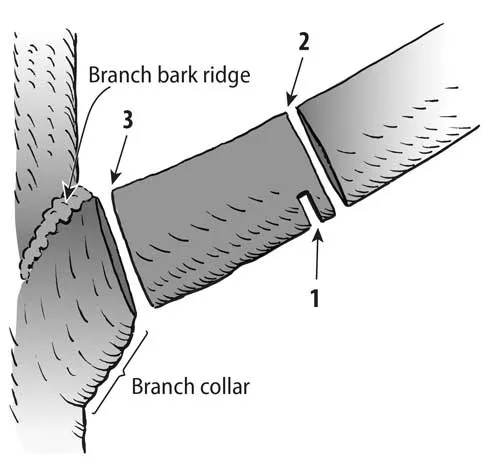
All pruning should be done using proper techniques and following the appropriate work protocol to ensure jobsite safety. At a minimum, the pruner should be familiar with the concept of natural target pruning as articulated by Alex Shigo and incorporated into standard practice within textbooks (e.g., Arboriculture by Harris, Clark, and Matheny), and professional standards (ANSI A300). Special situations—palms, large and/or old trees, fruit trees, hazardous trees, trees near power lines, etc.—require specialized equipment and skills.
EXTERNAL IMAGE
Pruning Effects on Tree Physiology
Removing branches has at least three effects on tree physiology: it diminishes the tree’s energy capture ability, draws down the stored energy reserves, and alters the growth pattern of the tree. Potential energy capture by photosynthesis is reduced after pruning, as the total leaf area (the “sugar factory”) is diminished. Additional energy reduction occurs because the starch reserves that had been stored in the removed branch are lost. These two losses can range from negligibly small (e.g., when small twigs are trimmed), to catastrophically large (e.g., when mature trees are topped, which severely shortens the large branches). Tree growth is affected in a somewhat paradoxical way, in that the growth of an individual shoot is invigorated (i.e., increased) by pruning as the tree’s root system is able to direct more water and nutrients into those shoots that remain after pruning. Yet, considered as a whole, a pruned tree will produce less total growth (compared to an unpruned tree) as its photosynthetic capacity was (at least temporarily) reduced by pruning.
EXTERNAL IMAGE
Pruning Effects on Tree Defense Systems
Pruning also affects a tree’s ability to resist pathogens and insects, in both direct and indirect ways. In direct terms, the pruning wound presents a potential site of pathogen entry into the tree, an “infection court,” and allows the pathogens to bypass the tree’s defense layers. Heartwood, for example, is usually shielded from wood-rot fungi by the bark and sapwood but becomes exposed in branch stubs left after topping cuts. In addition, some insects are attracted to fresh pruning cuts, and these pests can either cause a problem by themselves or by transmitting a pathogen (e.g., some elm bark beetles attracted to pruning cuts are vectors of Dutch elm disease).
Furthermore, large-scale pruning predisposes the tree to insect or pathogen attack by reducing the total energy available to the tree (as described above), thereby limiting the tree’s capacity to use this stored energy to defend itself from insects or pathogens by producing defensive compounds (such as pitch) or by limiting the spread of pathogens through the tree (compartmentalization).
Unfortunately, this predisposing effect is often hard to detect: first, it usually takes some time for an energy-starved tree to become afflicted with a disease or insects (and by then the pruning has long been forgotten). Second, the afflicted part of the tree is often distant to the pruned area and so the connection between pruning and the problem remains hidden. In extreme cases, the severely pruned trees (often an attempt to reduce their size) often are the first to develop insect or disease problems. In the words of the late Dr. Shigo, “You cannot prune a big tree to make it a small healthy tree no matter how you try.”
Timing
Research results are somewhat conflicting regarding the best time of year to prune. In general, it is not advisable to prune trees at “times of low energy reserves, when a tree is stressed, and when the soil is uncharacteristically dry or flooded.” In addition, remember to check for specific insects and diseases that could affect the tree you are about to prune, and ensure that you will not be making the tree more attractive to those pests (e.g., prune elms in winter, when the Dutch elm disease vector beetles are inactive.)
Bottom Line(s)
The removal of large branches in mature trees may predispose trees to insect and disease problems. We can avoid having to remove large branches, by pruning more often to remove small branches before they grow and thus guide the tree to its optimal form and condition without having to incur the penalty of losing too many leaves and too much stored energy.
In three simple steps:
1. Prune small – prune often! and limit the total amount of branches removed.
2. Prune well! by making correct cuts; with clean tools, timed to avoid insects and diseases; and disposing of pruned material appropriately.
3. Respect the natural form! by remembering that we should not make a round-headed redwood by pruning or a pole-like coast live oak without severely stressing the tree.
Benefits of Pruning
Pruning can also be highly beneficial for many landscape trees. The following are some approaches to pruning which either directly suppress pests or maintain tree health; and because impaired health predisposes trees to a number of diseases, these pruning measures could thus be considered part of an integrated pest management program.
Formative Pruning
A young tree arriving from the nursery or getting established in its first few years in the landscape often requires pruning, over multiple seasons, to guide the tree to a site-appropriate mature form. This is the best time to correct, by pruning, any structural deficiencies, such as co-dominant leaders, rubbing or overlapping branches, or girdling roots. In most cases, these structural problems are not self-correcting, making pruning a necessary measure. Importantly, a young tree is not only better able to tolerate the removal of live biomass than a mature tree (i.e., the pruning dose can be larger—up to 50% of foliage might be removed from a newly-planted tree), but the pruning cuts themselves are made on small branches and are thus smaller and more rapidly sealed over, minimizing the likelihood of infection by plant pathogens or wood decay fungi. A number of printed and on-line instruction manuals are available demonstrating the goals and methods of formative pruning, such as articles and leaflets, from the University of California and Tree Cue Cards from CAL FIRE.
Corrective Pruning
In cases where formative pruning was neglected or was insufficient, or where a tree has suffered some physical damage (e.g., from storms or vandalism), pruning can be useful in correcting defects like broken or overlapping branches, double leaders, or poor branch spacing on mature trees. Corrective pruning aims for minimally sized, properly located pruning cuts that promote successful compartmentalization; that is, cuts that allow the tree to seal over with callus tissue on the outside, and that limit the spread inside the tree of any decay organisms that may invade. Proper pruning cuts are always preferable to failures (e.g., breaks or tear-outs) of branches or leaders, which are often caused by un-corrected structural defects and which frequently result in large wounds that compartmentalize poorly (e.g., because they are located mid-branch, or they tear away large strips of bark) and remain a major invasion pathway for pathogens or wood decay fungi.
The pruning dose for corrective pruning should be smaller than for formative pruning, not exceeding about 25% of foliage removal from an established tree. As little as 10% foliage removal is the recommended maximum for older, mature trees.
Eradicative Pruning
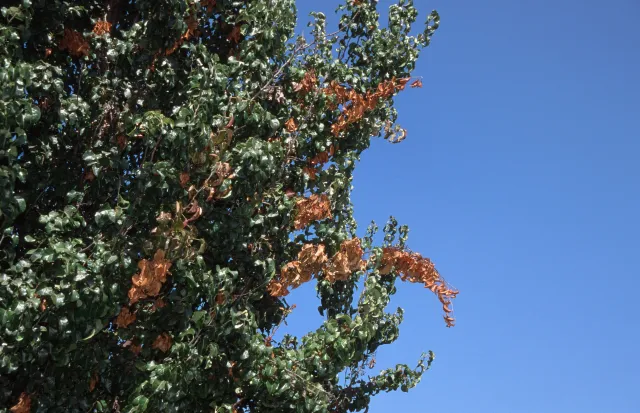
It is possible in some cases to use pruning as surgery to remove infected parts from trees, thus removing (eradicating) disease. Several diseases can be managed in this way, including some canker pathogens (like branch cankers), and tip necroses (like fire blight), and even some insect infestations. For plant diseases, the effectiveness of eradicative pruning varies by pathogen as some spread quickly through the tree and are typically systemic by the time symptoms appear (e.g., vascular wilts).
The effectiveness also varies by tree size and accessibility of the infected/infested branches. For example, Pitch canker in Monterey pine is usually a set of individual infections from branch tips that can be cut off to reduce the disease, but pruning away the multiple infected branchlets may be impractical on a large or tall tree. Fire blight, on the other hand, often occurs on smaller-stature trees, and can be successfully managed by removing infested branches well below the canker margin. In using this approach to manage pathogens, it is important that the pruning cut be made well below (8–12 inches or so) any infected tissue, so as to both remove all of the infected tissue and to prevent contamination of the pruning tool (see Diseases Spread by Pruning). While the extent of some infestations on a tree branch is quite obvious, for other diseases you may have to look for subtle symptoms such as sunken or discolored bark, or wilted foliage to identify the margins of infection.
Sanitation Pruning
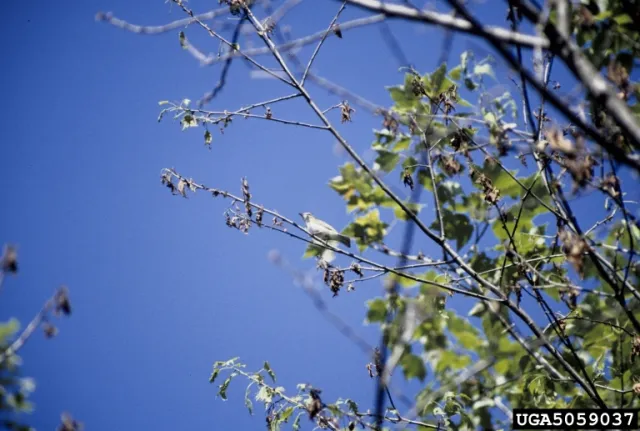
While practiced extensively in orchards, sanitation pruning is often underappreciated in ornamental trees but is quite applicable here as well. It is especially effective in suppressing those diseases that overwinter in dead tips of twigs or branches, or in hanging dead foliage or fruit (mummies). In landscape trees, spring inoculum for diseases such as anthracnose (e.g. in sycamores and plane trees) and powdery mildews can often be effectively reduced by removing the dead twigs in winter.
Disease Spread by Pruning
While spreading disease with pruning tools is a reasonable concern, it actually appears to be somewhat uncommon in the practice of landscape tree maintenance. To reduce the risk of contaminating pruning tools, the best approach is to ensure that pruning cuts are made well below cankers or branch lesions. For example, the current recommendations for fire blight are for branch cuts to be made at least 12 inches below the edge of the blight-lesion.
For some diseases, however, spread by contaminated tools is a real threat, as exemplified by Fusarium wilt of Canary Island date palms or the somewhat uncommon canker stain of sycamore. In these cases, it may be possible to disinfect some pruning tools, such as hand saws, after each cut by using bleach or household disinfectants. However, tools like chainsaws are impossible to disinfect and should not be used to prune Fusarium-susceptible palms. Some practitioners have resorted to using a separate set of hand tools for each high-value palm tree so as to minimize the potential for spreading disease between individual trees.
[Originally featured in the Winter 2013 edition of the Green Bulletin Newsletter and reprinted in the Spring 2026 issue.]