


Important climate warming research led by UC Davis entomologist Mia Lippey gained traction last week when a noted sustainable agriculture scientist wrote a commentary, “Beyond Temperature: Why Climate Adaptation in Agriculture Needs a Systems Approach” in the June 1st issue of the Proceedings of the National Academy of Sciences (PNAS).
In his commentary, Bruno Basso, the John A. Hannah Distinguished Professor, Department of Earth and Environmental Sciences, Michigan State University, East Lansing, praised it “an exemplary piece of system ecology.”
“The significance of this work,” Basso pointed out, “is not in rejecting climate‐driven pest risk. “Risk remains and will grow. The paper’s significance is that it dismantles the convenient story of a single‐driver, species‐agnostic response and in doing so, exposes a more uncomfortable truth about how we forecast the biosphere under climate change.”
The News Story on ENT/NEM Website
Some background: We posted a news story May 11 on the UC Davis Entomology and Nematology website. The lede: “The widespread ‘pest-proliferation hypothesis’ that climate warming will result in unprecedented agricultural pest populations and lead to monumental food insecurity worldwide is oversimplified, a nine-member team of entomologists and ecologists led by UC Davis entomologist Mia Lippey declared today. But their study indicates that pests fare better in warmer temperatures than their natural enemies, “a cause for concern.” Globally, current crop losses to arthropod pests exceed $470 billion annually, accounting for 20 percent of total crop production.
The work, “Field Data Challenge Predictions of Universal Crop Pest Proliferation under Warming,” contradicts the “laboratory-based thermal performance experiments that arthropod crop pest densities will consistently escalate under rising temperatures,” we posted.
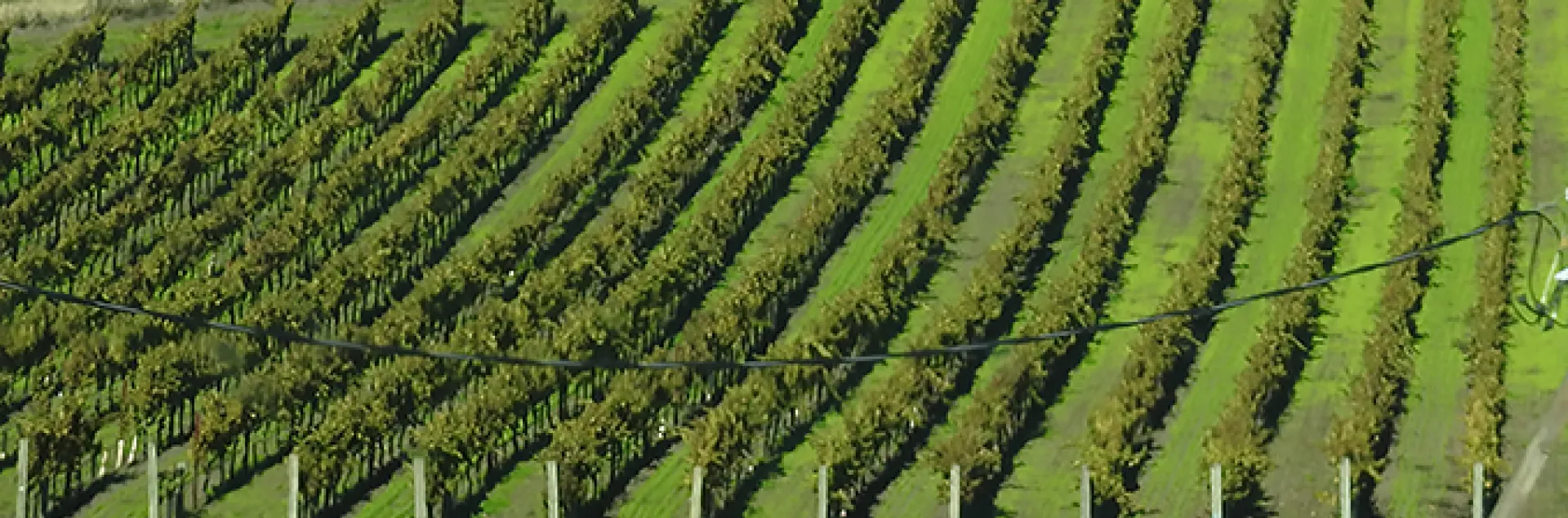
The team studied 141,562 field-year observations of 43 arthropod populations (30 pest and 13 natural enemy populations representing 28 pest and 11 natural enemy species) across five crops (rice, cotton, grapes, citrus, and olives) in Andalusia, Spain and California, two temperate agricultural regions with uniquely extensive long-term monitoring data.
“Laboratory measured thermal performance and life-history traits failed to explain the variability of responses across taxa,” the Lippey team wrote in its paper. “Our findings challenge predictions of universal pest proliferation, highlighting the urgent need for species-specific monitoring approaches in agricultural climate adaptation.”

Lippey, who holds a doctoral degree (2026) from UC Davis and studied with major professors Emily Meineke and Jay Rosenheim, co-authors of the paper, related: “We found that both pests and natural enemy insects exhibit highly diverse responses to warming, with about half of the populations increasing in size under warming and half decreasing. While natural enemies did show some evidence of heightened vulnerability to warming compared to pests, we need more research to understand what drives these differences and how severe of an impact this difference would have on agriculture.”
Both Meineke, an urban landscape entomologist and Rosenheim also commented on the their paper in the ENT/NEM news story.
- “Our study," Meineke said, "also indicates that pests appear to do slightly better in warmer climates than their natural enemies, which is cause for concern and further emphasizes the importance of monitoring both pests and the insects we rely on to control them.”
- Rosenheim commented that the convention wisdom in answering “Will our warming climate cause widespread pest insect population increases, threatening food security?” suggests the answer is yes.” However, Lippey’s work “showed that pest populations responded quite variably to warming, with some increasing and others decreasing. As is often the case, real field ecology is more complex than the simple models suggest."
More on Basso's Commentary

In his commentary, Basso wrote that “Few questions cast a longer shadow over agricultural sustainability than the question of how rising temperatures will reshape the balance among crops, pests, and the beneficial insects that suppress them.” The UC Davis team’s message, he wrote, “is clear and, for the field, important. Some populations increase with warming, others decline, many show no detectable response, and laboratory‐measured thermal performance traits fail to predict which species fall into which camp.”
“The significance of this work is not in rejecting climate‐driven pest risk,” Basso emphasized in his commentary “Risk remains and will grow. The paper’s significance is that it dismantles the convenient story of a single‐driver, species‐agnostic response and in doing so, expose a more uncomfortable truth about how we forecast the biosphere under climate change.”
Basso makes a good point: “We should aim to invest in more intensive species‐specific monitoring networks for pest and their natural enemies, of the kind that made this paper possible. Climate‐adaptation science for agriculture must move decisively away from single‐driver, trait‐based extrapolation and toward multidriver, process‐based, field‐validated system models. Pests, soil, water, nutrients, and yield are not separable problems. They are coupled states of the same system, and the only credible forecasts will come from frameworks that treat them that way.”
And importantly, as Basso pointed out: “Lippey et al. do not resolve the fate of agricultural arthropods under climate change; they reframe the question. They show that universal predictions were always going to fail because the real world refuses to be universal. They also show that the scientific infrastructure exists to replace those predictions with something better, large‐scale, long‐term field data, analyzed with proper statistics, and coupled with process‐based models that can project them forward.”
This bears repeating: The team did not “resolve the fate of agricultural arthropods under climate change; they reframe the question. “They show that universal predictions were always going to fail because the real world refuses to be universal.”
We look forward to more of this research.