
PalmArbor Articles 2016:
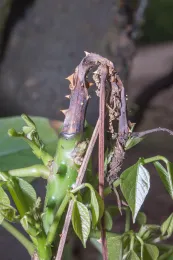
Erythrina stem or twig borer: a new and potentially devastating pest of coral trees in southern California. Donald R. Hodel, James E. Henrich, Kenneth J. Greby, Gevork Arakelian, Linda M. Ohara, and Surendra K. Dara. PalmArbor 2016-01: 1–18. DOI: https://doi.org/10.21414/B1D01R
The Erythrina stem borer (sometimes known as the Erythrina twig borer) (Terastia meticulosalis) is a new and potentially severe pest of Erythrina or coral trees in California. Here we illustrate and discuss its taxonomy, identification, distribution, life cycle, damage, and management strategies.
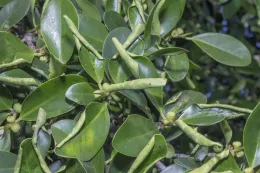
The Ficus leaf-rolling psyllid: a new pest of Ficus microcarpa. Donald R. Hodel, Gevork Arakelian, Linda M. Ohara, Cheryl Wilen, and Surendra K. Dara. PalmArbor 2016-02: 1–15. DOI: https://doi.org/10.21414/B18598
The ficus leaf rolling psyllid (Trioza brevigenae) is a new pest of the Indian laurel tree or Chinese banyan (Ficus microcarpa) in California. It distorts new growth by forming it into a tight role. Here we illustrate and discuss the history of its detection, damage symptoms, description of the pest, and possible management strategies.
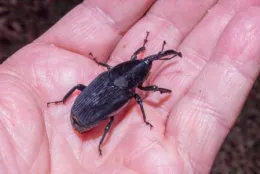
The South American palm weevil: a new threat to palms in California and the Southwest. Donald R. Hodel, Michael A. Marika, and Linda M. Ohara. PalmArbor 2016-03: 1–38. DOI: https://doi.org/10.21414/B14G60
The South American palm weevil (Rhynchophorus palmarum), one of a genus of unusually destructive beetles well known for attacking palms, is now destroying palms (Arecaceae), mostly Canary Island date palm (Phoenix canariensis) in the San Diego area. Here we provide information about the names, a description, hosts, distribution, natural history, damage symptoms, potential involvement in red ring disease, detection and management, and disposal strategies for the pest. DOI: https://doi.org/10.21414/B14G60
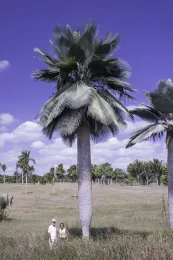
Copernicia fallaensis: the greatest fan palm of them all. Donald R. Hodel, Raúl Verdecia Pérez, Duanny Suárez Oropesa, Milián Rodríguez Lima, and Leonel A. Mera. PalmArbor 2016-4: 1–17. DOI: https://doi.org/10.21414/B10P42
The exceeding handsome and imposing but critically endangered Copernicia fallaensis (Arecaceae), considered by some to be the greatest fan palm of them all, is illustrated and discussed, including its history, a description, distribution and ecology, ethnobotanical uses, and comparison to other species.
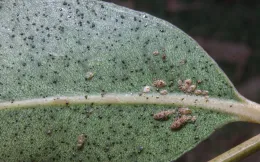
The bronze bug: another new threat to eucalypts in California. Donald R. Hodel, Gevork Arakelian, and Linda Ohara. PalmArbor 2016-05: 1–15. DOI: https://doi.org/10.21414/B1W013
The bronze bug (Thaumastocoris peregrinus), a serious and potentially damaging, sap-sucking insect pest of eucalypts (genera Corymbia and Eucalyptus), has very recently been detected in southern California. Here we provide information on its history, identification, biology, distribution, symptoms, hosts, and possible management strategies.