
When we think about youth leadership in 4-H, we may picture youth officers, ambassadors, or teen teachers. These are valuable roles, but they are not the only opportunities for 4-H members to develop leadership skills.
Sometimes youth engagement can be built into the work we are already doing.
Recently, our 4-H team invited Quinn, a 4-H youth member, to serve on an interview panel for a staff position that would work directly with youth and community partners. Rather than asking adults to speculate about what youth might want or need from this staff position, we invited one of our own members to actively participate in the conversation.
Shared Decision-making
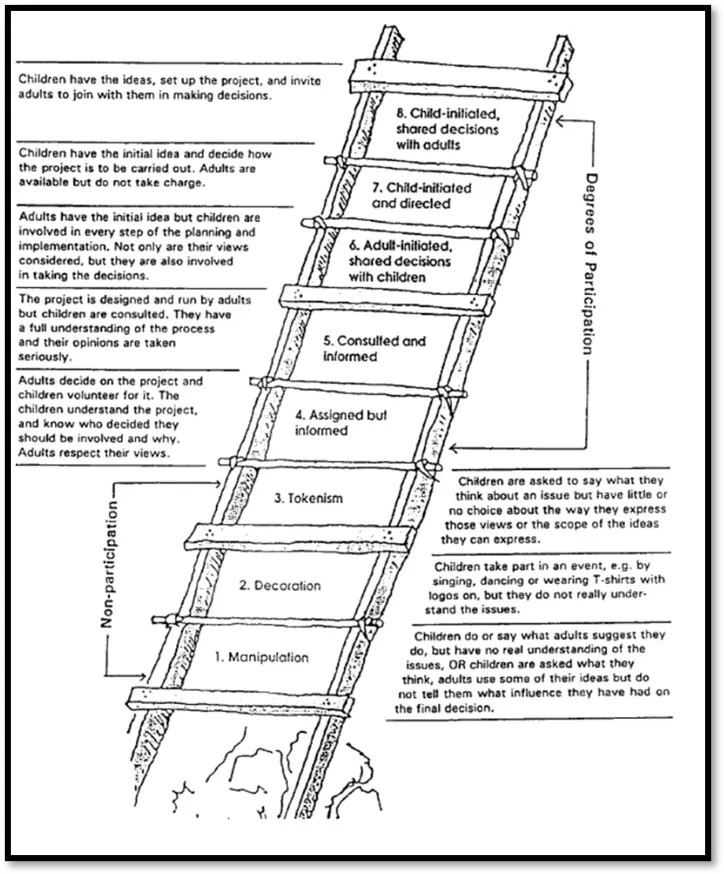
Hart’s Ladder of Participation offers a useful framework for considering how adults can involve young people. The ladder has eight levels, or ‘rungs’, ranging from non-participation to youth-initiated activities and shared decisions.
This example most closely aligns with the sixth rung: adult-initiated, shared decisions with young people. Staff initiated the recruitment and established the position description and selection criteria, but Quinn participated as a youth member on the interview panel. She helped evaluate candidates, sharing her perspective throughout the process.
Policies regarding hiring committee members vary depending on the type of recruitment. When a youth member cannot serve formally on a committee, the hiring manager and/or committee chair can explore an advisory or ex officio role, which can allow them to provide input without formal voting authority. Before determining a youth participant’s role, hiring managers and/or committee chairs should review applicable policies and consult with HR.
Quinn’s participation was not performative. She asked interview questions, listened to candidates’ responses, and evaluated them alongside committee members. In fact, she noticed things that we did not. Her perspective helped us think more carefully about how candidates might relate to and communicate with the young people they would serve.
This experience reinforced an important lesson: asking adults to represent youth voice is not the same as inviting youth to speak for themselves. Although their role may differ depending on the recruitment type and policies, youth can still have meaningful influence when we create the space.
Preparing for Youth Participation
Including a youth member required some planning, particularly because recruitments involve confidentiality and sensitive information. We took several steps to make the experience appropriate and worthwhile:
- We reviewed policies and consulted with HR
- We obtained parental consent
- We ensured that at least two 4-H staff members served on the committee
- We removed identifying information from materials shared with committee members
- We informed candidates in advance that a youth member would be attending interviews
- We prepared Quinn by explaining the position, interview process, committee expectations, and responsibilities
- We developed evaluation materials with a scoring rubric that clearly defined ratings
- We treated Quinn’s observations as valuable contributions (because they were!)
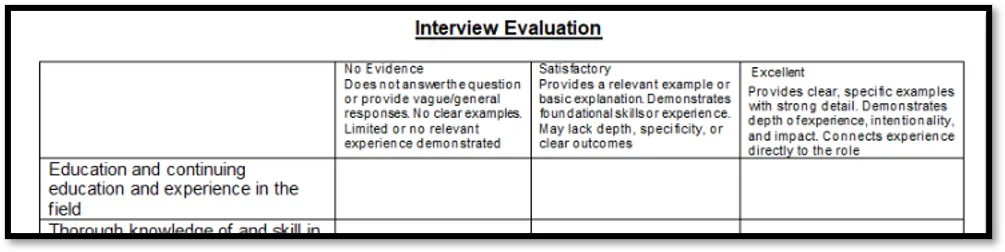
Example from evaluation used
Quinn also brought her own sense of professionalism. Without being asked, she wore her 4-H uniform to the in-person interviews. Candidates responded enthusiastically, and her presence provided a visible reminder of who the position was ultimately intended to serve.
Considerations
Youth participation in recruitment also requires careful consideration. Because a youth member was present, the committee could not engage in some of the more sensitive conversations about candidates during deliberations.
We had to intentionally think about which discussions were appropriate for the full panel and whether any potential confidential personnel matters needed to be addressed separately by authorized staff. Hiring managers and/or committee chairs should consult with HR, identify what information must remain confidential, and clearly define the youth member’s role and decision-making authority in advance.
Finding Opportunities in our Current Work
We often assume that creating new and meaningful experiences for 4-H members requires launching a new program or initiative. Yet many opportunities for youth engagement already exist within our everyday work.
It can begin by pausing to ask: Is there a young person whose contribution would strengthen this decision? If so, how can we prepare and support them to be fully included?
Joining the interview panel gave Quinn a chance to experience a professional recruitment while practicing critical thinking, communication, evaluation, and decision-making. Just as important, she shared a perspective the adults in the room could not provide themselves. Her involvement demonstrates that preparing young people for the future also means recognizing and valuing what they can contribute today.
Quinn gained insight into what employers look for in candidates and reflected that the experience helped her better understand how to prepare for an interview. By allowing her to practice career-ready skills while contributing to a real organizational process, this experience demonstrates how we can put the 4-H Beyond Ready vision into action.
“Recently I was invited to be part of the hiring committee for the new CES3 for Santa Barbara County 4-H. This experience was very enlightening and educational. It helped me understand the process of interviewing and the hiring for a job, more so it provided me the skills to give a compelling interview. I felt like a valued member of the committee and I was glad to be a part of it. I am thankful to have had opportunity to represent the Santa Barbara County 4-H youth. “
Quinn Camacho (15)
President, Santa Ynez 4-H