
Tolerance of lettuce varieties to Fusarium wilt – 2025
Alex Putman, Yu-Chen Wang, and Chris Greer
Summary
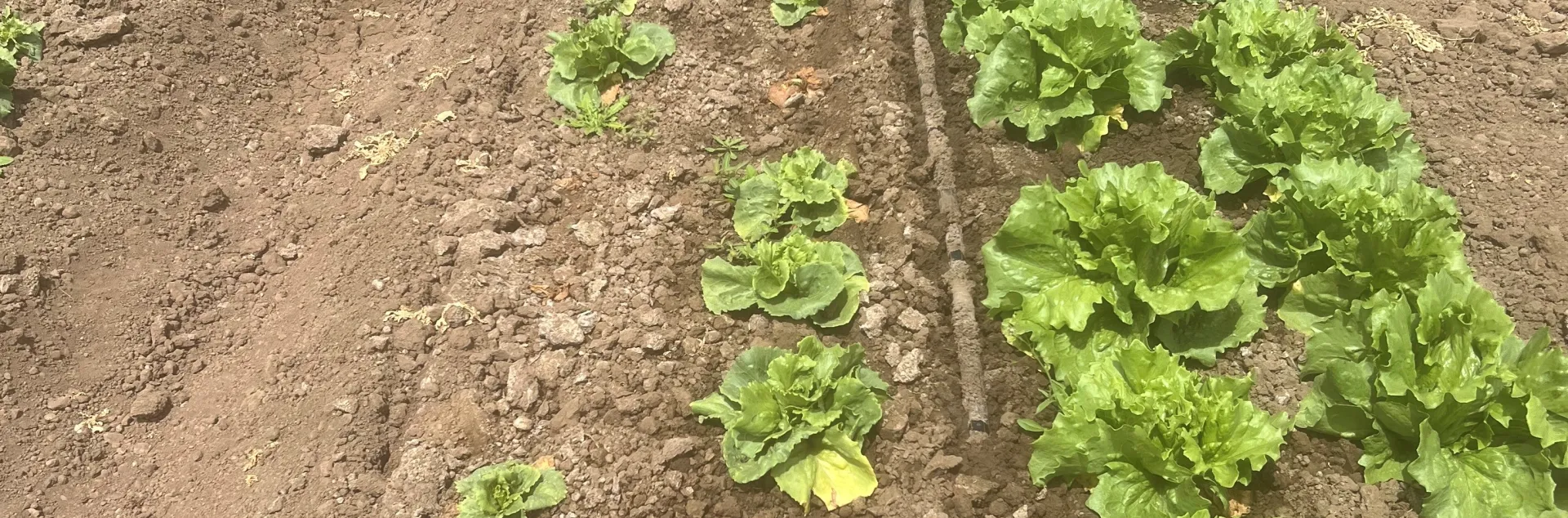
Fusarium wilt of lettuce, caused by Fusarium oxysporum f. sp. lactucae (FOL), is an economically significant disease on the Central Coast of California. We conducted field trials to evaluate 41 iceberg and 23 romaine varieties for tolerance to Fusarium wilt. The trials were in commercial fields in Soledad (wet date of June 25, 2025), Greenfield (wet date of July 2, 2025), and Guadalupe (wet date of July 27, 2025). Foliar disease severity of each plant was visually evaluated on August 25 at Soledad, September 8 at Greenfield, and September 30 at Guadalupe, and was converted to percent marketability (yes or no) per plot. The FOL strain present was determined from samples in previous years or adjacent blocks to be the Costa Rica #4 variant at Soledad and Greenfield, and race 1 at Guadalupe. However, Verticillium wilt was the primary active disease at Greenfield, and lettuce drop incidence was also high at Greenfield. In addition, corky root symptoms were observed at all three locations. Disease severity was highest at Greenfield and lowest at Guadalupe. Iceberg varieties that exceeded 70% marketability at all three locations were Friesian, PS1541, SVX 150035, SVX 150038, San Andreas, San Angelo, and San Clemente. Romaine varieties that exceeded 70% marketability at all three locations were Almanor and Inferno. These trials provide public data on the tolerance of iceberg and romaine varieties to Fusarium wilt under field conditions in the presence of other diseases.
Methods
Field trials were conducted in Soledad, Greenfield, and Guadalupe to evaluate both in-slot and out-of-slot varieties (total of 41 iceberg and 23 romaine) for tolerance to Fusarium wilt in commercial fields with a history of the disease. At Soledad and Greenfield, bed center spacing was 80 inches, and plots were 1 plant line wide by 100 ft. long. At Guadalupe, bed center spacing was 38 inches, and plots were 1 plant line wide by 50 ft. long. Iceberg and romaine varieties were evaluated separately, and plots of each type were arranged in a randomized complete block with four replications. Treatments were direct seeded using single-line push planters. The wet dates were June 25, 2025, for Soledad, July 2, 2025, for Greenfield, and July 27, 2025, for Guadalupe. After thinning by commercial crews, 50 plants at Soledad and Greenfield in the center of each plot were counted, and the section was marked with stakes. Data were collected from this center section. At Guadalupe, all plants in the plot were counted after thinning and used for data collection. Evaluations were performed on August 25 at Soledad, September 8 at Greenfield, and September 30 at Guadalupe. Foliar disease severity of each plant was assessed on a 0 to 4 scale where: 0 = healthy; 1 = wilting or chlorosis of one to three outer leaves; 2 = up to moderate stunting and wilting or chlorosis of <25% of leaf area; 3 = head is severely stunted or absent and between 25% and 75% of leaf area is wilting or chlorotic; and 4 = head is absent and >75% of leaf area is chlorotic and nearly dead, or plant is entirely dead. For analysis, foliar disease severity was converted to marketability, where: disease severity of 0 or 1 = marketable; and disease severity of 2, 3, or 4 = not marketable. Percent marketability was calculated for each plot, analyzed by an analysis of variance (P < 0.05), and variety means were separated using Tukey’s honestly significant difference test.
Results – Pathogens and FOL races present
Two races of FOL are present on the Central Coast: race 1, and a novel race variant (Nayak et al., 2024), which we are temporarily calling the “Costa Rica #4 variant”. To determine the FOL race present, isolates from each location that were collected in 2022 or 2023 were evaluated in a race typing experiment in the greenhouse. Variety Costa Rica #4 showed a susceptible reaction to both Soledad isolates and to both isolates from the block adjacent to the Greenfield location, which supports the observation that the Costa Rica FOL race variant is present at the Soledad and Greenfield locations. Costa Rica #4 showed a highly resistant reaction to both isolates from the Guadalupe location, which supports the observation that FOL race 1 is present at the Guadalupe location.
Although Fusarium wilt was active at all three locations, it was not the only disease observed. Symptoms resembling Verticillium wilt were observed within the trials. Verticillium wilt symptoms were widely prevalent at the Greenfield location, present at low incidence at the Soledad location, and not observed at Guadalupe. Due to these observations, plant samples were processed in the lab for diagnosis of Fusarium wilt and Verticillium wilt. At Soledad, FOL was detected more frequently than Verticillium dahliae, the pathogen that causes Verticillium wilt, whereas at Greenfield V. dahliae was detected more frequently than FOL.
In addition, corky root was visually observed at all three locations. Corky root incidence was severe at Greenfield, moderate at Soledad, and low at Guadalupe. Finally, lettuce drop caused by Sclerotinia minor was present at low levels at Soledad and Guadalupe, and incidence was moderate to high at the Greenfield location, particularly among romaine varieties.
In summary, the primary disease active at Soledad was Fusarium wilt Costa Rica #4 variant, at Greenfield was Verticillium wilt, and at Guadalupe was Fusarium wilt race 1. The secondary disease at Greenfield was the Fusarium wilt Costa Rica #4 variant.
Results – Marketability
Disease pressure among the locations was highest at Greenfield, moderate at Soledad, and lowest at Guadalupe. Iceberg varieties that exceeded 70% marketability at all three locations were Friesian, PS1541, SVX 150035, SVX 150038, San Andreas, San Angelo, and San Clemente (Table 1). Two varieties that exceeded 90% marketability at only Soledad and Guadalupe were Powerball, and Powerpack.
For romaine, two varieties exceeded 70% marketability at all three locations: Almanor and Inferno (Table 2). Varieties that exceeded 90% marketability at only Soledad and Guadalupe were Abilene, Cardinal, Duquesne, Grackle, Holbrook, Iverson, PS1432, Rawhide, Rio Bravo, Sparrow, Stampede, and Warbler.
If you have additional questions about these trials, please contact Alex Putman at 951-522-9556 or aiputman@ucr.edu.
Please Send Us Samples
We are continuing to collect samples of lettuce Fusarium wilt to determine the distribution of races and to monitor the pathogen. To support this research, please contact the person in your region. Your help would be greatly appreciated.
- Monterey, San Benito, or Santa Cruz Counties – Yu-Chen Wang (831-201-9689 or yckwang@ucanr.edu)
- San Luis Obispo, Santa Barbara, or Ventura Counties – Chris Greer (805-888-1355 or cagreer@ucanr.edu)
- Any other California county – Alex Putman (951-522-9556 or aiputman@ucr.edu)
Acknowledgements
We are grateful to Betteravia Farms, D’Arrigo Brothers Co. of California, and Huntington Farms for the space and maintenance of the variety field trials. We thank seed producers for providing seed for the trial. Funding for this project was made possible by a grant from the U.S. Department of Agriculture (USDA) Agricultural Marketing Service. Its contents are solely the responsibility of the authors and do not necessarily represent the official views of the USDA. Funding was also provided by the California Leafy Greens Research Program.
References
Nayak, S., K.L. Richardson, A.I. Putman, N.R. LeBlanc, F.N. Martin, N. Li, and J.D. McCreight. 2024. Detection of novel pathogenic variants of Fusarium oxysporum f. sp. lactucae in California. Plant Pathology 74(2):295-307. doi:10.1111/ppa.14019
Table 1. Percent marketable heads of iceberg lettuce varieties in 2025.
Company | Cultivar | Soledad1 | SD Slot2 | Greenfield1 | GF Slot2 | Guadalupe1 | GP Slot2 |
|---|---|---|---|---|---|---|---|
SVS | SVX 150027 | 99.5 a | over | 94.9 a | over | - | - |
Rijk Zwaan | Kawinas | - | - | - | - | 96.4 abc | in |
SVS | SVX 150031A | 98.1 a | - | 85.9 abc | - | - | - |
Pinnacle | PS1541 | 99.0 a | - | 90.9 a | - | 82.0 f-i | - |
Seminis | Powerpack | 98.0 a | in | 56.3 e-i | in | 93.1 a-e | in |
SVS | San Clemente | 98.6 a | over | 93.2 a | over | 73.0 hij | in |
Takii | TLE001 | 89.6 a-d | - | 59.3 e-h | - | 97.1 a | - |
Greengo | Mickey | 98.5 a | - | 54.7 e-j | - | 85.7 a-h | - |
SVS | Paraiso | 98.5 a | over | 97.0 a | over | 68.2 ijk | in |
3 Star | Friesian | 90.5 ab | over | 85.3 a-d | over | 92.2 a-f | in |
SVS | SVX 150035 | 95.2 a | - | 91.5 a | - | 77.3 f-i | - |
Vilmorin | 25FT-003 | - | - | 39.3 h-l | under | 96.5 a-d | under |
Greengo | Balboa | 98.5 a | - | 46.4 h-k | - | 89.3 a-g | - |
SVS | San Miguel | 99.0 a | over | 91.0 a | over | 5.4 m | in |
Seminis | Powerball | 95.0 a | in | 52.5 e-j | in | 93.2 a-f | in |
SVS | San Angelo | 96.6 a | over | 94.1 a | over | 70.6 hij | in |
SVS | San Andreas | 97.1 a | over | 87.8 ab | over | 73.1 hij | in |
Takii | TLE002 | 89.9 abc | - | 51.5 f-j | - | 94.0 a-e | - |
SVS | SVX 150038 | 75.4 b-f | - | 71.8 b-e | - | 85.8 a-h | - |
Vilmorin | 25FT-002 | - | - | 36.5 i-l | under | 96.3 a-e | under |
Vilmorin | 25FT-006 | - | - | 38.3 h-l | under | 94.6 a-d | under |
Sakata | Sakata-1 | 96.1 a | over | 89.3 a | over | 32.6 l | over |
Greengo | Adrian | 89.9 abc | - | 54.7 e-i | - | 84.1 d-i | - |
Sakata | Meridian | 95.0 a | in | 48.5 g-j | in | 83.9 e-i | in |
Greengo | Paulie | 96.0 a | - | 39.3 h-l | - | 83.9 a-h | - |
Syngenta | Ortega | 72.4 ef | over | 69.9 c-f | over | 83.6 b-h | in |
Vilmorin | 25FT-005 | - | - | 26.1 kl | under | 94.3 a-e | under |
Syngenta | Fremont | 93.2 a | over | 54.5 e-i | over | 77.0 f-i | in |
Enza Zaden | Newcastle | 66.0 efg | in | 70.2 d-g | in | 83.2 d-i | in |
Syngenta | Lucia | 73.9 c-f | over | 50.3 i-l | over | 85.6 a-h | in |
3 Star | Fredonia | 83.0 a-e | under | 39.1 h-l | in | 90.7 a-h | in |
Sakata | Iceman | 98.5 a | over | 40.7 h-l | over | 54.6 jk | over |
3 Star | Fresco | 48.2 gh | under | 50.5 f-j | under | 90.4 a-g | under |
SVS | Primo | 66.7 efg | over | 24.2 l | over | 95.8 ab | in |
SVS | SVX 150031 | 67.3 efg | - | 57.2 e-i | - | 73.9 hij | in |
Greengo | Pismo | 91.8 a | - | 39.1 h-l | - | - | - |
3 Star | Fronterra | 58.8 fg | under | 48.5 f-j | under | 83.7 c-i | under |
Pinnacle | PS1534 | 95.0 a | - | 33.0 jkl | - | 71.5 hij | - |
Pinnacle | PS1546 | 96.7 def | - | 24.4 l | - | 47.6 kl | - |
Enza Zaden | Telluride | 62.0 fg | in | 26.6 kl | in | 83.7 c-h | in |
3 Star | Tamarack | 34.5 h | under | 6.6 m | under | 74.6 g-j | under |
Rijk Zwaan | Rhodenas | 9.5 i | in | 2.5 m | in | 31.8 l | in |
1 Marketability is defined as a rating of 0 (no disease) or 1 (slight chlorosis on outer leaves or slight stunting) on the Fusarium wilt severity rating scale. Means within each location followed by the same letter are not significantly different at P = 0.05 according to Tukey’s honestly significant different test. Varieties are sorted by averaging the ranks for each location.
2 Maturity slot for the wet date at each location: in = in-slot; under = variety is expected to not reach marketable size and quality; and over = variety is expected to develop beyond ideal maturity. Location abbreviations: SD = Soledad, GF = Greenfield, and GP = Guadalupe.
Table 2. Percent marketable heads of romaine lettuce varieties in 2025.
Company | Cultivar | Soledad1 | SD Slot2 | Greenfield1 | GF Slot2 | Guadalupe1 | GP Slot2 |
|---|---|---|---|---|---|---|---|
Syngenta | Cardinal | 98.5 a | in | 58.0 abc | over | 95.5 abc | in |
Enza Zaden | Almanor | 98.5 a | in | 73.9 a | in | 92.4 abc | in |
Syngenta | Duquesne | 98.5 a | in | 38.0 d-i | in | 98.2 a | in |
Syngenta | Grackle | 99.0 a | in | 36.0 d-j | in | 96.3 ab | in |
Syngenta | Iverson | 99.5 a | over | 34.5 e-j | over | 94.8 abc | over |
Syngenta | Sparrow | 99.5 a | in | 25.0 g-j | in | 95.3 abc | in |
Syngenta | Stampede | 99.0 a | in | 38.0 d-i | in | 92.4 abc | in |
Syngenta | Boronda | 99.5 a | over | 41.5 c-g | over | 89.4 a-d | over |
Pinnacle | PS1432 | 98.0 a | - | 39.2 c-h | - | 94.1 abc | - |
Syngenta | Rio Bravo | 98.5 a | over | 39.0 c-h | over | 91.7 abc | over |
Syngenta | Warbler | 98.0 a | over | 26.0 f-j | over | 95.9 abc | over |
Syngenta | Abilene | 98.0 a | in | 43.5 c-f | in | 91.2 abc | in |
Syngenta | Holbrook | 98.0 a | over | 52.5 b-e | over | 90.8 a-d | over |
Rijk Zwaan | Salvius | 58.5 b | in | 24.0 g-j | in | 98.6 a | in |
Syngenta | Green Thunder | 97.5 a | over | 54.5 bcd | over | 84.9 cd | in |
Syngenta | Rawhide | 95.5 a | in | 38.0 d-i | in | 92.2 abc | in |
Syngenta | Inferno | 71.8 b | over | 70.8 ab | over | 74.5 de | in |
Vilmorin | 25FT-008 | - | - | 31.7 f-j | under | 91.9 abc | under |
Vilmorin | Kanaka | - | - | 20.5 ij | under | 94.5 abc | under |
Vilmorin | Bluerock | - | - | 19.5 jk | under | 93.1 abc | under |
Vilmorin | Ranchero | - | - | 25.0 g-j | under | 91.4 abc | under |
Vilmorin | 25FT-010 | - | - | 21.5 hij | under | 64.4 f | under |
other | iceberg check | 33.0 c | - | 6.0 kl | - | 59.0 ef | - |
Vilmorin | 25FT-009 | - | - | 5.5 l | under | 86.5 bcd | under |
1 Marketability is defined as a rating of 0 (no disease) or 1 (slight chlorosis on outer leaves or slight stunting) on the Fusarium wilt severity rating scale. Means within each location followed by the same letter are not significantly different at P = 0.05 according to Tukey’s honestly significant different test. Varieties are sorted by averaging the ranks for each location.
2 Maturity slot for the wet date at each location: in = in-slot; under = variety is expected to not reach marketable size and quality; and over = variety is expected to develop beyond ideal maturity. Location abbreviations: SD = Soledad, GF = Greenfield, and GP = Guadalupe.
3 Iceberg cultivar included as a susceptible control.