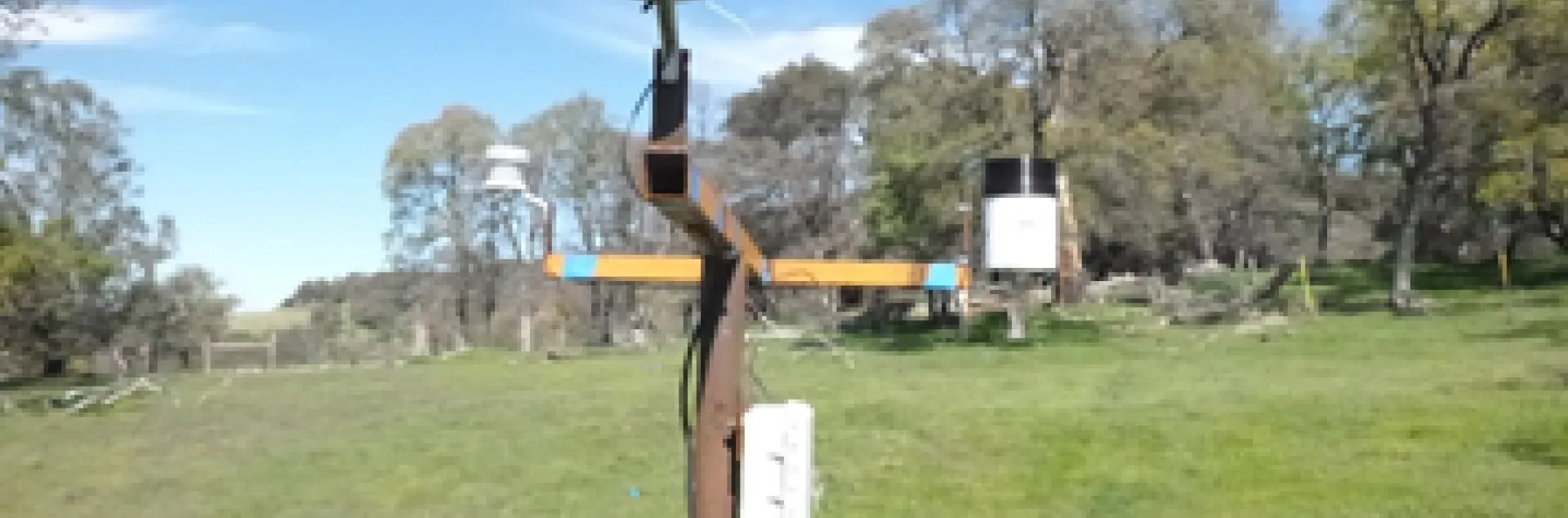
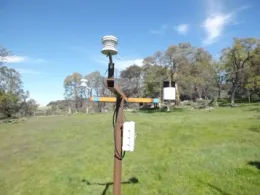
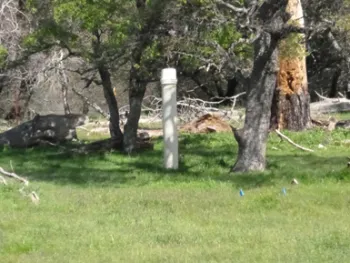
This is the new weather station in the Forage Production Plot-taken 3/7/18.
SFREC News
Article

Forage Production Data March 2018

This is a photo of the new weather station in the Forage Production Plot-taken 3/7/18.
This is the new weather station in the Forage Production Plot- taken 3/7/18.

Sierra Foothill REC has been collecting and recording rangeland forage production data since 1979. Every year when rangeland forage production values are recorded, explanations as to the results of pounds per acre grown are based on past forage production values & statistics, plus a CIMIS weather station which resides at 660' elevation; whereas, the Forage Plot lies at 1470' and 1.3 miles away from #084 Browns Valley CIMIS Station. SFREC has recently installed replicated soil temperature sensors (5-10 cm in depth), soil water content sensors (5-10 cm, 25-35 cm, & 56-65 cm in depth), air temperature sensors, and a precipitation gauge. Two replicated soil sensor stations were each placed under canopy and in the open. Illustrated below are tables and graphs depicting rangeland forage production values and trends, newly installed soil sensor data (Open and Canopy), and a dramatic comparison (Forage Plot vs. CIMIS) in precipitation values.
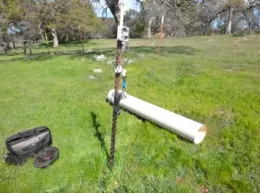
This is the HOBO micro station, it takes soil temperature and moisture readings, under open sky.

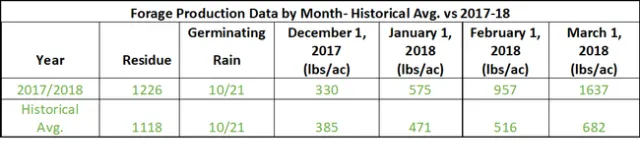
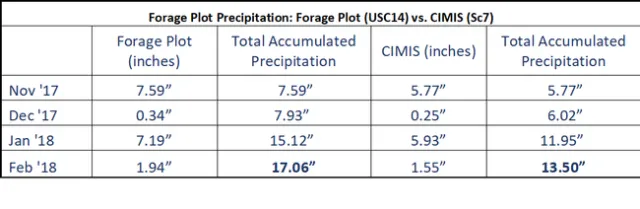
There were two major developments during this rangeland forage production season (Nov 1, 2017 thru March 1, 2018). The first being that we had the highest level of forage production for the month of February (1637 lbs/ac) in our recorded history. The warm February we had may be a contributing factor to this. The other major development is the significant differences in monthly/total precipitation values between the CIMIS and the forage plot.

If you have any comments, please leave your reply directly below.
This is the HOBO micro station, it takes soil temperature and moisture readings, under closed canopy.
This is the HOBO micro station, it takes soil temperature and moisture readings, under tree canopy.
 
This table shows forage production data until March 1.
Table comparing forage production data by month between the 2017/2018 year and the historical average, including residue in lbs/acre, germinating rain date, and forage weight in lbs/acre for December 1, January 1, February 1, and March 1, 2018.


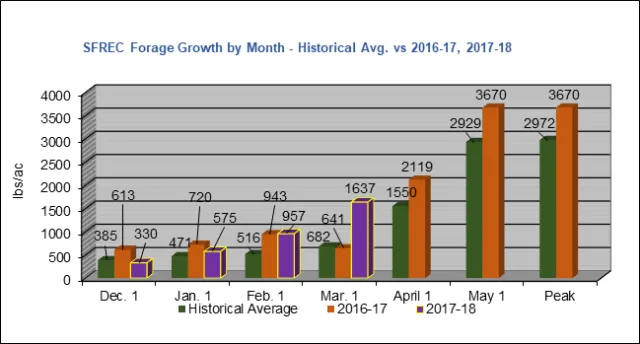
This shows a graphical display comparing forage production to this year to last year and historical averages.
SFREC Forage Growth by Month - Historical Avg. vs 2016-17, 2017-18." It displays forage growth in lbs/acre for December through peak, with bars for historical average (green), 2016-17 (orange), and 2017-18 (purple). The highest growth occurs in May and peak months, reaching 3670 lbs/acre.


Differences in Forage Plot and CIMIS Station precipitation data.
Table comparing forage plot precipitation data for November 2017 to February 2018, including total accumulated precipitation in inches, data from CIMIS station, and total precipitation, with values increasing over time and some entries marked as "n/a" or with notes on equipment failure.


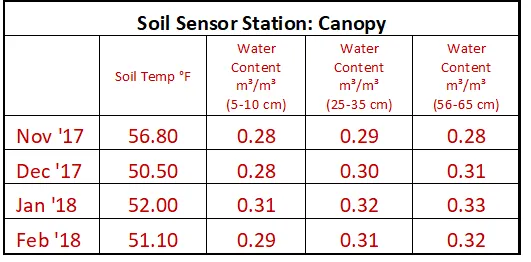
This table show soil temperature and moisture levels under tree canopy
Tables showing soil sensor data for canopy and open locations from November 2017 to February 2018. Each table includes soil temperature in °F and water content in m³/m² at depths of 5-10 cm, 25-35 cm, and 56-65 cm, with some values marked as "n/a" or "0.30."
 
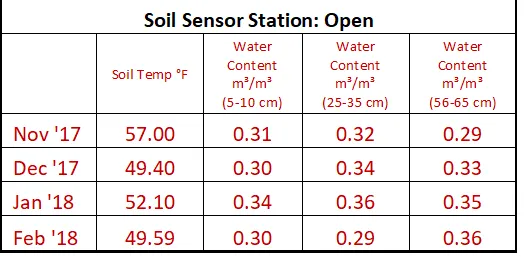
This table shows soils temperature and moisture levels under the open sky.
Table titled "Soil Sensor Station: Open" showing soil temperature in °F and water content in m³/m² at three depths (5-10 cm, 25-35 cm, 56-65 cm) for four months: November 2017, December 2017, January 2018, and February 2018. Values include soil temperatures of 57.00, 49.40, 52.10, and 49.59°F, and water content ranging from 0.29 to 0.36 m³/m², with some entries marked as "n/a" or "0.30".