
By Michelle McNeill.
If you live in an area where deer roam, now is the time to take action to protect any new trees on your property from deer damage during rutting season.
Recently I discovered that the tung oil tree I planted in April had suffered major damage to its narrower-than-a-finger-in-diameter trunk. A deer had scraped and rubbed its antlers on it. Upon further inspection around my property, I discovered my Necta Zee nectarine tree was another victim: most of its branches had been broken off and were lying on the ground.
Why was this happening now? Each spring, male deer (also called stags or bucks) grow a new set of antlers that are coated with a furry, velvet-like covering. By fall, the antlers have fully grown and the velvet coating starts to itch, so the bucks use young trees to scrape off the velvet and also to mark their territory. In the competition for mating, when males joust with one another to win over female deer (does), a hard antler surface is more valuable than a softer, velvety one.
The breeding peak for deer in Northern California is roughly late October into November. While bucks are able to breed with a doe as soon as they shed the velvet from their antlers, no mating actually occurs until a doe enters her estrous cycle. Since bucks are ready weeks before this, they become increasingly active and aggressive as the fall arrives. Bucks will paw into the ground to form oval bare-earth patches called “scrapes” and rake their antlers against trees and shrubs leaving “rubs.” These “rubs” are likely a communication tool to advertise a buck’s presence to other deer in the area. Rubbing and scraping begin as soon as a buck starts shedding the velvet from his antlers and continues to build until actual breeding begins.
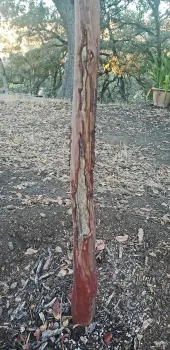
Bucks usually target trees with smooth bark and trunks that are between one and four inches in diameter. They will also bruise and batter tree branches with their antler racks and tend to target younger trees because the smaller branches are the right size to strike between their antlers. It is believed that the thrashing against a tree is practice for the competitive antler battles that occur during the mating season, and that the thrashing also toughens the muscles in the animal’s neck. Bucks tend to avoid trees with thorns, rough bark, or low branches. Saplings and smaller trees with pliable trunks are at high risk, while larger, more mature trees are less likely to be affected.
As the deer rub to clean the summer velvet from their antlers, they strip the bark from young trees. This can be fatal to trees because beneath that bark is a nutrient and water transport system known as the cambium layer. If the cambium layer is removed around the entire tree trunk, also known as girdling, there is no way for the tree to survive. If the damage is only partial, the tree may be able to seal over the damaged area. Over several years or more, new bark will grow in and slowly cover the wounded wood. However, even if the tree does not die, the damage can be so extensive that it may be stunted and never fully recover.
How can trees be protected? Buck rub can be discouraged by utilizing scare tactics. Deer are wary animals and you can use this to your advantage by employing motion sensor sprinklers or noise-making devices. Some say that hanging reflective objects such as CD’s or aluminum foil strips within the vicinity of your trees is a deterrent because the sudden movements, flashes, or noises will startle the deer. Another possibility is to apply a commercial deer repellent; these typically contain strong-smelling substances that deer find unpleasant. This method, however, must be continually refreshed as the offensive scent dissipates.
By far the most effective way to protect your trees is to protect them from deer with some kind of physical barrier. This can be achieved in various ways. For example, a perimeter fence that is high enough that deer cannot jump over it (seven to eight feet) is certainly an effective deterrent to protect an area. If a high perimeter fence isn’t possible, three or four T-posts pounded in around individual trees, leaving a three-to-four-foot diameter space that’s wrapped with hardware mesh or chicken wire securely fastened to the T-posts can be an effective barrier. When the tree matures enough you can remove the T-posts and surrounding material.
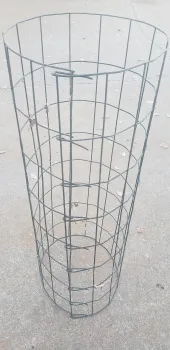
Another method is to encircle your tree with stiff wire goat fencing, cutting a large enough section to surround the tree and bending the wire squares of one side back through the squares of the other side to secure it. Or you can make an inexpensive barrier from corrugated drainage tubing that can protect the trunk when limbs are high enough to be out of danger. It can be reused year after year. You can find this in four-inch diameter by ten-foot-long sizes at most home improvement stores, usually for less than $20. Measure the distance from the ground to the first set of branches on your young tree, then cut a piece of tubing to that measurement and slice down the length of the tube in a straight line. To install, pull the tubing open and fit it around the tree trunk, being careful not to scrape the bark with the edges of the tubing. It may be helpful to have a second pair of hands for this. When rutting season is over, simply remove the tubing or goat fencing and store for use again the following year.
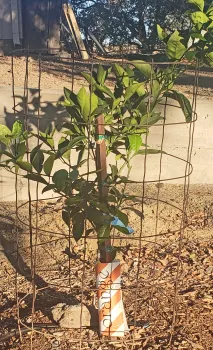
The best time to protect your young trees is before the deer find them during the annual rutting season. For this year, that window is closing fast. If tree damage is extensive and a tree is girdled, it’s sometimes possible to train a new sprout from below the damage into a new top. In an effort to save my girdled tung oil tree, I cut the trunk back below the “rub” damage, leaving only six inches of trunk. Time will tell if it recovers.
The Master Gardeners 2026 Fall Workshop Series has begun! September Workshops include Composting (September 19) and Vegetable Gardening (September 26). And we are offering a Fall Garden Talk on how to Grow a Salad in a Garden Bed (September 12). For more information, visit our workshop webpage.
UC Master Gardeners of Butte County are part of the University of California Cooperative Extension (UCCE) system. To learn more about us and our upcoming events, and for help with gardening in our area visit the UC Master Gardener website. If you have a gardening question or problem, email the Hotline at mgbutte@ucanr.edu or leave a phone message on our Hotline at 530-552-5812. To speak to a Master Gardener about a gardening issue, or to drop by the MG office during Hotline hours, see the most current information on our Ask Us section of our website.