
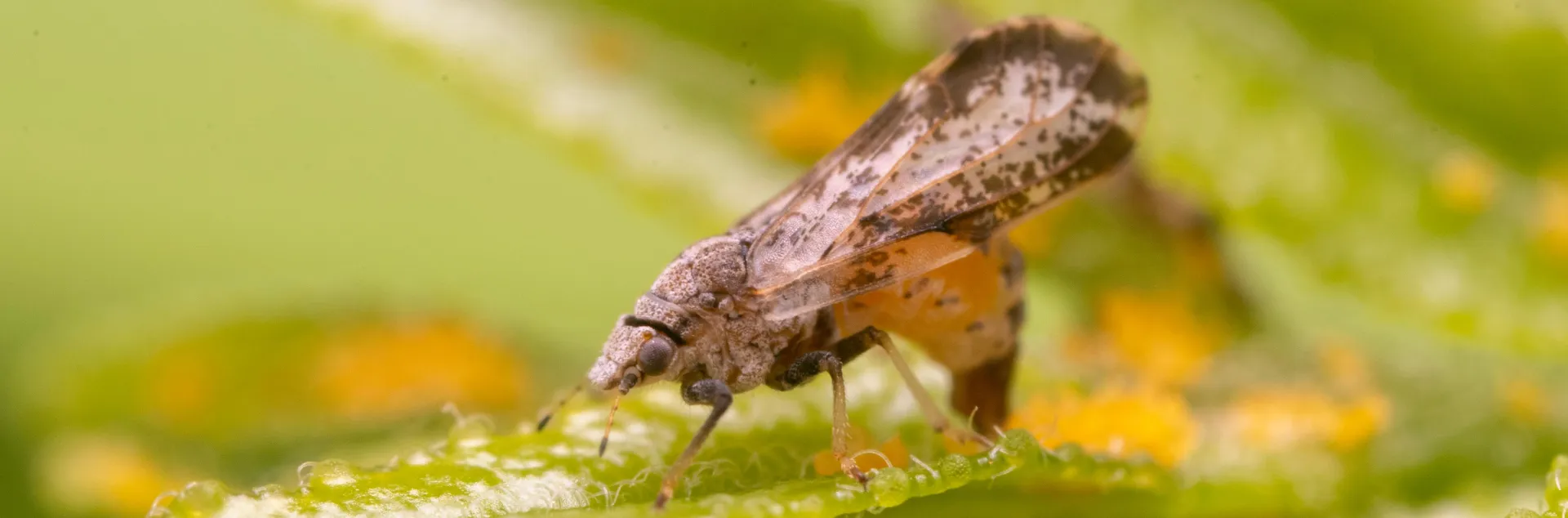
Following the July 16th webinar Update on Asian Citrus Psyllid in California, our presenter, Dr. Sandipa Gautam, answered live questions from participants. Below are some of the questions asked about Asian citrus psyllid (ACP) and Huanglongbing (HLB) disease. Keep in mind that some of the questions were related to content shared during the live presentation. This list does not include all questions that were answered live.
Monitoring
Q: Who should I contact to inspect my trees for symptoms of HLB or ACP?
A: Contact your local County Agricultural Commissioner’s office or UC Cooperative Extension office. You can also report suspected detection to the California Department of Food and Agriculture (CDFA) Pest Hotline at 1-800-491-1899.
Q: After the bacterium has been introduced to the tree, how long does it take for the tree to begin manifesting HLB symptoms?
A: It can take anywhere from 9 months to 3 years for a tree to show visible symptoms of Huanglongbing (HLB) disease.
Q: Is there a season in which ACP is more active?
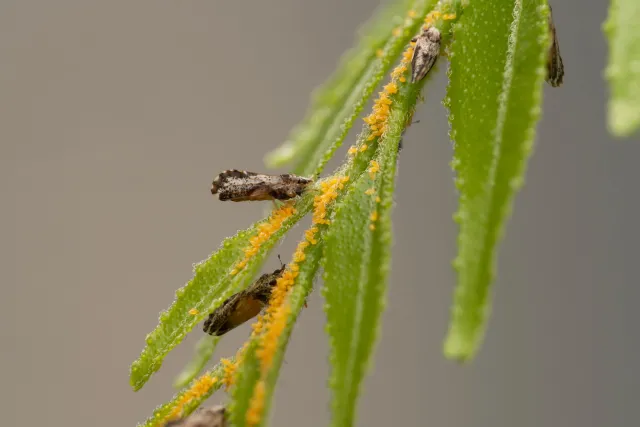
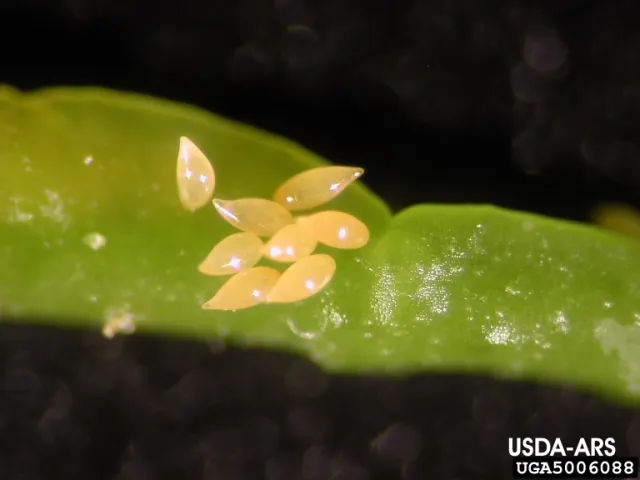
A: Yes. Asian citrus psyllid (ACP) is more active when trees are flushing (producing new leaves) in spring, fall, and winter (in some regions). This is because ACP adults only lay eggs on new flush since nymphs cannot survive on mature leaves. Monitoring and management should focus on when the trees are flushing. If I have to pick one season when they are most active, that would be on fall flush, as ACP numbers tend to be higher during warmer weather than in winter or spring.
Biological Control
Q: Are hover flies being used to control ACP?
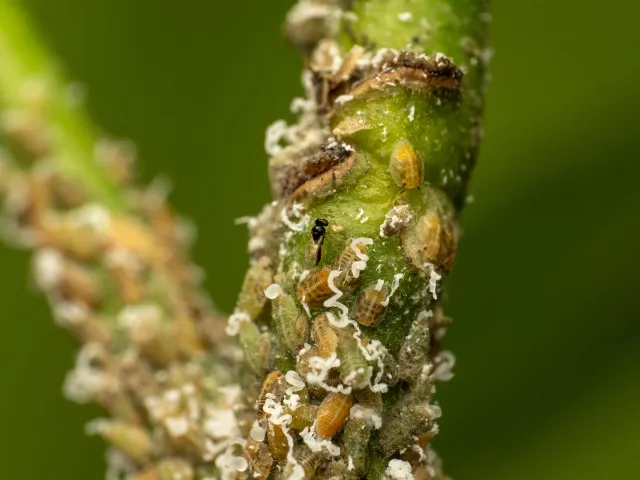
A: Not as augmentative control. Research has shown that hover fly larvae can feed on Asian citrus psyllid (ACP) nymphs, but growers are not currently relying on it as a biological control agent for ACP in California. The primary biological control program focuses on releasing Tamarixia radiata, a parasitic wasp that specifically attacks ACP nymphs and has proven to be much more effective at reducing ACP populations in residential areas. Hover flies, also known as syrphid or flower flies, are beneficial insects and may provide some incidental predation, but they are not mass-reared or released as part of California's ACP biological control program.
Q: Does the parasitic wasp, Tamarixia radiata, become established in the area when released or does it eventually die off?
A: Tamarixia radiata has been recovered from the areas where it has been released. One of the key things to understand is that Tamarixia is a specific parasitoid and does not survive if the host (in this case, Asian citrus psyllid nymphs) are not present. This is the reason why Tamarixia releases are focused in areas where ACP populations are known to be established.
Q: Why does the release of T. radiata mainly take place in coastal areas?
A: Tamarixia radiata is released primarily in coastal areas because these regions have well-established populations of Asian citrus psyllid (ACP). They also have a high density of residential citrus trees at the urban–agricultural interface, where biological control can help suppress ACP populations and reduce the risk of psyllids moving into nearby commercial citrus orchards.
Chemical Control
Q: Given the range of topical and systemic insecticides, is citrus that’s been treated safe to eat?
A: Yes. Citrus treated with registered topical or systemic insecticides are safe to eat when the products are applied according to the pesticide label. Before a pesticide can be used on citrus, it must undergo rigorous evaluation by federal and state regulatory agencies to ensure that any residues on fruit remain well below established safety limits. These products have required pre-harvest intervals (PHIs), which specify how long growers must wait between the last application and harvest to ensure the fruit is safe for consumption. Homeowners should also follow all label directions, including any waiting periods before harvesting fruit from treated trees.
Q: Do these insecticides harm beneficial insects, like bees?
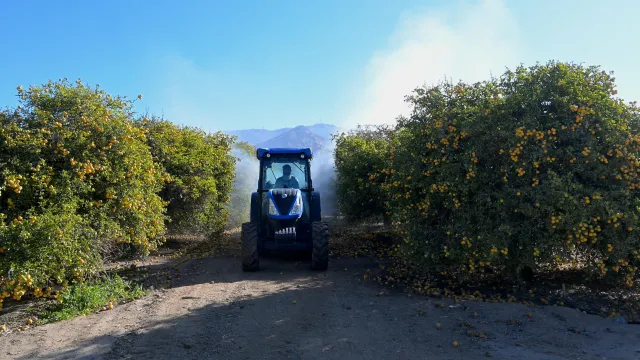
A: Some insecticides used to manage Asian citrus psyllid (ACP) can affect beneficial insects, including bees and natural enemies if they are applied improperly. To minimize these risks, treatments are made according to label directions, which include measures such as avoiding applications during bloom or when bees are actively foraging. In commercial citrus, integrated pest management (IPM) practices are used to balance effective ACP control with protection of beneficial insects.
Q: How do organic commercial growers manage ACP on their citrus orchards?
A: Organic growers use an integrated pest management (IPM) approach that includes regular monitoring, protecting natural enemies, and applying organically approved insecticides when needed. Because organic products often have shorter residual activity, precise timing and frequent scouting are critical for effective ACP management. However, if the organic orchard falls inside the HLB quarantine area, the grower is encouraged to treat with conventional insecticide to move fruit outside the quarantine zones.
Q: Can biological control agents and insecticides be combined to manage ACP?
A: Yes. Biological control agents and insecticides can be combined as part of an integrated pest management (IPM) program. The key is selecting insecticides that are effective against ACP while minimizing impacts on beneficial insects, and timing applications carefully to conserve natural enemies such as Tamarixia radiata, and generalist predators like hover flies and lacewings. Combining multiple strategies improves ACP suppression and helps reduce the risk of HLB spread.
Other
Q: What type of netting can be used to protect citrus trees?
A: Fine mesh insect exclusion netting can be used to protect citrus trees from Asian citrus psyllid (ACP). The netting must have a small enough mesh size # US size 30 or more to prevent ACP from entering while still allowing light, air movement, and plant growth. Netting is most effective for small trees, nursery plants, or high-value residential citrus trees and must be installed carefully to prevent gaps where psyllids can enter. However, you have to inspect the trees and ensure that the insects are not present prior to netting. If they are present, it can make things worse by helping contain the population and creating a microclimate that is more favorable for ACP and other pests such as mealybugs.
Q: Can ACP be trapped on transparent tape, like Scotch tape?
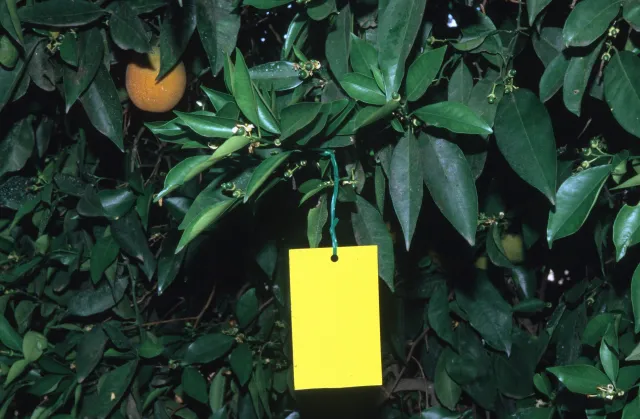
A: Yes, ACP can be captured on sticky surfaces, including transparent tape, but Scotch tape is not recommended for routine monitoring. Standard ACP monitoring uses specialized yellow sticky traps because they are more attractive to psyllids and provide more reliable detection. For homeowners, transparent tape can help confirm the presence of a suspected psyllid, but proper identification is still important.
Q: What bioengineering pest control is currently taking place under UC ANR guidance?
A: UC ANR is involved in research and outreach related to emerging bioengineering approaches for pest management, including evaluating technologies that could help manage Asian citrus psyllid (ACP) and Huanglongbing (HLB). These approaches include studying engineered plants and naturally derived pest-control traits, such as citrus expressing biopesticidal proteins that target ACP. Any potential use would require extensive research, regulatory review, and public engagement before adoption.
Q: Is it safe to assume that citrus trees being sold in areas that are not under quarantine have not been exposed to ACP?
A: Not necessarily. While citrus trees sold through reputable nurseries follow regulations designed to prevent the movement of ACP and HLB, trees in non-quarantine areas may still be at risk of exposure if ACP is present nearby or if plants are moved from other areas. Purchasing citrus trees from certified sources and following local regulatory guidelines helps reduce the risk of spreading ACP and HLB. It is also important to monitor new trees regularly for ACP and symptoms of HLB.
Q: Does ACP favor one variety of citrus over others or are all varieties equally at risk? (lemon, lime, orange, mandarin, etc.)
A: ACP can infest all citrus varieties, but it is more attracted to some than others, especially those producing young flush. Varieties such as mandarins and sweet oranges can be highly susceptible because new growth provides ideal sites for ACP egg laying and nymph development. Lemons grown in coastal regions where the climate is mild and flush multiple times provide support to ACP populations. Regardless of variety, all citrus trees should be monitored and protected because any infected tree can contribute to the spread of HLB.
Q: If you find ACP eggs on your tree and proceed to cut the leaves, will that help prevent an infestation?
A: Removing leaves with ACP eggs or young nymphs can help reduce the number of psyllids developing on a small tree, but it is not a reliable long-term control method. ACP can lay eggs on new flush throughout the tree, and adults can quickly move in from surrounding areas. The best approach is to combine monitoring with appropriate ACP management practices, especially when new flush is present.
Q: What research is there on Australian finger limes being used as a treatment for HLB?
A: It is not currently a treatment or cure for HLB, but it is being studied because it shows natural tolerance to the disease. Research has identified that finger lime contains compounds and defense mechanisms that may help limit Candidatus Liberibacter asiaticus (CLas), the bacterium associated with HLB.
Q: Why is the psyllid pressure low in the desert?
A: ACP populations are generally lower in desert citrus-growing areas and in the San Joaquin Valley because the extreme heat and dry conditions are less favorable for psyllid survival and reproduction. High summer temperatures can reduce egg and nymph survival, and the desert climate limits the availability of suitable young flush, which ACP needs for feeding and reproduction. Continued monitoring is still important because ACP can survive in irrigated citrus areas, and introductions from other regions remain a risk.
Q: Is ACP the only insect that can transmit HLB? What about other sap sucking insects?
A: Asian citrus psyllid (ACP), Diaphorina citri, is the only psyllid in California known to transmit the bacteria associated with Huanglongbing (HLB). Other psyllids occur on different host plants and are generally not a threat to citrus because they do not feed on citrus in the same way or are not capable of transmitting HLB. Continued monitoring and regulatory efforts focus specifically on ACP because of its ability to spread HLB and its close association with citrus.
For help managing pests, visit the UC IPM website at ipm.ucanr.edu.