

What’s the Big Deal?
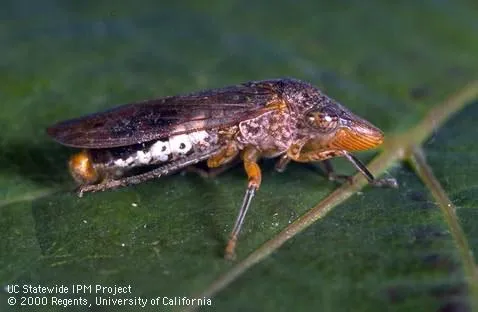
The invasive glassy-winged sharpshooter (GWSS), Homalodisca vitripennis, is a large (~0.5 inch long) leafhopper that feeds on plant fluids in the xylem, a plant’s water-conducting tissue. The glassy-winged sharpshooter was first found in California in 1990 after it was inadvertently introduced from the Southeastern United States where it is native. GWSS is established now throughout Southern California and some Central California locations.
GWSS Can Transmit Incurable, Often Fatal, Plant Diseases
The biggest problem with the GWSS is that the insect can vector diseases, meaning that it can transmit several important, often fatal, plant diseases in California. These diseases include Pierce's disease of grape, alfalfa dwarf, almond leaf scorch, mulberry leaf scorch, and oleander leaf scorch.
The transmitted bacteria plug the xylem tubes and limit the flow of water to the affected branches. There is no known cure for Pierce’s Disease of grape or oleander leaf scorch. Infected oleander plants decline and then die, usually within 3 to 5 years. Grapes, depending on the age and variety, die in 1-4 years, with younger grapes being more susceptible to the disease.
GWSS Could Enable the Spread of Oleander Leaf Scorch
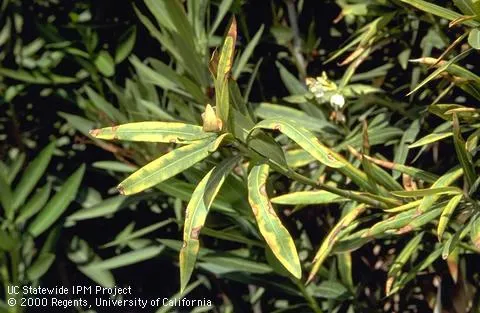
Right now, oleander leaf scorch is mostly found in southern California. While the disease has not been recorded north of Santa Barbara County, it is thought that this disease could spread through the Central Valley and along the coast where the glassy-winged sharpshooter is established.
GWSS Greatly Magnifies the Threat of Pierce’s Disease of Grapevines
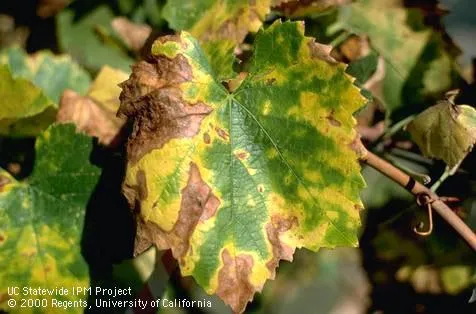
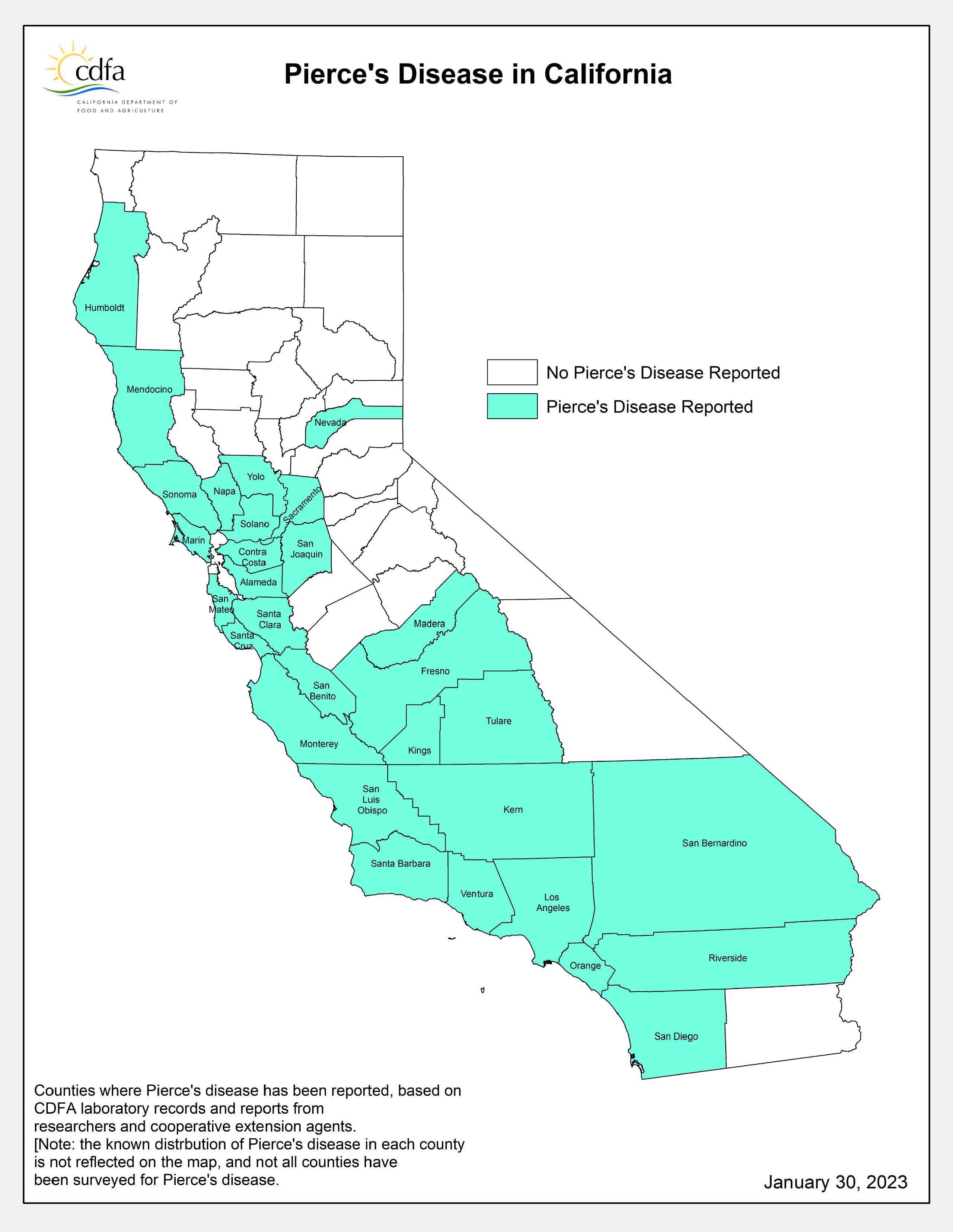
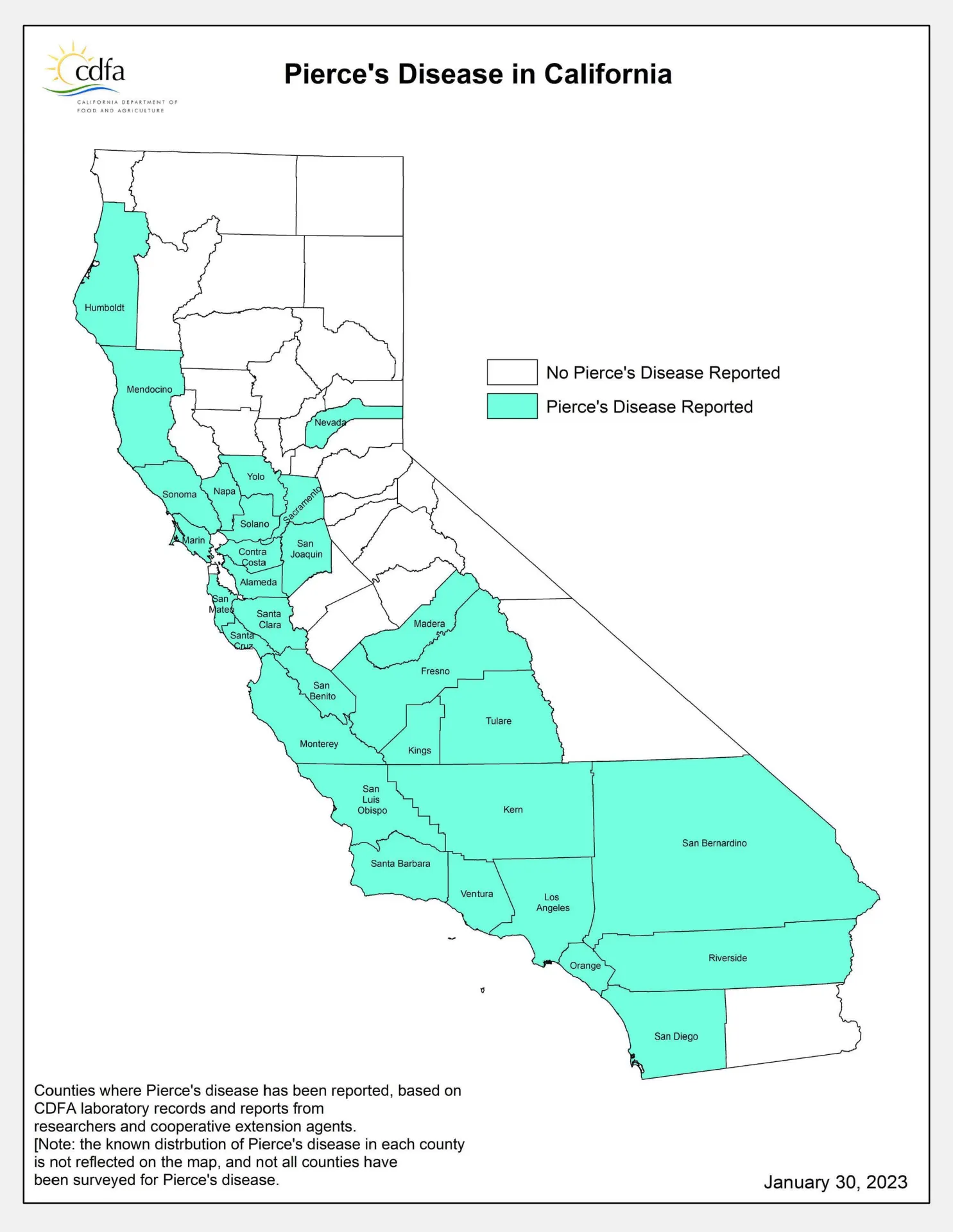
Pierce’s Disease has been present in California since 1884 and has caused sizable losses in the past, but usually the damage was not enough to prevent grape production in the affected areas. However, things changed dramatically with the arrival of the Glassy Winged Sharpshooter in the 1990’s. The combination of the disease and GWSS acting as a more effective vector, spreading the disease, has escalated the severity of risk to grape production. For instance, in 1999, over 300 acres of grapevines infested with GWSS were decimated by Pierce’s Disease. Currently Pierce’s Disease is established in 28 counties, mostly in Southern California and the San Joaquin Valley. It is spread by the GWSS which is currently primarily established in Southern California.
Current Distribution of Pierce’s Disease of Grapevines
Pierce's disease is of most concern in California since the state accounts for about 94% of U.S. grape production. As the map below shows, Pierce's Disease of grape has been reported in many counties throughout California, including Alameda County.

Managing of the Threat of the Combination of Pierce’s Disease and GWSS
The glassy-winged sharpshooter has a much greater potential of spreading Pierce’s Disease than other insects because, comparatively, GWSS flies greater distances and it can live and reproduce on a wider range of host plants in a variety of different habitats. Control of the spread of glassy-winged sharpshooter is currently the primary means of management of Pierce’s Disease, especially in Northern California.
Current GWSS Eradication Efforts in Northern California
California Department of Food and Agriculture (CDFA) and county agricultural officials are working to find and eradicate new GWSS infestations outside of generally infested areas. There are currently GWSS eradication efforts in five counties: El Dorado, Sacramento, Santa Clara, Shasta, Solano, Stanislaus.
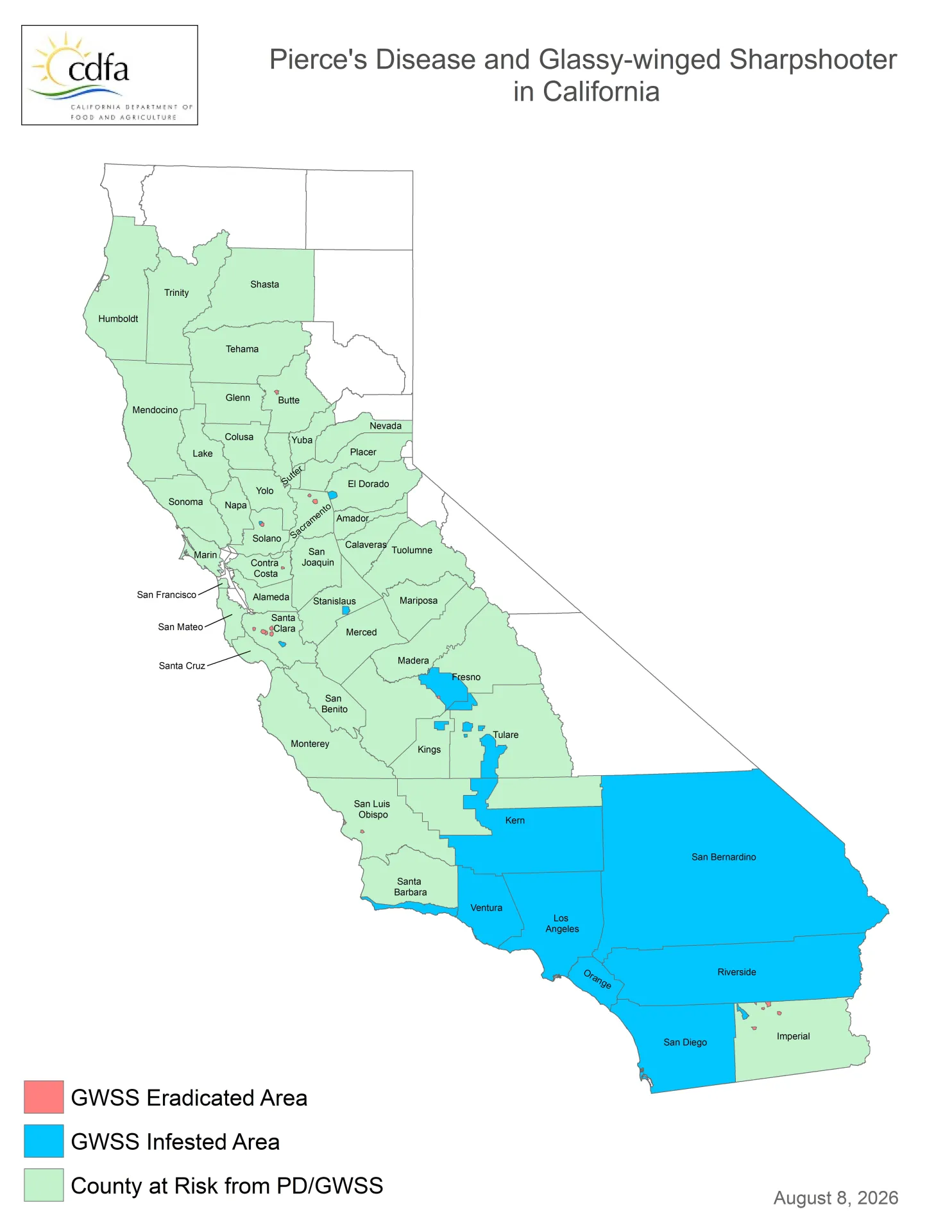
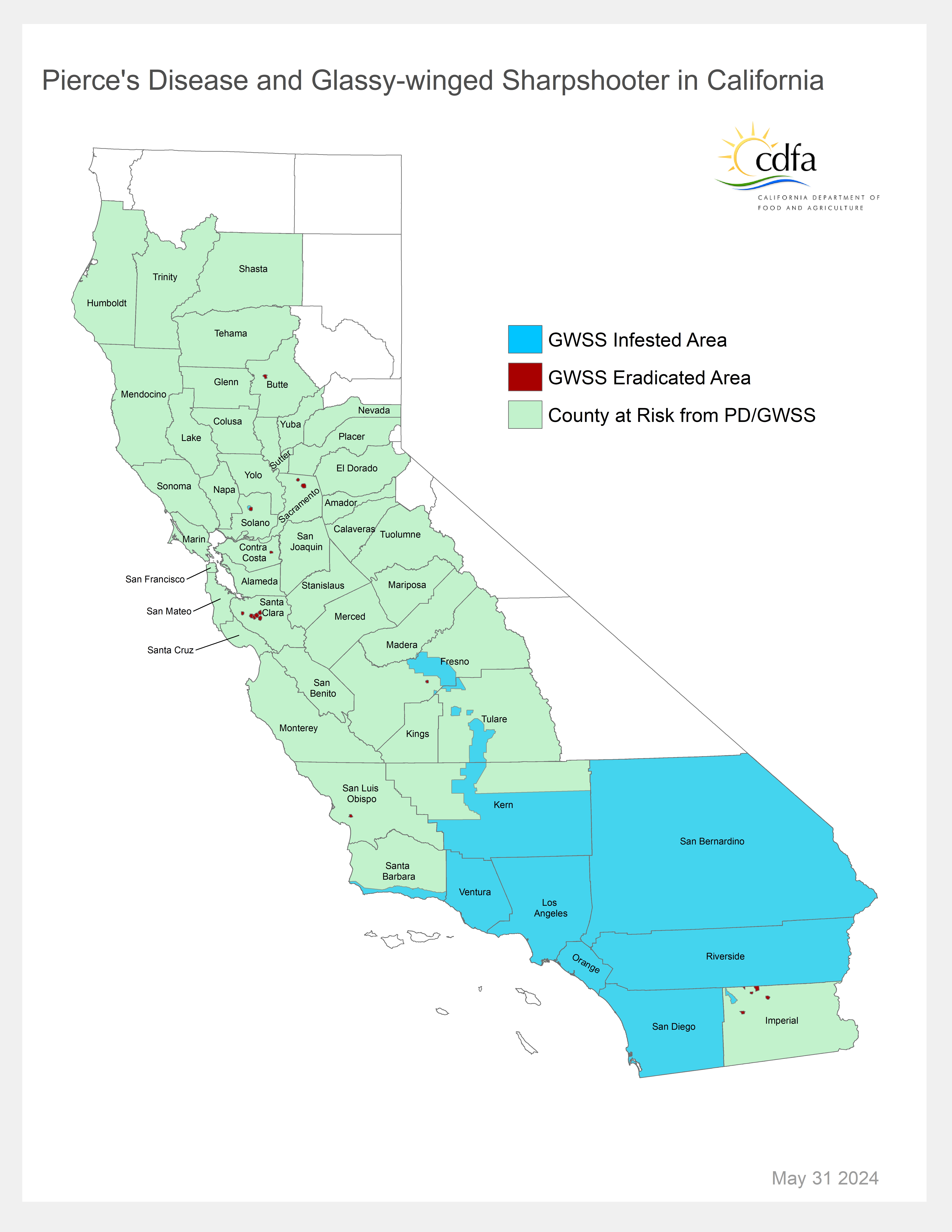
The blue area of the map shows the counties that have both GWSS and Pierce’s Disease, a situation that CDFA is trying to prevent from spreading further north in California.
The green areas of the map show counties that have reports of GWSS but no established populations of GWSS; they are at risk from Pierce’s Disease and GWSS. If you look closely at the map, you will see that Solano, Santa Clara, Stanislaus and El Dorado counties have areas that are currently infested with GWSS and the counties are working to eradicate the pest with oversight from the GWSS Control Project.
The tiny dark red dots on the map indicate areas of eradication of GWSS. Eradication areas include ones in the counties of Santa Clara, Contra Costa, Solano and Sacramento. Infestations are declared eradicated when there have been no GWSS finds in the area for about two years since the last treatment.
The CDFA is working to control the spread of GWSS to reduce the number of areas that have both GWSS and Pierce’s Disease, and thereby reducing the threat of this disease to grapevines, almonds, oleander, and other crop and ornamental plants.
Important alert from California Department of Food and Agriculture
Purchased a Grapevine or Desert Willow at Costco?
Important GWSS Information …Last updated: July 7, 2026
EXTERNAL IMAGE
EXTERNAL IMAGE
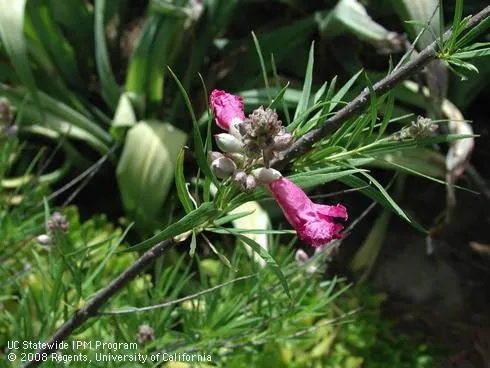
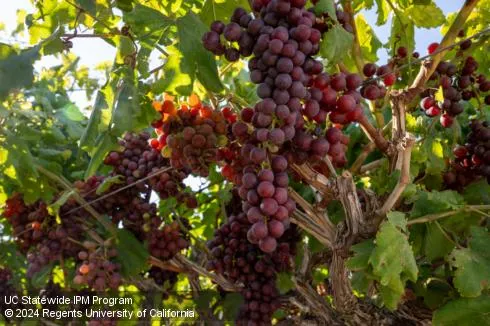
The California Department of Food and Agriculture (CDFA) is responding after invasive glassy-winged sharpshooter (GWSS) insects were found on grapevines sold at select Costco locations in Northern California between April 21 and May 19, 2026 and desert willows sold at Costco locations between June 24 and July 3, 2026. (Costco is not at fault and is cooperating with the CDFA response.)
Anyone who purchased grape plants or desert willow from Costco stores is asked to help prevent further spread of the pest by contacting their local county agricultural commissioner’s office.
Alameda County residents who purchased grapevines or desert willow plants at Costco should:
- Keep the plant in its original pot or container and away from other plants.
- Place two garbage bags over the plant and secure them tightly.
- Do not attempt to return, transport or relocate the plant.
- Do not place the plant in the trash or compost bin.
- Contact the Alameda County Department of Agriculture at 510-670-5232 or email alameda.ag@acgov.org to schedule an inspection.
Early detection critical to prevent spread of GWSS and associated diseases
Early detections and collaboration with local and state agricultural officials is critical to prevent the pest GWSS from spreading further.
EXTERNAL IMAGE
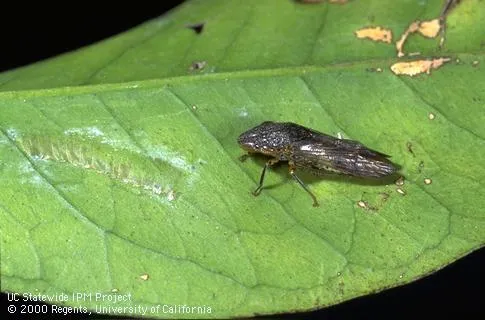
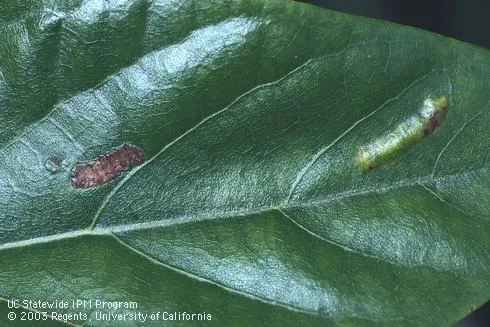
Glassy-winged sharpshooter adults are ½ inch long and dark brown to black when seen from the top or side. The head is blackish covered with yellowish or ivory spots. The wings are clear with red venation, a pattern of veins; the red color fades with age. Eggs are laid in small clusters just under the skin (epidermis) on the underside of young, fully-developed plant leaves , resembling a greenish blister. Once the eggs hatch, the surrounding leaf tissue turns brown and remains as a scar on the leaf.
EXTERNAL IMAGE
Here are some resources for identification of the GWSS from CDFA:
- GWSS Spread Incident flyer - English - Español
- General GWSS flyer - English - Español
- General GWSS landscapers flyer - English - Español
- GWSS brochure - English - Español (2018)
- GWSS pocket identification card
- Glassy-winged Sharpshooter photos CDFA
How to Inspect Plants for GWSS
Many hosts in addition to grapevines and oleanders
The glassy-winged sharpshooter feeds on many woody plants as well as annual and perennial herbaceous plants. A host plant is a plant that supports the feeding and reproduction of an organism. Citrus is a favored host of GWSS.
- Fruits and Crops: grape, citrus, stone fruit, almond, avocado
- Landscape plants: oleander, crepe myrtle, privet, acacia, eucalyptus, heavenly bamboo, photinia, pittosporum, hibiscus, some roses, and more
- Shade trees: oak, elm, maple, sycamore and more
- See more GWSS host plants: bit.ly/GWSS-Hosts.
Look at new growth
Inspect plants for this pest, especially 6 inches to a foot from the tips of new shoots or growth. GWSS blends well with twigs and branches, moving to the other side of the branch or twigs when disturbed.
Look for evidence of feeding by sharpshooters
EXTERNAL IMAGE
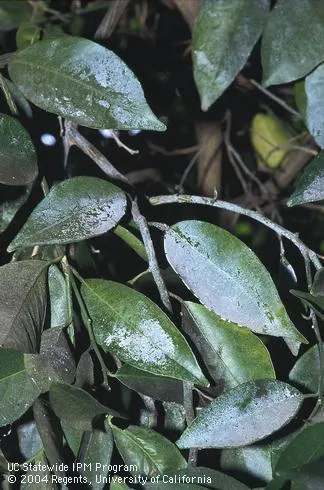
The insect feeds on the fluids in xylem, which are like tiny water pipes inside a plant. To get enough nutrients, the insect must consume tremendous amounts of fluid. Therefore, the adults and immatures excrete large amounts of liquid waste, which can coat fruits and foliage, giving them a whitewashed look. Small droplets of liquid falling from taller hosts like trees or grape arbors may be a clue that sharpshooters are present overhead. Usually feeding by GWSS is more cosmetic than damaging if the insect is not transmitting a disease.
Help your local county agriculture department
EXTERNAL IMAGE
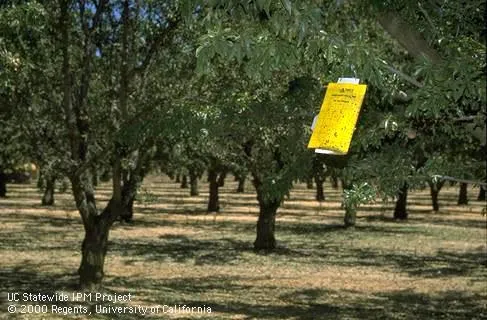
- Yellow sticky cards are used as a monitoring method by government agencies, like the Alameda County Department of Agriculture, to track glassy-winged sharpshooter populations. If asked, allow the Agriculture Department to place the yellow sticky card on your property.
- If you suspect you have GWSS on your plant, contact the Alameda County Department of Agriculture at 510-670-5232 or email alameda.ag@acgov.org to schedule an inspection.
- If GWSS is found, then CDFA through the Pierce’s Disease Control Program works with county agricultural officials to eradicate new GWSS infestations.
Help Protect California and Its Crops and Ornamentals
The glassy-winged sharpshooter is around, lurking in plants transported from other areas infected with the GWSS. Help prevent the pest from permanently settling in and transmitting disease. You can help by reporting possible infected plants or sightings to the Alameda County Department of Agriculture at 510-670-5232 or email alameda.ag@acgov.org.
To learn more about this pest and the diseases it transmits, visit Pest Notes: Glassy-winged Sharpshooter.
References:
Alameda County Agriculture Department Information on GWSS
https://www.acgov.org/cda/awm/documents/AlamedaCountyGWSSPressRelease52726.pdf
https://www.acgov.org/cda/awm/agprograms/pestexclusion/sharpshooter.htm
Glassy-Winged Sharpshooter and Citrus Glassy-Winged Sharpshooter / Citrus / Agriculture
Identifying photos of the sharpshooters and labs identifying Pierce’s Disease Pierce’s Disease in the San Joaquin Valley
Photos and Description of watery waste The glassy-winged sharpshooter lands in Marin | UC Marin Master Gardeners
Natural enemies of glassy-winged sharpshooter Glassy-winged sharpshooter Cosmocomoidea parasitoids
Pierce’s Disease Identification in Tulare County Vineyards (photos) 2011 https://ucanr.edu/sites/default/files/2011-03/82048.pdf
Pierce’s Disease fact sheet by CDFA https://www.cdfa.ca.gov/pdcp/Documents/PD.pdf
Research summary on glassy-winged sharpshooter https://entomology.ucr.edu/glassy-winged-sharpshooter-homalodisca-vitripennis
The GWSS - A serious new PD vector for California Vineyards by Phil A. Phillips (Archived content) https://ucanr.edu/county/cooperative-extension-ventura-county/gwss-serious-new-pd-vector-california-vineyards
Want to learn more?
This blog post is brought to you by the Help Desk of the UC Master Gardeners of Alameda County. Subscribe to our blog!
Have a Gardening Question? We'll Help.
Visit our Help Desk page to submit your question and see additional ways you can reach us.