
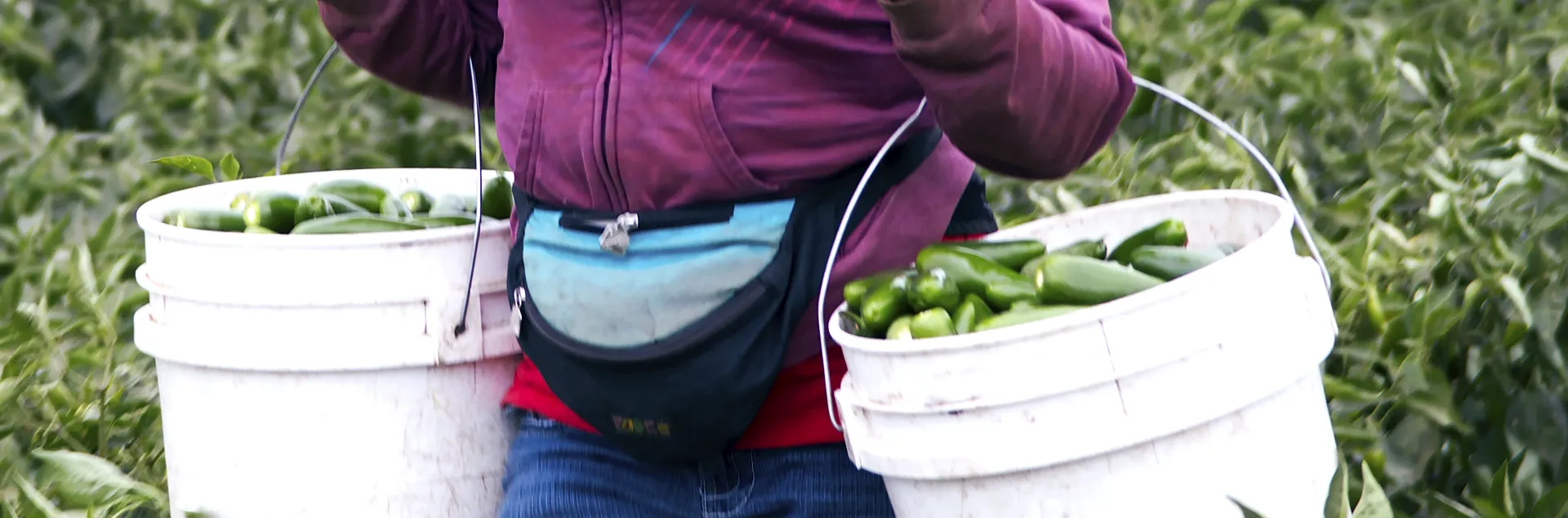

A recent study suggests that nearly three-in-four Indigenous migrant farmworker communities in California’s Central Valley experience food insecurity, and more than one-in-three live in inadequate housing. Migrant farmworkers are the critical workforce for the California farm industry, which is the backbone of the American food system, responsible for producing over one-third of all vegetables and more than three-quarters of the fruits and nuts grown in the United States. Yet, the very people ensuring the nation's food security are often unable to secure it for their own families.
Between July 2022 and March 2023, University of California researchers collaborated with community researchers to survey 40 Triqui-speaking Oaxacan Indigenous migrant farmworker households using the Self-Reliance Index—a measurement of refugee household progress towards self-reliance in meeting their basic needs. The results showed systemic vulnerability:
- Food insecurity and deprivation: 48% reported being able to eat only one full meal and 25% reported being able to eat, but only a partial meal. Some families reported surviving on diets as limited as herbs on tortillas with salt.
- Housing instability: 35% reported living in inadequate housing. Families described overcrowded living conditions, rising rents, and broken heating and cooling systems in areas where temperatures are above 90 degrees in the summer and below 40 degrees in the winter.
- Employment instability: 73% reported only temporary or seasonal employment. Additionally, women farmworkers experienced limited or inability to work due to lack of accessible childcare.
Published in the Journal of Immigrant and Minority Health, researchers emphasized the need for policies and programs such as immigration reform, Medicaid expansion and enforcement of labor laws to support the wellbeing of migrant workers.
This research was a collaborative effort by Hannah Thompson and KC Fiedler from the Nutrition Policy Institute, Graciela Chong from the University of California, Berkeley Goldman School of Public Policy, Armando Celestino Venture from Frente Indígena de Organizaciones Binacionales California (FIOB), and Seth M. Holmes from the UC Berkeley Rausser College of Natural Resources, ICREA, and University of Barcelona. The study was supported by NSF Grant (2121144) “Essential Workers in the US Food System” as well as ERC Grant (101045424) FOODCIRCUITS and MCIN/AEI Grant (CNS2023-144290) AgriHeat.
A Spanish-language article by UC ANR News and Outreach in Spanish describing these findings is also available, Trabajadores agrícolas que alimentan al país enfrentan inseguridad alimentaria.