
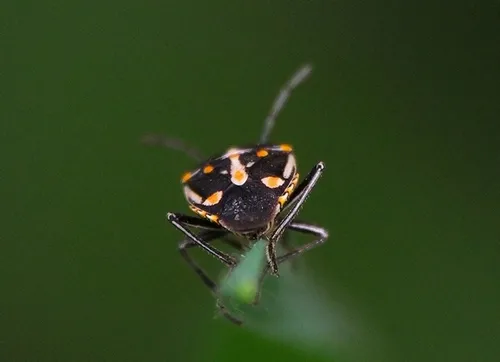
Bagrada bug adults on grass (Photos by Bryan Jones, San Francisco)
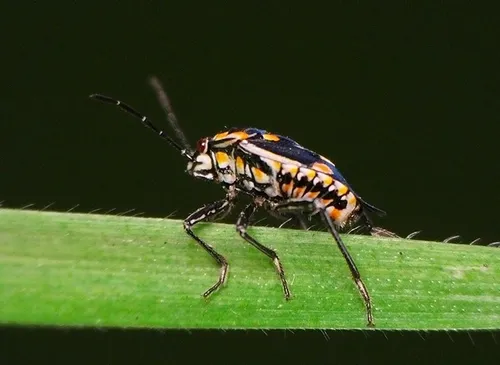
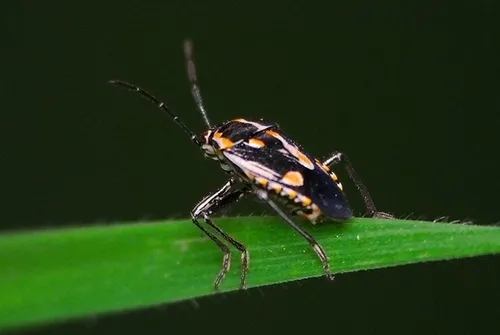
Invasive Bagrada bug continues to spread to various counties in California. Compared to previous years, reports of Bagrada bug infestations came in quite late in 2013. They also seemed to survive cold winters. How they survive cold temperatures when there are no cultivated or weed hosts is not clear, but they can hide under vegetation, in the crop debris, or the top layer of soil.
Bryan Jones of San Francisco just reported seeing a Bagrada bug on his backyard grass. This is probably the first report of its spread to San Francisco. It was also reported from Fresno, Monterey, San Benito, and San Bernardino Counties, suspected to be present in Santa Cruz County in 2013, and appears to be in Kern County for a couple of years or more. Out side California, it is present in La Paz, Maricopa, Pinal, and Yuma Counties in Arizona, Luna, Santa Fe, Socorro, and Valencia Counties in New Mexico, and some parts of Utah and Texas. Unlike other invasive pests such as the brown marmorated stink bug or the Asian citrus psyllid which moved to the west coast from eastern parts of the US, Bagrada bug is moving to the east.
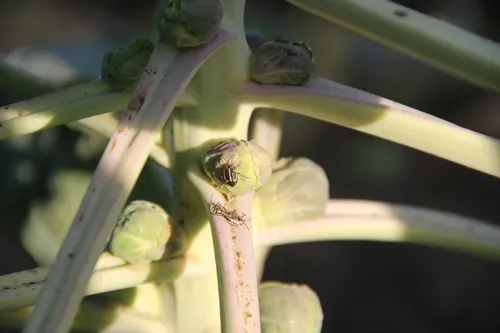
Bagrada bugs on Brussels sprouts (above) and radish in Bakersfield (Photo by Surendra Dara)
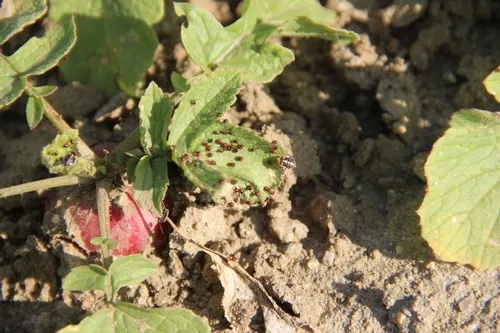
Regular monitoring, timely treatments during the early stages of plant development, crop rotation with non-host plants are some of the available management options. Using sweet alyssum or other hosts as trap crops does not seem to be an effective strategy accordingly to some research.
Bagrada bug Pest Alert can be downloaded from: http://www.ipm.ucdavis.edu/PDF/pestalert/bagradabug.pdf