
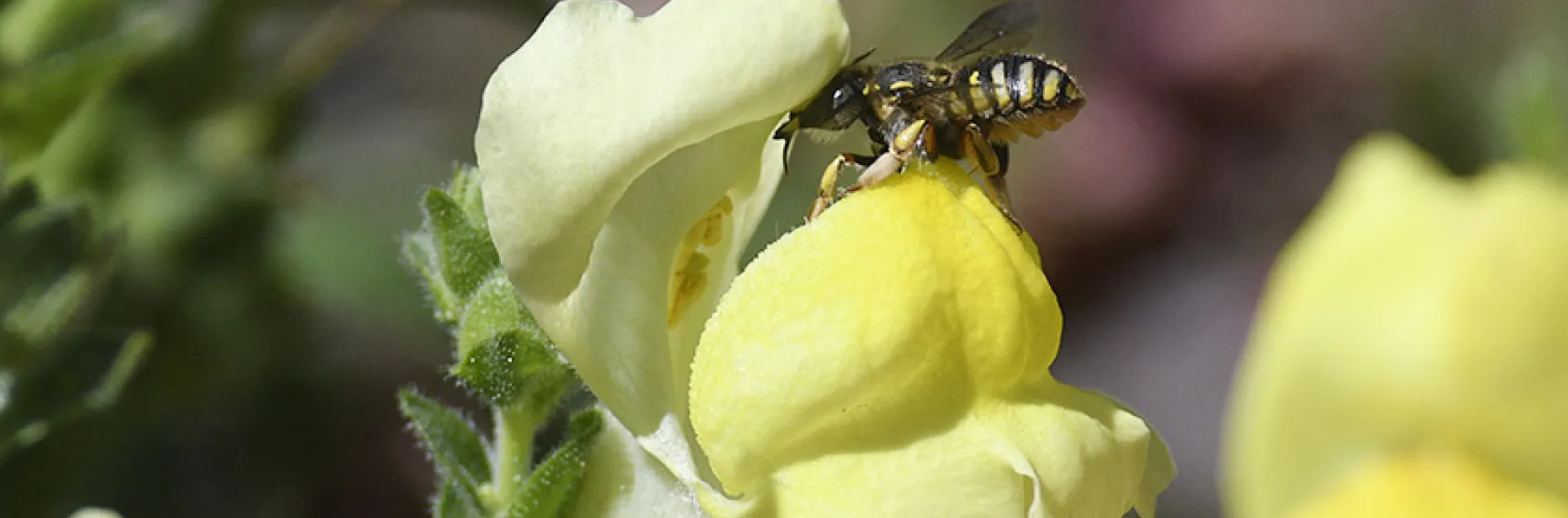

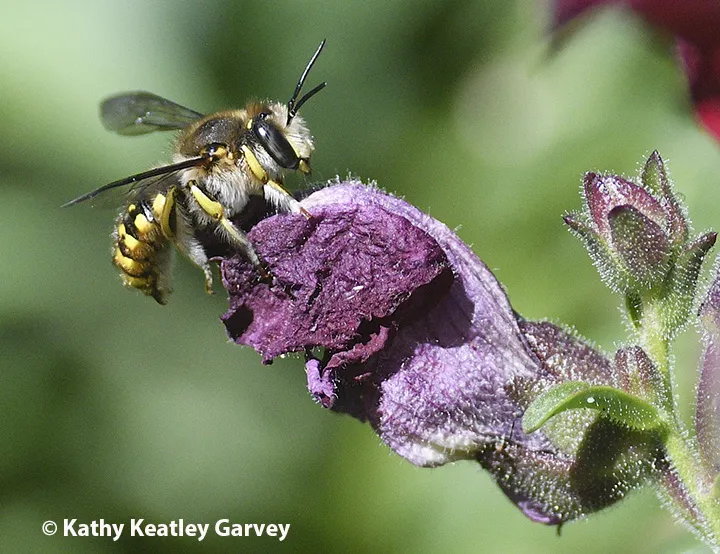
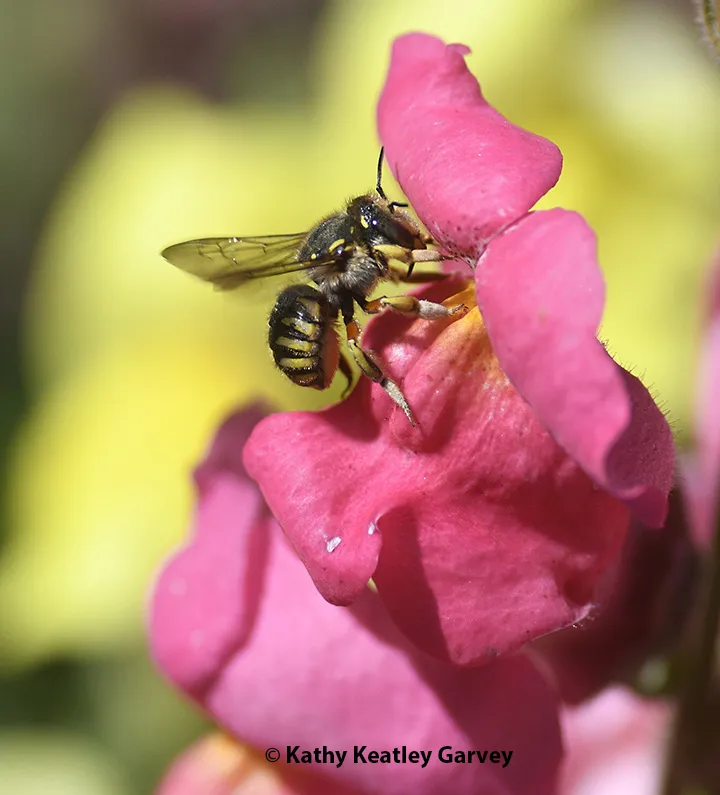
If you want to draw European wool carder bees to your garden, plant snapdragons.
The males of this species are known as "the bullies of the garden" or "bopper bees" because they are quite territorial; they target or body-slam any and everything that's occupying "their" blossoms. (The late UC Davis Distinguished Emeritus Professor Robbin Thorp used to say that they're trying to save the nectar for the females of their species so they can mate with them.)
It's a challenge to photograph these speedsters because they move fast and they zigzag.
European wool carder bees (Anthidium manicatum, family Megachile), are so named because the female collects or "cards" hairs on such plants as lamb's ear (Stachys byzantine, mint family Lamiaceae) for their nests.
These bees, about the size of honey bees, are black and yellow, black with yellow abdominal bands. The females range in body length from 11 to 12 millimeters, while the males are 14 to 18 mm.
They are native to Europe. Their "immigrant ancestor" was first detected in the United States (New York) in 1963, and the species then began spreading west. The bees were first recorded in California (Sunnyvale) in 2007.
The species, according to research entomologist Tom Zavortink of the Bohart Museum of Entomology at UC Davis, was accidentally introduced into New York state. They were not purposefully introduced to pollinate alfalfa, as some reports allege, he said.
Writing in a 2008 edition of the Pan-Pacific Entomologist, Zavortink and fellow entomologist Sandra Shanks, now of Washington state, pointed out that several papers “have documented its spread from neighboring areas in the northeastern United States and southern Canada” and that the species has since crossed the country. It was confirmed in Colorado in 2005, Missouri in 2006, and Maine, Michigan, Maryland and California (Sunnyvale) in 2007, the entomologists wrote. Records show it was first collected in Davis on July 26, 2007.
The European wool carder bees were well established in the Central Valley by 2008. We first encountered them in Vacaville, Solano County, in the spring of 2010. Their plant preferences include lamb's ear, grown for its fuzzy, silvery gray-green foliage. It's also been collected in the figwort/snapdragon family (Scrophulariacae) and the pea and bean family (Fabaceae), according to the Zavortink-Shanks research.
The snapdragon, genus Atirrhinum, is so named because it resembles the face of a dragon. And when there's bully on the "dragon"...
Oh, snap!
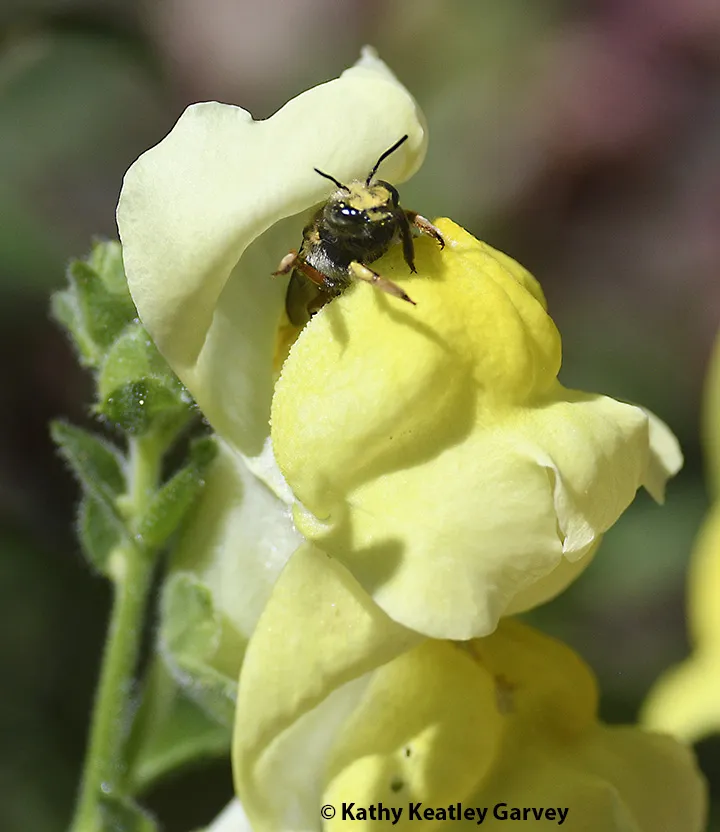
Cover image: European wool carder bee about to enter the "pocket" of a snapdragon. (Photo by Kathy Keatley Garvey)