

I suddenly had an urge to taste a lost flavor from my early life, namely broad beans. For some reason, I have never seen or eaten one since coming to this country more than 40 years ago, and it was time to investigate the reason and rectify the problem.
Overview
The seeds of these plants are eaten extensively in many countries, from Egypt to China and Indonesia, yet I had to search through several catalogs before I found seeds for sale in this country. Here, they are apparently grown mainly as a green manure to be dug into the soil in spring or, if grown for food, are mainly used as dry beans. What a waste!
Broad beans (Vicia faba, formerly Faba vulgaris), also known as fava beans, bell beans, or horse beans, are a giant vetch in the Fabaceae family. They are fairly hardy and need cool conditions because they cannot tolerate heat. They need regular soil and moisture and a fairly sunny spot, with some afternoon shade in hotter climates. Like most legumes, they produce nitrogen-fixing nodules on their roots. They do not produce tendrils, so they need support.
UC Small Farms program has a brief overview on raising them available online that may be of interest.
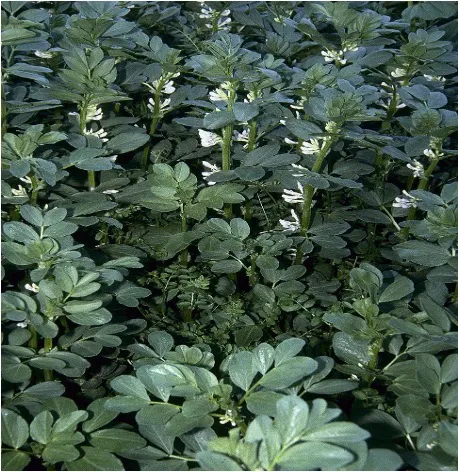
My Experience
I planted 16 seeds of Broad Windsor at the end of August last year—two rows 16 inches apart, with seeds 1 inch deep and 4 inches apart, although I eventually thinned them to 8 inches apart. I had a 100% germination rate.
Each plant grew several strong stems from the base. I put a 5-foot stake at the end of each row, then strung twine 8 inches and 2 feet off the ground around the outside of the bed to support them through the winter.
They continued to grow quite fast, and in spite of being battered by heavy rain and even some snow in November, by January they had reached about 3 feet. At this time, I covered them with frost cloth, which proved difficult because they had outgrown my hoops for supporting the cloth above them.
The snowfall in the middle of February beat them down, but nearly all the stems recovered, and they were in flower by the end of the month. The short racemes of white flowers, with purplish-black spots on the two side petals, made a very welcome sight.
Sadly, no flowers set fruit at this time, I suspect because of the lack of pollinating insects so early in the year. The first flowers set fruit in the middle of March, and after that the plants produced a good crop of 8-inch-long, fur-lined pods with delicious beans embedded in them. Unlike French beans, the pods are easy to see and harvest, and after harvesting I still had a lot of green manure to use!
Uses
When young, the pods can be eaten whole—raw, sautéed, or puréed. As the pods enlarge, they can be shelled and the seeds steamed or boiled, often accompanied by a basic white sauce. There are many recipes online available.
The seeds are covered with a thickish skin, and many recipes from this country suggest removing it. However, in the UK we never subjected ourselves to such a tedious business, and to me, it was just part of the bean to be eaten.
When mature, the beans can be dried and ground to make falafel, tofu, miso, nut milk, or flour.
Fresh beans can be blanched and frozen for later use.
In China, broad beans are fermented to make sauces, and they are a main ingredient in Sichuan chili bean sauce.
Results
I was pleased with my first attempt at growing these in Bishop, but I wonder if they might have done better if sown in early spring, when the crop would take much less time to come to maturity—potentially as little as 80 days, according to some sources.
I had no insect or disease problems, although in the UK the growing tips would get severe infestations of blackfly toward the end of the season. We controlled these by cutting off the new growth.
Warning ⚠️
Some people have a genetic condition in which they lack an enzyme that normally protects red blood cells. Eating fava or broad beans can make affected individuals extremely ill, and in some cases exposure to the plant's pollen can also cause a reaction. This condition is commonly associated with glucose-6-phosphate dehydrogenase (G6PD) deficiency, and the reaction to fava beans is known as favism.
People who know they have this condition, or who have relatives who do, should avoid fava beans and any products made from them. If you have concerns, discuss favism with your physician.