
By Anila Lijo
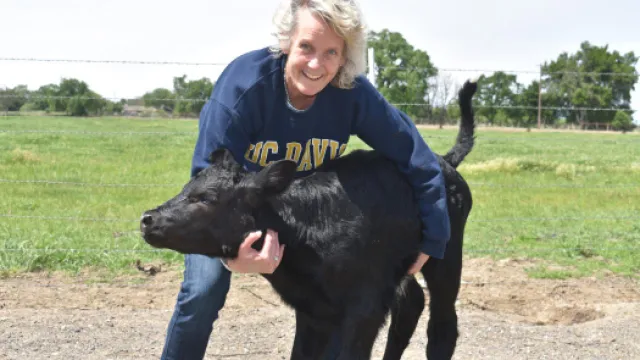
Alison Van Eenennaam first arrived at UC Davis from Australia in the 1980s as an exchange student studying agricultural science.
What began as a single year abroad became the foundation of a remarkable career spanning genetics, biotechnology, extension education, public advocacy, and scientific innovation.
As an undergraduate exchange student from the University of Melbourne, she landed an internship in the lab of a young assistant professor, Juan Medrano, who encouraged her to pursue graduate school.
“I was like, ‘No, no. I’m sick of school. I want to get a real job,’” she recalled.
But after briefly returning to Australia, she took a leap of faith and returned to UC Davis in 1989 for a master’s degree studying milk protein polymorphisms in California dairy cattle.
That decision changed everything.
Over the next several decades, her career followed a winding and unconventional path. She worked as a UC Cooperative Extension dairy and livestock advisor in the San Joaquin Valley, returned to UC Davis for a Ph.D. studying sex determination in sturgeon, and later joined Calgene — the pioneering Davis biotechnology company behind the Flavr Savr tomato.
At Calgene, she witnessed the birth of commercial genetic engineering firsthand.
In 2002, she returned to UC Davis as a Cooperative Extension specialist in animal biotechnology and genomics –— beginning her faculty career at age 39.
“It’s not a particularly normal time to start an academic career,” she said. “Most people that age are already associate professors.”
When funding restrictions halted research involving genetically engineered animals, she pivoted toward genomic testing and livestock improvement, helping producers understand emerging DNA technologies and bringing practical science directly to agriculture.
Van Eenennaam worked with ranchers to modify cattle genetics to improve the quality of the beef. In 2009, UC Cooperative Extension livestock advisor Dan Drake introduced her to Siskiyou County cattleman Jack Cowley.
“We're now up to where all of our animals are graded anywhere from 20% to 40% Prime and the rest Choice,” said Cowley in a 2023 interview.
Later, genome editing technologies such as CRISPR allowed her to return to the kind of molecular biology research she had originally trained to do.
But one moment stood above the rest.
After several years of failed experiments, her team finally achieved a successful pregnancy from a gene-edited bovine embryo. The calf, named Cosmo, was born during the height of the COVID-19 pandemic in April 2020, when shortages of veterinary drugs complicated the delivery.
“And then he plopped out,” Van Eenennaam recalled. The calf wasn’t breathing.
As she told the story, she became emotional and paused, wiping away tears.
“And then he took that first breath,” she said quietly. “I reckon that was my favorite scientific moment.”
Soon after, her graduate student confirmed the breakthrough following DNA testing.
“He rang me and said, ‘I’m happy to report that we have the first ever knock-in bovine embryo-edited bull calf.’”
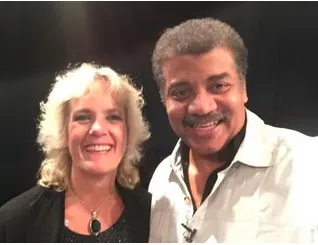
Beyond the lab, she became a passionate advocate for science communication, publicly defending agricultural biotechnology through debates such as Intelligence Squared U.S., television appearances, and over 850 invited presentations to global audiences. She appeared in the documentary Food Evolution, narrated by astrophysicist Neil deGrasse Tyson, which explored the science and controversy surrounding GMOs and food production.
“If we’re not communicating our science out to the public, we haven’t really finished the job,” Van Eenennaam said.
Now entering retirement, she plans to continue traveling, speaking internationally and advocating for innovation in agriculture.
And through it all, she says, “I am 100% a product and the beneficiary of UC Davis education.”
Van Eenennaam would like to stay involved in research and has applied for emeritus status from UC Davis.
This article was originally published at https://www.ucdavis.edu/news/uc-davis-retirees-reflect-careers-service-and-impact