
Sarah Marsh Janish

My name is Sarah Marsh Janish, and I am excited to serve as the Rice Farming Systems Advisor for Colusa and Yolo counties. I am based out of Colusa at the Colusa UCCE office. I grew up on a diversified row-crop and orchard farm in Arbuckle and am grateful for the opportunity to serve the community in which I was raised. After completing my undergraduate degree in Plant and Environmental Soil Science at Texas A&M University, I obtained a M.S. in Horticulture and Agronomy at UC Davis, where I worked with Dr. Kassim Al-Khatib in studying weeds and herbicide resistance in rice agroecosystems. I have since worked in rice breeding research and integrative pest management in several row crops in the Upper Gulf Coast region. I am so thrilled to have the opportunity to learn from all of you, and I am excited to partner with the community to craft a research program that can deliver relevant results. I encourage you to reach out with ideas, requests, or questions relating to rice farming as I develop priorities to pursue in this position.
Please feel free to drop by the Colusa UCCE office or give me a call . I can be reached via email at smarsh@ucanr.edu or telephone at (530) 987-7501.
B.S. Plant and Environmental Soil Science, Texas A&M University. 2020

Be Wary of Relying on Chat GPT for Agricultural Questions
Globally, approximately 570 million small and medium-sized farms need training in various agricultural fields. However, the delivery of agriculture training faces significant challenges. In some areas, the difficulty in obtaining this training has led to people turning to generative artificial intelligence (AI) models such as ChatGPT to ask questions relating to their agricultural production.
The way that ChatGPT and other models work is that the models are trained on vast amounts of data to learn patterns and relationships between words. This enables the models both to understand language in nuanced ways and to generate answers to a wide range of prompts, which means that ChatGPT can become adapted to specific uses and theoretically provide a comprehensive answer to any question. Researchers supported by the CGIAR's Excellence in Agronomy Initiative and the Digital Innovation Initiative studied the accuracy of Chat GPT-provided information and professional advice in response to queries from African farmers. Tzachor et al (2023) found significant inaccuracies that could potentially lead to poor management and crop losses. The problems with the answers ranged from vagueness to inaccuracy.
I became curious as to how accurate ChatGPT was with regards to questions relating to California rice and so conducted an informal test of my own. I asked ChatGPT questions relating to California water-seeded rice management to see how accurate the model was.
When queried about the insecticides that are registered for use in California water-seeded rice to control armyworms, ChatGPT responded with 6 insecticides – only one of which (lambda-cy) is used in CA rice systems. The remaining insecticides “recommended” were not used in California, not used for armyworms, or no longer commercially available.
I also asked ChatGPT “How to manage weedy rice in California water-seeded rice fields.” The model returned several paragraphs, with one problematic paragraph reproduced below:
Apply herbicides labeled for controlling weedy rice in water-seeded rice fields. Herbicide options may include products containing penoxsulam, propanil, or other active ingredients specifically targeting weedy rice. It's crucial to follow label instructions carefully and use herbicides at the appropriate timing and application rates to maximize effectiveness and minimize off-target effects.
As evidenced by these examples, ChatGPT is responding with answers that are not accurate and should not be taken as recommendations.
Zembu™: A New Residual Herbicide for Early-Season Weed Control in Water-Seeded Rice
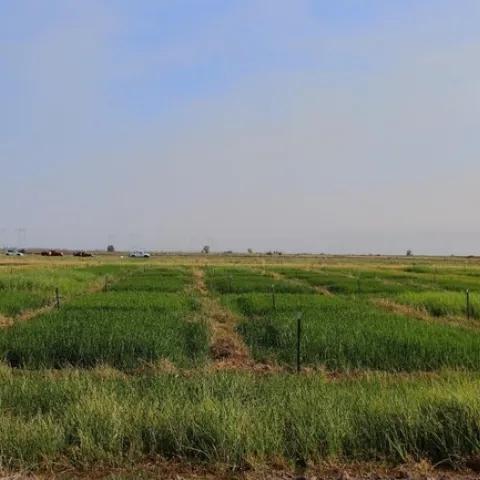
A new herbicide for early-season weed control in water-seeded rice will be available soon. The herbicide active ingredient (a.i.) is pyraclonil, which will be trademarked as Zembu™ (1.8% a.i.) by Nichino, America Inc. The mode of action is a protox porphyrinogen (PPO)-inhibitor or Group 14. This herbicide is formulated as a granule and will be used as a residual preemergence for application on the day of seeding onto flooded fields. The use rate is 14.9 lbs ac-1 applied by air. While this herbicide is not a new mode of action for water-seeded rice, it is a new mode of action for early-season residual weed control. Pyraclonil is widely used for weed control in paddy fields worldwide and is the most commonly utilized herbicide in Japan [1]; however, Zembu™ will be the debut of pyraclonil to the U.S. rice market [2].
In order to evaluate Zembu's strengths and weaknesses, UC researchers, in collaboration with Nichino, America, has conducted extensive research on Zembu since 2015 and developed foundational information for the use of Zembu in California water-seeded rice. In this post we highlight two studies which demonstrate Zembu's use and how it can be incorporated in an herbicide program for season-long weed control.
Zembu Timing
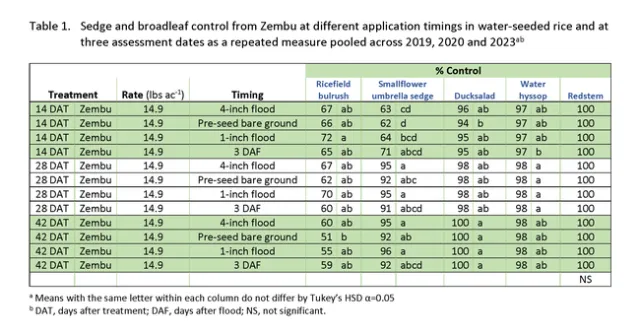
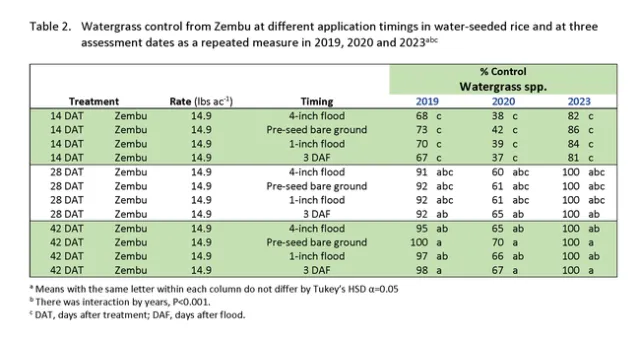
In the study conducted at the Rice Experiment Station in Biggs, CA in 2019, 2020 and 2023, Zembu application timings were evaluated. The pre-seed bare ground was the first Zembu application at 3 days before flooding the field and seeding rice, then the application at 1-inch flood, then the application at 4-inch flood, followed by the application 3 days after flooding (DAF). The rice was seeded after the 1-inch flood and before the 4-inch flood. 'M-209' rice was seeded in 2019 and 2020 at 120 lbs ac-1 and 'M-209' was seeded in 2023 at 150 lbs ac-1. The objective of studying the different application timings was to determine if the application timing will affect weed control and rice response.
Cross species weed control was not affected by the different application timings of Zembu (Table 1). Zembu does not have great activity on ricefield bulrush and changing the application timing did not improve its control, which reached only 60% by 42 days after treatment (DAT) (Table 1). Zembu provided excellent control of smallflower umbrella sedge and all present broadleaves, which included ducksalad, water hyssop and redstem (Table 1). Across years, there were differences in control levels for watergrass control; however, there were no observed differences in watergrass control across the application timings (Table 2). In 2020, where watergrass control levels were low, was a year when the whole field had an increased pressure of watergrass caused by late rains immediately before the field preparation and initial flood, which provided soil moisture to give the grasses a head start. In 2019 and 2023, all weeds and rice germinations were initiated at time of flooding and led to greater control of watergrass (Table 2). The Zembu label will note that watergrass is suppressed by the chemical, not controlled. When applicators use Zembu for herbicide control, the incorporation of other herbicides to control ricefield bulrush and watergrass populations will be important.
Zembu in Herbicide Programs
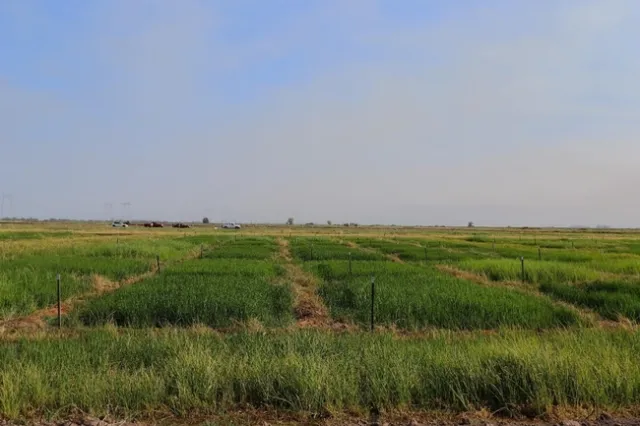
Zembu will need to be incorporated into herbicide programs for season-long control. In the study conducted in 2019 and 2021 at the Rice Experiment Station in Biggs, CA, herbicide programs that included Zembu were evaluated for weed control and rice response. ‘M-206' rice was seeded at 120 lbs ac-1 and 150 lbs ac-1 in 2019 and 2021, respectively. All Zembu applications were done at day of seeding (DOS) onto the 4-inch flood. All other herbicides were applied following their label (Table 3).
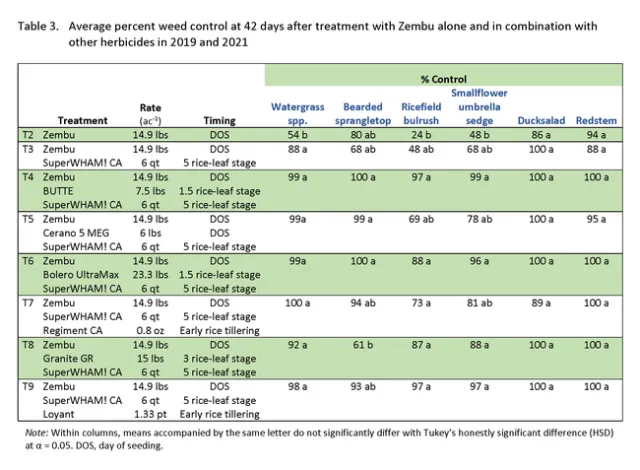
When accompanied and followed by other herbicides, Zembu is a great addition to achieve season-long weed control (Table 3). In this study, it is observed that Zembu alone did not control the watergrass and when followed by various other herbicides the control level was increased (Table 3). Similar with ricefield bulrush control, other herbicide combinations increased the control levels when compared to Zembu applied alone (Table 3).
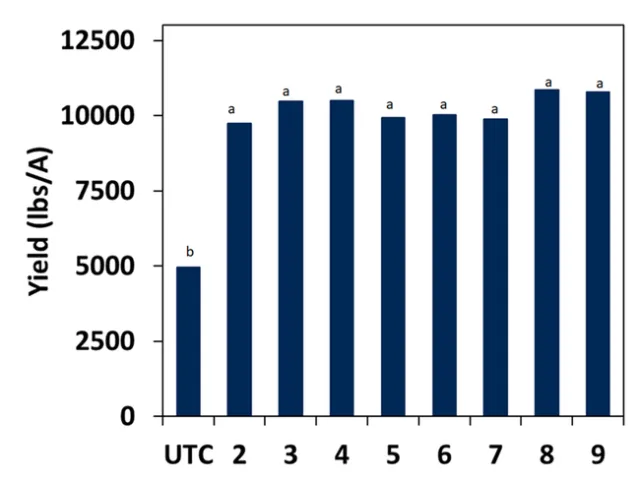
Rice response was minimal across treatments except with the Zembu and Bolero Ultramax combinations, which demonstrated greater visual injury early on. However, injury was overcome later in the season and rice grain yield did not differ across treatments (Figure 1).
Zembu will be a great addition to the herbicides available for early-season weed control in water-seeded rice.
References
[1]. Zhang YB (2014) Development and application of pyraclonil in paddy field. World Pestic 36(6):1-3
[2]. Anonymous (2023) Zembu™ Herbicide. Nichino America, Inc. Accessed on January 14, 2024 from https://nichino.net/products/zembu-herbicide/