
Succulents
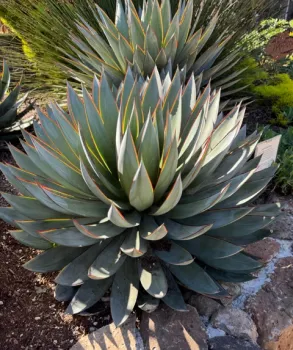
Succulents are one of the most ideal plants you can add to your Marin County garden. These resilient plants come in every shape and size as well as in a variety of textures and colors. Much appreciated by busy gardeners, succulents are drought-tolerant, don’t mind some neglect, and readily adapt to Marin County’s dry and Mediterranean climate.
For best results, select succulents that will thrive in the microclimate in your garden. Most prefer about six hours of full sun and warmth, but some prefer partial shade. Check out the requirements, expected size, and shape of your succulent choices so you know their preferred environment and how best to maintain them in a healthy state. Most remain compact and 2-4 feet tall while some grow to 5-7 feet.
Most succulents thrive in bright, indirect light or in a south-facing window if grown indoors. Move them outdoors once nighttime temperatures are consistently above 60oF; protect them from heavy rain. Transition succulents to the outdoors by placing them in a shady place for a few days and then slowly move them to a sunnier location. Avoid outdoor sites that receive intense, hot sunlight during midday. Move your succulents to another location if the leaves yellow or look droopy. Bring plants back indoors before fall chills set in.
Succulents store water in their thick fleshy leaves, stems, and roots, so they are able to survive equally well whether planted in the ground or in a container. Excellent drainage is essential. In Marin County, watering succulents once a week during the warmer months usually works well, i.e., water only when the top inch of soil feels dry to the touch; pour water directly into the soil, not on the leaves. Choose terra cotta pots with drainage holes, as terra cotta dries faster than plastic. Use a succulent and cactus potting mix that contains sand, perlite, or pumice to prevent soggy roots. Cut back on watering in winter when water needs are markedly reduced.
Repot only when your succulent outgrows its container. Most succulents have adapted to nutrient-poor soils, so a rule of thumb is to only feed with a fertilizer if your specific succulent type requires it. If your plant becomes leggy, prune it back to fresh growth in early spring.
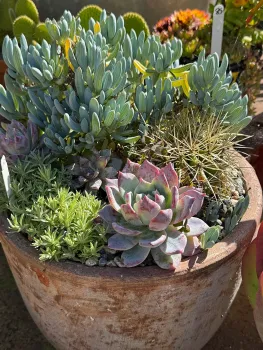
Aphids and mealybugs are their most common pests. Insecticidal soap works best as a defense against aphids. In more severe aphid infestations, a pyrethrin-based or neem oil insecticide is effective. Mealybugs are sometimes more difficult to manage; a Q-tip dipped in rubbing oil and swabbed across all visible insects kills them. Avoid overwatering to help prevent the onset of a fungal disease. Also, if plants are grown indoors, ensure good air circulation. Keep leaves clean by gently wiping away dust; remove damaged or dying leaves. Most diseases in succulents are caused by overwatering or incorrect sun exposure.
Many varieties of succulents can be propagated by stem or leaf cuttings and offsets. Offsets occur when root tissue forms leaf buds which sprout at the base of the mother plant. Once the offsets are big enough and have established roots, they can be separated and replanted in small separate containers. It takes at least a month for cuttings to develop sufficient root growth to be successfully repotted into more permanent settings. Leaf cuttings take longer to mature than stem cuttings.
Join us for the Succulent Sale! The Master Gardeners are hosting their annual succulent sale on Saturday, May 30, from 9 am to 12 pm at the Falkirk Cultural Center’s rear parking lot on Mission Street in San Rafael. There will be individual plants, potted arrangements, and bromeliads for sale. Experienced Master Gardeners will be on hand to answer your questions. For more information, see https://www.youtube.com/watch?v=GKZbJItCz0I.
Whether you are new to gardening or a pro, this sale offers a chance to get expert advice on selecting beautiful, drought-tolerant, easy-care, and mostly pest-free succulents for your garden.
By Martha Proctor, May 23, 2026