
Central Sierra: UCCE Central Sierra Hosts Virtual Fencing Workshop for NRCS Staff
Virtual Fence Cost May Be Offset with NRCS EQIP Funds
Virtual Fencing (VF) is a livestock management tool that uses GPS collars to track livestock and guide their movements with audio and electric pulse cues. Instead of building a physical fence, users can draw a virtual boundary on a computer or mobile app, and send them to collared livestock in the pasture. VF is not a legal fence nor a replacement where complete containment is required, such as along busy roads. However, it can be a highly adaptable tool for managing livestock distributions and monitoring locations remotely. Interest in this new technology is increasing among livestock producers and land managers in California, but upfront costs remain a common barrier to adoption. Costs vary by herd size, vendor, and pricing structure. For example, collaring 100 mature cattle may cost between $10,000 and $30,000 in the first year, with subsequent annual subscription or leasing costs of about $2,000 to $10,000.
Virtual fence is now eligible for support through the USDA Natural Resources Conservation Service (NRCS) Environmental Quality Incentives Program (EQIP). This creates new opportunities for producers interested in using the technology to support conservation grazing practices. EQIP provides technical and financial assistance to agricultural producers and forest landowners implementing conservation practices on working lands. Applicants work with their local NRCS field office to complete a site visit, identify conservation needs, and develop a conservation plan. For approved EQIP projects, the initial investment in VF may be supported through Practice 382 (Fence). Subscription or lease costs in years two through five may be supported through Practice 528 (Grazing Management) to implement the grazing plan.
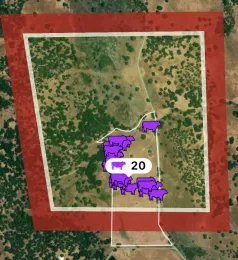
On May 12, 2026, UCCE Central Sierra hosted NRCS field staff from across California for a virtual fencing workshop in Amador County. The workshop was organized due to a growing interest among NRCS staff seeking practical guidance on the technology as they work with applicants considering VF through EQIP. Participants traveled from field offices throughout the state, including Visalia, Napa, Susanville, and other regions.
The workshop covered how VF tracks and contains livestock, recent advancements in the technology, vendor comparisons, system costs, producer feedback, app functionality, and lessons from UC ANR field trials (Figure 1).
These trials explored the use of VF for targeted grazing of invasive medusahead and barb goatgrass, linear fuel break installation, livestock exclusion from sensitive and recreational sites, and rotational grazing with small ruminants. Participants also discussed practical implementation considerations, including how to evaluate cellular coverage across a new pasture, and emerging direct-to-satellite options.
The afternoon included a field demonstration with Leisel Finley, a fifth-generation cattle rancher in Amador and El Dorado Counties, and owner/operator of Mt. Echo Ranch (Figure 2).
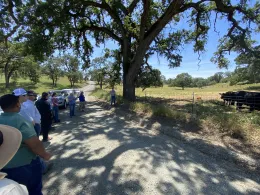
The ranch has used virtual fencing since the 2021 Caldor Fire destroyed significant physical fencing infrastructure on their summer grazing allotment on the El Dorado National Forest. NRCS staff were able to see collared livestock up close and speak directly with a producer experienced in the practical opportunities and challenges of using virtual fencing on working rangelands.
More information about EQIP is available through local NRCS field offices and at: https://www.nrcs.usda.gov/programs-initiatives/environmental-quality-incentives-program