
Creating Your California Native Habitat
Article by Vincent Hughes
Have you ever thought about creating your own native habitat garden? If so, you’ve come to the right place! But are you new to the idea of creating a native habitat garden, or just curious about what a native habitat garden is? You’ve also come to the right place! For those of you who may be reading this series for the first time, and those who simply would like a refresher on what exactly a native habitat garden is, let’s take a moment to review.
A native habitat garden is a landscaped area that utilizes native plants to create a functional ecosystem that supports local wildlife. What wildlife, you might ask? A native habitat garden is likely to support birds, bees, butterflies, and more by providing food, water, shelter, and nesting sites. When building your own native habitat garden, something to keep in mind is that the most successful habitat gardens are built around a keystone species. Today, the keystone that I want to propose to you is the California Live Oak or Coast Live Oak, Quercus agrifolia.
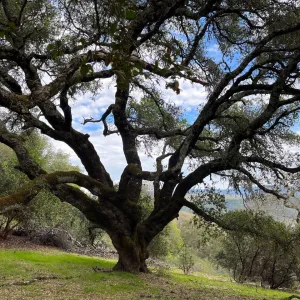
Coast Live Oak is a native, evergreen hardwood tree that grows from Mendocino County in the north to Baja California in the south, and from the coast to about 60 miles (100km) inland. Coast Live Oaks also thrive in areas near perennial streams. Typically, they prefer areas below 2300 feet in elevation but have been found as high as 4900 ft above sea level. This species also has a tolerance for salinity, allowing it to thrive in areas of coastal fog. In its native environment, the Coast Live Oak can grow to be between thirty and eighty feet in height and up to five feet in diameter, though a truly large tree can exceed that. Individual Coast Live Oaks can live to be over one 300 years old under ideal conditions. In older trees, it is common for the trunk to be extremely gnarled, contorted, and truly massive.
As stated earlier in this article, Coast Live Oak is a keystone species. But you may be wondering what exactly a keystone species is. A keystone species is a species that is critical for various types of wildlife for either food or cover. In the case of Coast Live Oak, it is commonly browsed by deer, livestock, and rodents for the acorns while also providing den or nest sites for owls, woodpeckers, and squirrels. Caterpillars also thrive feeding on the fallen leaves from this tree. It is also commonly utilized as a shade tree by numerous species seeking relief from the sun in Spring and Summer and shelter in the Winter.
Coast Black Oak is a beautiful, majestic, and mighty tree that’s native to our state, our county, and our climate. It also has a lengthy history of uses across human history, ranging from Native Americans utilizing the acorns to make bread to settlers utilizing the wood for charcoal in adobe forging kilns, to ship builders utilizing its odd, angular limbs to make specialized support joints. All of this can help to make this tree a fantastic focal point for a native habitat garden, not only the beauty of its growth patterns, but also the history it carries within our state. When paired with any of the native plants that are often found as companion plants around it in nature, such as Hummingbird Sage, California Coffeeberry, or Blue Elderberry, it’s sure to quickly become a center of attention for your local wildlife. And with time, you’re sure to see your native habitat garden become a lively and thriving ecosystem.
So do you think that you’ll want to plant your own Coast Live Oak to start your native habitat garden? There’s no better time to start one than the present. Coast Live oaks are one of our fastest-growing oaks and are easy to start from acorns. But whether you decide to start your native habitat garden now or simply continue to cultivate the garden you already have, good luck and happy growing!
Read more on Creating Your Own Habitat Garden around the Coast Live Oak by Pam Muick.