
Rosie's corner: What to do about Botrytis blight
Can you believe the year is almost halfway over? Time is flying!
Walking around the neighborhood, I noticed that there are roses which look like they have measles. As far as I know, measles is not contagious from humans to roses (thank goodness!). If you see red dots or spots on the petals of your roses, it is a fungal disease called Botrytis blight. With the unusual weather we have been having, yes, this fungal disease is out there. Light colored roses may end up with spots that can range from pink, to red, to purple which sometimes have clear centers. That is called ghost spotting. The petals can start to turn gray, brown or tan (sometimes with fine gray spores) and won’t open.
It can be hard, after waiting all winter for your beautiful roses to bloom, to have a late spring shower and suddenly, the buds won’t open or your roses (especially the light-colored ones) and are covered in spots or fuzzy grey mold. What can you do? Not much once the rose has been infected. I cut off the infected buds/flowers and wait for new growth and blooms to appear. Make sure your roses are not crowded, are able to have air circulating around them, and don’t leave rose debris around the bottom of your roses as that can also harbor fungal diseases.
What else needs to be done in the rose garden other than deadheading? If you can, try to fertilize around the end of the month. Use organic fertilizers if possible. Organic fertilizers feed your soil as well as your plants. Roses like a constant supply of nutrients including micro-nutrients such as copper, manganese, magnesium, in addition to nitrogen (the N on the fertilizer label), phosphate (the P on the fertilizer label), potassium (the K on the fertilizer label). They help the rose to develop strong blooms and roots. Remember, more is not better. Follow instructions on the bag. If you haven’t put down a layer of compost, that can be done as well.
Make sure you have a good three inches of mulch around the dripline of your roses. It will help to keep weeds at bay, retain water and keep the roots cooler in the upcoming summer weather. Enjoy your roses and blooms this month.
Rose classification: Miniature roses
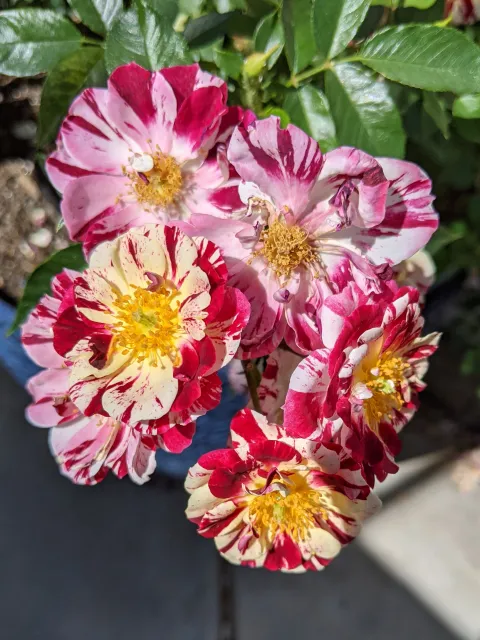
Last month, I mentioned that there are different rose classifications that I will be going over in the next few months. One of them is miniature roses. Miniature roses are the same as their bigger cousins other than size. Most minis are grown (here in the U.S.) on their own roots, not grafted. They have the same requirements regarding sunlight, watering, fertilizing, etc., as their cousins, but on a somewhat smaller scale. For example, you would not feed a small one-foot miniature rose the same amount of fertilizer as a large 12-foot climbing rose.
Miniature roses come as shrub roses, climbers, etc. They are great for tucking into corners, planting in flowerboxes or pots. They are quite hardy and not difficult to grow. I have several that I have “saved from death” at the grocery store and planted them in my yard. They do extremely well, planted outdoors. They do not make a good houseplant as tempting as that seems.
One of my favorites (I do have several) is a rose from Australia named Minnie Mouse, also known as Roller Coaster. Yes, this rose is available in the U.S. This rose has maroon and white stripes and is continuously in bloom. The flowers are about 2.5 inches across and are beautiful! They remind me of Minnie Mouse’s clothes. It is very disease resistant and makes me smile every time I look at it. It does wonderfully in a large (20-24 inch) pot as it will get about 5 feet tall and wide. It has been classified as a mini climber. It also does well with our summer heat. If you don’t deadhead it, it will make red hips in the fall. I have included a picture of this beautiful rose from my yard. It is a pretty one!
Until Next Month…”Teaching you how to grow a garden is better than giving you a thousand roses.” - Matshona Dhliwayo
____________
Written by UC Master Gardener Debbie D.