
Cultivating Emotionally Healthy Beyond Ready Skills
Introduction
We all have feelings. And they matter. Feelings help us learn about ourselves and others. Despite their benefit, many of us have a hard time identifying feelings. In his book, Permission To Feel, Dr. Marc Brackett encourages us to lean in to our feelings. By doing so, we can lead more healthy and productive lives. This becomes especially important for those of us who work in youth development programming, such as the 4-H program. By learning about our own feelings, we can help youth identify their own feelings. This blog post is a review of Brackett's book Permission To Feel.
Why Feelings Matter
Feelings are information. Brackett writes, "Our multiple senses bring us news from our bodies, our minds, and the outside world, and then our brains process and analyze it and formulate our experience. We call that a feeling." Researcher Daniel Goleman in his book, Emotional Intelligence explains that emotional intelligence (EQ) is a better indicator of career success than intelligence quotient (IQ). Through learning how to manage our own feelings and learning how to recognize the feelings of others, we can improve our interpersonal and intrapersonal skills. By helping youth learn about emotions, we can help prepare them to be "beyond ready" for their current and future goals.
Feelings are also related to our physical health. While emotional stress can lead to physical sickness, positive feelings can lead to physical wellness. Research has linked hostility and anger to heart disease. Negative emotions are also related to hypertension (elevated blood pressure), increased heart rate, and decreased function of the immune system.
Because of the importance of feelings, Brackett provides a set of specific skills that we can develop that will help us to become emotion scientists. People who can identify feelings and can manage them in ways that promote wellness. Brackett provides an Acronym: R.U.L.E.R.
Developing RULER Skills
R. The first step to becoming an emotion scientist is to recognize when an emotion happens. To do this, we can observe a change in our own thoughts, energy, or body. We can also see someone else's emotions in their facial expression, body language, and tone of voice. These observations provide us with information about what feelings may be happening in ourselves and others.
U. The second step is to understand the cause of the emotions. When we understand the cause of emotions, we can see how the feelings shape our thinking and our decisions. Understanding feelings helps us forecast how we behave and how others behave.
L. The third step is to label the feeling. Labeling feelings includes the process of connecting an emotional experience to a descriptive word that describes the feeling. Having a robust vocabulary of feeling terms can increase our accuracy in describing emotions.
E. The fourth step is to express our feeling. Key to this step is knowing a helpful way to display our emotions and under which timing to do so. Social context can play an important role in helping us make decisions on expressing our feelings in meaningful and helpful ways.
R. The last step is to regulate our feeling. Regulating our emotions includes the ways we monitor and modify our emotional reactions. By doing so, we can increase our chances of personal and professional success.
By practicing these R.U.L.E.R. emotional skills, we can increase our emotional intelligence and help others improve theirs as well. For those of us who serve youth, teaching youth how to develop RULER skills can help them better understand themselves and relate to their peers. In addition to RULER, Brackett provides one more important emotional intelligence tool called The Mood Meter.
Measuring Feelings Using The Mood Meter
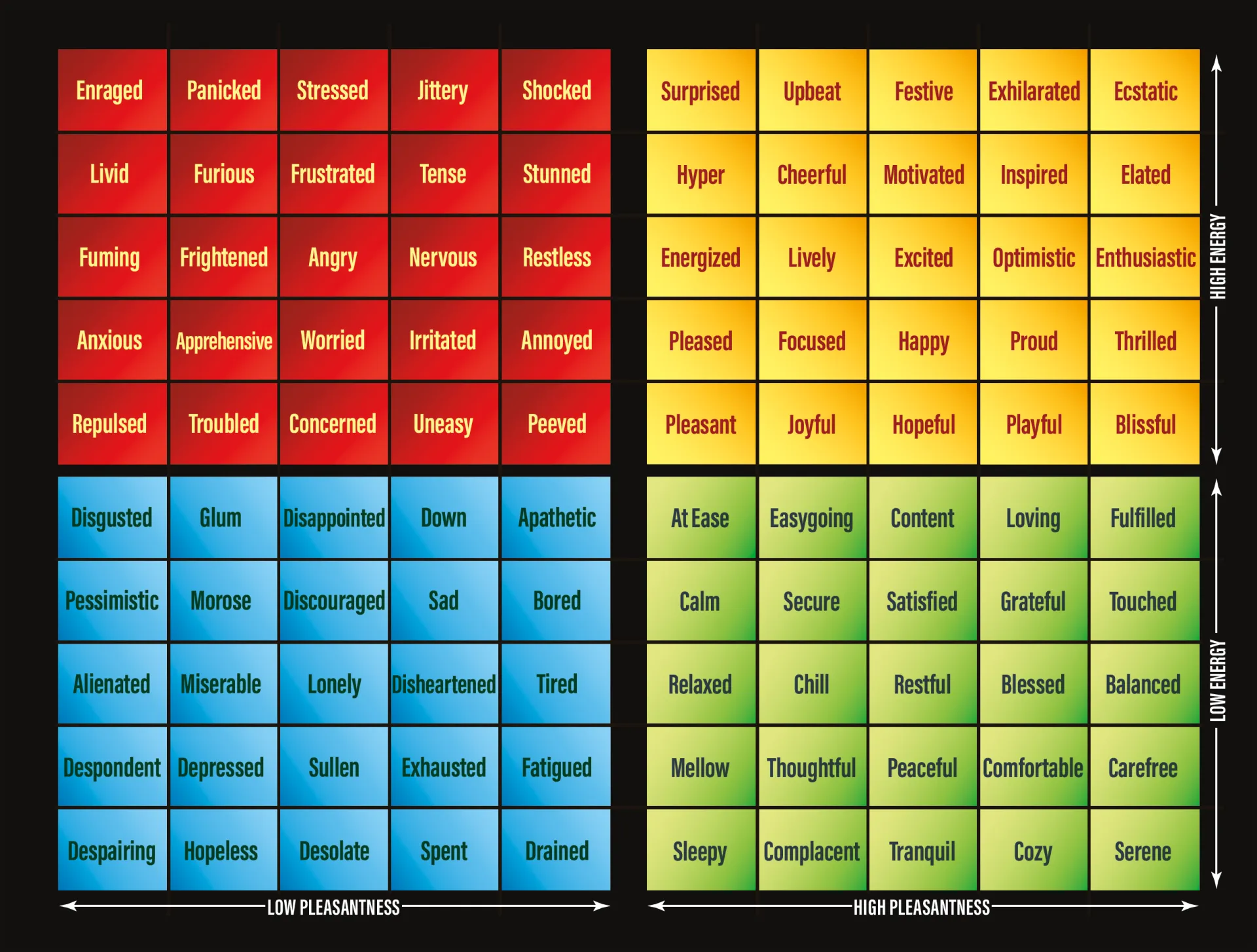
The Mood Meter provides a matrix of feelings that are organized into four main categories: 1) Low Pleasantness and Low Energy, 2) High Pleasantness and Low Energy, 3) Low Pleasantness and High Energy, and 4) High Pleasantness and High Energy. In Figure 1, we see that each category is represented with a color: Blue, Green, Red, and Yellow. In general, the blue color represents when a person feels lonely, the green color represents when a person feels restful, the red color represents when a person feels angry, and the yellow color represents when a person feels excited.
But because emotions can vary, there are gradients of feelings that can occur within each of the four quadrants based on the degree of pleasantness and energy. For example, a person may feel more than angry, they can feel enraged because they feel a very low rate of pleasantness and a very high rate of energy. This person feels more than just angry, they feel enraged. In this example, the descriptive word "enrage" more accurately describes the person's feeling than merely "angry." Or suppose a person just got married and feels more than excited, they feel ecstatic. While excited may describe the person's feeling, if they have a high rate of energy and a high degree of pleasantness, a more accurate descriptor of excited would be the word "ecstatic." These two examples show the power of using labels that accurately describe our feelings.
Figure 1. The Mood Meter by Dr. Marc Brackett. See his website to download The Mood Meter.
Conclusion
Feelings play an important part in our lives. As such, we have the privilege (and permission) to feel. By leaning into our feelings, we can explore a wonderful world of emotions. We can also help others tap into their own emotional world as well. For those of us who work in youth development, helping young people apply their R.U.L.E.R. skills can help them increase their emotional intelligence so they can become "beyond ready" for their current and future goals. And helping youth learn how to label their emotions by using The Mood Meter can help them better describe their emotions. As we increase our emotional literacy, we can lead healthier and more productive lives.
References
Brackett, M. (2019). Permission to feel: The power of emotional intelligence to achieve well-being and success. Celadon Books.
Goleman, D. (2005). Emotional intelligence: Why it can matter more than IQ. Bantam.