
A Brief History of the Canning Jar (March 2026)
Monica Gross, UC Master Food Preserver Online Program Volunteer
For most of human history, feeding a family involved navigating times when food was plentiful, such as at harvest time, and periods when it was scarce. Before methods of food preservation were developed, food insecurity was a difficult challenge. Food preservation methods prior to ice boxes and refrigerators included smoking, drying, salting, root cellaring or cold storage, fermenting, and eventually canning.
Food preservation using home canning was evolving in the late 1800s alongside the development of refrigeration. It was not until 1858, however, in the United States, when John Landis Mason, who was 26 years old, patented a threaded screw-top jar that could be processed to be airtight and watertight. Hence, the Mason jar was born! This article will provide a brief recounting of the milestones that led to the development of the canning jar and lid.
Canning food began with a challenge by Napoleon
The dawn of the practice of canning began in France in 1795 with a proposal put forth by Napoleon Bonaparte. He challenged inventors to devise a method of preserving food for the French military. A multiskilled chef named Nicolas Appert developed “Appertizing,” which we now call “Canning.” It took Appert 14 years to develop his method and in 1810, he was awarded the handsome sum of 12,000 francs by the French Ministry of the Interior, subject to the requirement that he make the details of his canning process available to the public. (At the time, the typical daily wage of a French worker was just 3 francs!) In that same year, in fulfillment of the reward requirement, Appert wrote and published L'Art de conserver, pendant plusieurs années, toutes les substances animales et végétales (The Art of Preserving, for Several Years, All Animal and Vegetable Substances), the first book on what we would consider “modern” food preservation techniques.
Appert’s method used glass bottles called “fruit jars,” which were 2 to 4 inches in diameter. The jars had to be of uniform thickness throughout to prevent breakage. There were no threads at the neck as we are familiar with today. The top was secured by a cork, which was tapped into place. The cork was secured with a wire and the application of homemade luting or cement. The jar was then boiled.
Appert’s method persisted for 50 years before Louis Pasteur explained that it was the process of boiling the jars that killed the microbes that caused food spoilage.
A jar invented by a tinsmith
Approximately 50 years after Appert’s success, in America, John Mason filed a patent on November 30, 1858 for a new type of fruit jar closure (see Figure). He devised a brand-new closing method that involved the threads that we are familiar with on our modern Mason jars and lids. Surprisingly, John Mason was not a glassblower; he was a tinsmith by profession. The new lids that he invented were made of zinc and could be screwed onto glass fruit jars with threads.
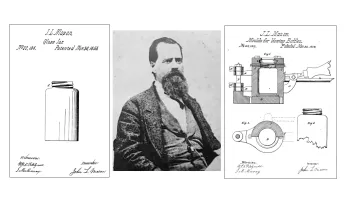
John L. Mason and figures from two of his U.S. Patents (Public Domain)
Mason hired others to make the fruit jars, as they were called. He conscripted a shop owned by Samuel Crowley to make the first jars. A glassblower named Clayton Parker, who worked for Crowley, made the first Mason jar. Crowleytown, New Jersey, is credited as the location where Mason jars were first manufactured. This interesting website shows a picture of the first Mason jar.
Mason's Patent Crowleytown Jar - FOHBC Virtual Museum of Historical Bottles and Glass
As it turned out, Mason’s screw top lids were not without problems. The zinc lid imparted a metallic flavor to the jar’s contents. The jars were also prone to breakage; the shoulders of the jars oftentimes couldn’t withstand the twisting force as the lid was applied or removed, and the jars sometimes broke. These deficiencies were worked on over the years by Mason and others.
After Mason’s patent expired in 1870, many others filed patents in an attempt solve the problems with the jars and lids. Mason himself filed other patents trying to overcome the jar’s inherent flaws. Later, a man named Lewis Boyd invented an opal glass plate to line Mason’s lid. This solved the metallic taste problem for the time being.
Innovation led to solutions
The problem of jar breakage was eventually solved as glass blowing methods improved over the years and the jars could be manufactured with uniform thickness. Much of the innovation came through the Ball brothers. Now that the fruit jar patent was in the public domain, the Ball brothers entered the glassmaking business in 1880. Their first jar was called the “Buffalo Jar” and was marked with the Ball Brothers Glass Manufacturing Company, BBGM Co insignia. The Buffalo Jar, with the company insignia, can be seen at this link: BBGMCo Buffalo Jar - FOHBC Virtual Museum of Historical Bottles and Glass
Other companies began manufacturing jars. Competition was fierce. The Ball Brothers Glass Manufacturing Company eventually came out on top because of the development of the Ball-Bingham machine, a powered glass-blowing machine. Jar production increased dramatically and the market was flooded with the Ball product. In addition, the Ball company partnered with colleges, established fellowships, and focused on agricultural home economic studies. The brothers extended their influence into the home with the publication of their first Blue Book, a pamphlet that included canning instructions and recipes. The pamphlet was published in 1909.
Ball Blue Book Canning Old | PDF | Fruit Preserves | Pickling
In 1915, a grocery wholesaler Alexander H. Kerr was advancing lid development. In 1915 he filed a patent for a jar lid with an integrated sealing compound that would flow when heated, creating a hermetic seal between the lid and the jar. The lid was held in place by a band. This was the precursor of the two-piece sealing method that we use today.
The modern canning methods that we use today allow us to safely and confidently can foods for our families and friends. We benefit from the collective innovation and work of Nicolas Appert, John Mason, the Ball brothers, namely Edmund, Frank, George Lucius, and William, and finally Alexander Kerr. Our modern societies no longer suffer from food insecurity because of problems with food preservation. In the modern era it may be hard to imagine the struggles that our ancestors overcame to feed themselves as we can easily get food at our local grocery store. We are fortunate to live in the 21st century!
References
Joann Moser, 2016, Mason Jar Nation: The Jars that Changed America and 50 Clever Ways to Use Them Today. Cool Springs Press, 144pp.
A Brief History of the Mason Jar, Smithsonian Magazine August 26, 2020.
How Did We Can? | Canning Timeline Table, USDA National Agricultural Library