
Home Soil Evaluation
Article by Caroline Gengo, UC Master Gardener Trainee -
What can your soil tell you about your garden? Soil is made up of decomposed rocks, organic matter, water, and air. Soil provides roughly eighty percent of the essential nutrients your plants need to grow. How we maintain and support our soil directly impacts our plants’ health and growth. In this article, we will describe a quick at-home soil test you can do to better understand your garden soil texture. This helps us understand how to support your plants from the ground up through efficient amendments, watering, and fertilizer application.
Nearly half of the soil is made up of decomposed rocks (also called mineral matter). Minerals come in all shapes and sizes, and can tell you a lot about how much water and fertilizer your soil might need. Smaller fragments of rocks pack together tightly and can keep water and nutrients in the soil layer for a long time. Clay is an example of a small particle size, finely textured soil. By contrast, larger fragments do not pack together as tightly and create larger spaces between fragments. These larger spaces allow water and nutrients to drain through the soil more quickly. Sand is an example of a large particle size, coarsely textured soil. The proportion of large and small fragments in your soil creates the soil texture. Texture is the first thing we can test in a home soil evaluation.
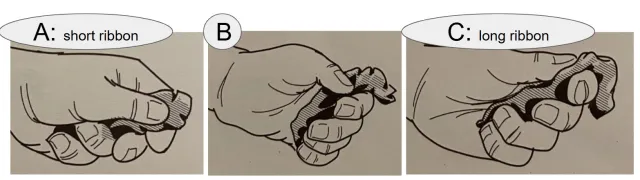
To start, grab a handful of moist soil and try to form it into a flat pancake in the palm of your hand like you might with playdough. Use your thumb to push the soil over your index finger to try and form a ribbon of soil. If the soil breaks apart immediately and you cannot form a ribbon with it this way, your soil is mostly coarse in texture and drains well (in other words: your soil might have a lot of sand). If you can form a strong ribbon that starts cascading down your hand, then your soil is mostly fine in texture and holds water and nutrients well (in other words: your soil might have a lot of clay). Something in between means your soil is a mixture and can be treated as an intermediate.
Now that you know what texture soil you have, you can start to water and fertilize more efficiently. Soil with large pore spaces and a coarse texture (no ribbon or a very small ribbon) allows water and nutrients to drain through rapidly and can require more frequent water and fertilizer application. Soil with smaller pore spaces and a fine texture (a long ribbon) holds water and nutrients for longer periods of time and does not require watering and fertilizer applications as frequently.
What did your soil tell you about your garden? In this article, we went over a quick at-home soil texture test and how that might affect water and nutrient retention in the soil. Understanding your soil’s texture can help you predict water and fertilizer needs while planning your garden this winter. Soil texture can also give you clues for how you might amend your soil for increased or decreased drainage if that is something your garden needs.
For more information, watch the video from Celtic Farm Soil Ribbon Test: The Trick Gardeners Swear By!
Illustration adapted from Pittenger, D. R. 2022. California Master Gardener Handbook: Second Edition. University of California Agriculture and Natural Resources Publication 3382