
Universal School Meals - A Powerful Strategy to Combat Food Insecurity
Research Brief • November 2025 • Download PDF (229 KB)
Means-tested approaches to school meals leave hungry kids unserved. School Meals for All programs ensure no child falls through the cracks.
Food Insecurity in California
Nearly 1 in 6 CA households with children—over 660,000 households—are food insecure, with limited or uncertain access to adequate food.1-3
Food insecurity in childhood is associated with:
- Poor overall health, both as children and into adulthood4-6
- Lower academic achievement, developmental delays7-8
School Meals Help
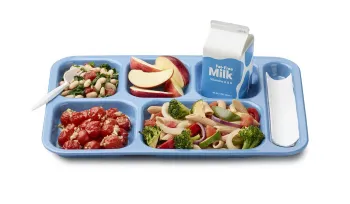
- Since 2022, California has offered two nutritious meals every school day to all of its 6 million TK-12 students, regardless of their family income
- School meals are the overall healthiest source of food in U.S. children’s diets9
- Cuts and restrictions to SNAP (CalFresh) in U.S. H.R.1 of 2025 make School Meals for All more important than ever in addressing food insecurity10-11
NPI Studied Food Insecurity and School Meals
2023 survey of 3,377 parents/caregivers in 4 states with School Meals for All (CA, ME, MA, VT) and 4 states with the traditional means-tested approach (AZ, TX, IL, NH).13
Key Findings from Across 8 States
12% less food insecurity among families with children in states with School Meals for All compared to states with means-tested school meals.
Greatest reduction in food insecurity among:
- Lowest income households (19% lower)
- Households just above reduced-price meal eligibility threshold (18% lower)
The most extreme form of food insecurity—where families need to skip meals—was 17% lower in states with School Meals for All.
Federal Means Testing and School Meals
A federal means test determines eligibility to receive school meals at free or reduced price — no charge for students with family income at or below 130% of Federal Poverty Level (FPL); reduced price for those between 130 and 185%; and full price for those above 185%.12 Federal income thresholds for eligibility do not take into account California's high cost of living. Notably, 44% of California’s food insecure families had incomes above 185% of FPL in 2022.2 California's program aims to maximize federal reimbursement of school meals and provide every student with free school meals regardless of family income level.
Conclusion
School Meals for All programs are associated with lower food insecurity, especially among the most vulnerable families.
References:
- Thornton T. Testimony: A Snapshot of Food Insecurity in California. Public Policy Institute of California. Mar 2025.
- Pryor L, et al. Universal School Meals Help All California Children Thrive. California Budget & Policy Center. Mar 2024.
- Households/Income Data for State: California. Health Matters in Ventura County. May 2025.
- Casey EG, Winsler A. Impacts of Food Insecurity on Child Development: Strengthening the Role of Childcare. Nutrients. 2025;17(15):2427.
- Pai S, Bahadur K. The Impact of Food Insecurity on Child Health. Pediatr Clin North Am. 2020;67(2):387-396. doi: https://doi.org/10.1016/j.pcl.2019.12.004
- Thomas MMC, et al. Food insecurity and child health. Pediatrics. 2019;144(4):20190397.
- Gallegos D, et al. Food Insecurity and Child Development: A State-of-the-Art Review. Int J Environ Res Public Health. 2021;18(17):8990. doi: https://doi.org/10.3390/ijerph18178990
- Shankar P, et al. Association of Food Insecurity with Children’s Behavioral, Emotional, and Academic Outcomes: A Systematic Review. J Dev Behav Pediatr. 2017;38(2):135-150. doi: https://doi.org/10.1097/DBP.0000000000000383
- Liu J, et al. Trends in Food Sources and Diet Quality Among US Children and Adults, 2003-2018. JAMA Netw Open. 2021;4(4):e215262.
- A Quick Guide to SNAP Eligibility and Benefits. Center on Budget and Policy Priorities. 2025.
- H.R. 1 (One Big Beautiful Bill Act) & CalFresh: Frequently Asked Questions. CA Dept of Social Services. Oct 2025.
- Child Nutrition Programs - National School Lunch Program. US Dept of Agriculture. Aug 2025.
- Orta-Aleman D, et al. Statewide Universal School Meal Policies and Food Insecurity in Households with Children. Am J Prev Med. 2025:107942. doi: https://doi.org/10.1016/j.amepre.2025
The Nutrition Policy Institute, University of California Agriculture and Natural Resources, is funded to conduct evaluation through CA SB 170 (2021), CA SB 154 (2022) and CA SB 101 (2023). For more information on NPI’s evaluation of School Meals for All, please visit NPI's School Meals for All website.
Suggested citation: Orta-Aleman D, Hecht C, Hecht K, French C, Zuercher MD, Sam-Chen S, Thompson HR, Ritchie LD, Gosliner W. Research Brief: Universal School Meals - A Powerful Strategy to Combat Food Insecurity. Nutrition Policy Institute, University of California, Agriculture and Natural Resources. 6 November 2025.
University of California Agriculture and Natural Resources is an equal opportunity employer. © 2025 UC Regents, Creative Commons 4.0 International License.
