Exploring the World of Unusual Citrus
California’s climate is a citrus grower’s dream, but beyond the familiar oranges, lemons, and limes lies a fascinating world of lesser-known citrus. Many of these fruits have deep cultural roots, unique flavors, and surprising uses — from culinary delights to ornamental beauty. Here are some of the most intriguing citrus varieties that can be grown in Stanislaus County, if care is taken to prevent frost damage.

Buddha’s Hand (Citrus medica var. sarcodactylis)
These unusual fruits likely originated in northeastern India or China. They are intensely fragrant, with no pulp or juice — just aromatic rind and pith. Buddah’s Hand zested is used for flavoring, as candied peel, and as a natural air freshener. In Buddhist temples, it’s offered as a symbol of happiness and longevity. Its finger-like segments make it one of the most visually striking citrus fruits. This unusual fruit is not frost tolerant but can thrive with protection from frost and does well in containers
Calamondin (× Citrofortunella microcarpa)
Believed to be a hybrid between kumquat and mandarin, Calamondin is native to the Philippines. The fruit is very sour, with a thin, edible peel. It is popular in Filipino cuisine for marinades, beverages, and condiments and is also grown ornamentally. Calamondin trees are often kept in pots indoors for their fragrant blossoms and decorative fruit. Calamondin do best in warm climates, preferring temperatures between 60oF-80oF and don’t tolerate prolonged exposure to temperatures below 50oF, but have been grown in our county with success.
Citron (Citrus medica)
One of the oldest cultivated citrus species, citron likely originated in the Himalayan foothills of India and Myanmar. Citron was among the first citrus fruits brought to the Mediterranean. It is valued for its thick rind, which is candied for holiday confections, especially in Italy and the Middle East. Citron has little pulp or juice. The rind is fragrant, with a lemony aroma and mild bitterness. Citron tolerates some frost but as with most citrus, does better if protected from frost.
Finger Limes (Citrus australasica)
Native to the rainforests of eastern Australia these unique fruits don’t have the traditional sections of oranges, lemons, and limes. Rather the thin skin opens to reveal caviar-like vesicles that burst in the mouth, usually with lime like tartness. The fruit can be cut open and the vesicle popped into the mouth, but they are popular as a garnish for seafood, cocktails, and desserts. Sometimes called “citrus caviar,” finger limes come in colors from pale green to deep pink. Finger limes are frost sensitive; and struggle in extreme heat. They require frost protection below 32°F; shade during heat waves above 95°F.
Kaffir Lime (Citrus hystrix)
Native to tropical Southeast Asia, the kaffir lime is widely grown in Thailand, Indonesia, and surrounding regions. The fruit itself is rarely eaten fresh due to its intensely bitter and aromatic rind. Instead, the leaves are the prized part — a staple in Thai, Cambodian, and Indonesian cooking. They are torn or sliced into soups, curries, and stir-fries, imparting a bright, floral-lime fragrance. The rind is used in traditional herbal remedies and in natural cleaning products due to its strong essential oils. In some cultures, the juice is used in hair rinses or skin treatments. These plants thrive in hardiness zones 10-12, but if grown in shade and protected from frost, can produce in our county.
Kumquats (Fortunella spp.)
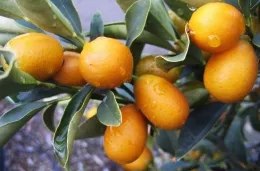
Native to China, kumquats have been cultivated for centuries and were introduced to the U.S. in the mid-19th century. Unlike most citrus, kumquats are eaten whole — peel and all. The skin is sweet, while the pulp is tart, creating a balanced flavor burst. Kumquats may be eaten whole, candied, made into marmalade, or used as a garnish. In Chinese tradition, kumquats symbolize prosperity and are popular during Lunar New Year. Unlike most citrus, kumquats are cold-hardy and can tolerate brief frost, making them a favorite for home gardeners in cooler California regions.
Sumo Citrus® (Shiranui/Dekopon)
Developed in Japan in the 1970s from a cross between Kiyomi tangor and Ponkan mandarin, these large fruits are exceptionally sweet, seedless, and easy to peel. Sumo citrus are best enjoyed peeled and eaten fresh. The fruit’s large size and bumpy skin hide a surprisingly delicate interior. California growers have perfected its cultivation for U.S. markets. These plants do well in Stanislaus County. Ask for ‘Shiranui.’
Tangelos (Citrus × tangelo)
A hybrid of tangerine and pomelo or grapefruit, tangelos were first bred in the late 19th century. They are juicy, sweet-tart, with a hint of grapefruit bitterness. Tangelos can be peeled and eaten, juiced or as a unique ingredient in salads. The “Minneola” tangelo, with its distinctive knob at the stem end, is one of the most popular varieties grown in California’s Central Valley.
Yuzu (Citrus × junos)
Native to China, and later cultivated extensively in Japan and Korea., Yuzu are tart, aromatic, with notes of grapefruit and mandarin. They are essential in Japanese ponzu sauce, yuzu kosho paste, and as a flavoring in beverages and desserts. Yuzu is valued more for its zest and juice than for fresh eating, and it’s frost-tolerant compared to many citrus. Yuzu trees prefer temperatures between 65°F -85°F and can tolerate light frosts but are sensitive to prolonged cold.
Additional information and resources:
UC Riverside Givaudan Citrus Variety Collection. https://citrusvariety.ucr.edu
Barbara Kissinger Santos has been a Stanislaus County Master Gardener since 2024