
Dahlias - Identifying Crown and Leafy Gall
By Karen Burgesser
Dahlias are bushy, tuberous herbaceous perennial plants and belong to the Asteraceae family. There are only 42 species but over 57,000 cultivated varieties. Dahlias, native to Mexico, are designated as the national flower. Dahlias produce a starchy root tuber and originally were grown by the Aztecs as a food crop. Eventually dahlias were transported to Europe by the Spanish colonists.
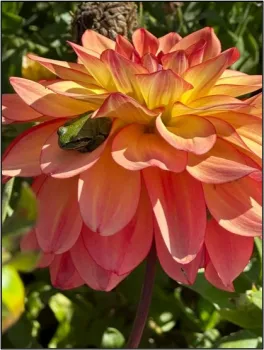
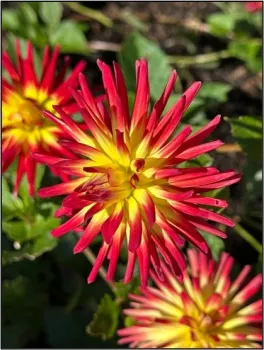
Dahlias are a wonderful addition to a flower garden. The plant size ranges from 18” to over 4 feet. Tree dahlias are even taller! The blooms appear in early summer through late fall. Some cultivars boast 10” blooms and some are as small as 2”. There are several flower shapes (such as waterlily, anemone, cactus, ball and pompom) Dahlias come in every color you can imagine (except blue). They can be grown from seed, but more commonly are grown from tubers.
DAHLIA TUBER PLANTING TIPS
- Plant tubers directly in the ground in the spring after the last frost. Place the tuber on its side, in a hole about 6 inches deep. The “eye” or sprout, should be facing up. Allow about two feet between plants for room to grow.
- Place in a site with good drainage and in partial to full sun.
- Place a sturdy stake, tomato cage, or other support to hold the plant as it grows.
- Do not water until sprouts are above ground.
- Deep root watering is needed, do not hand water.
- Use fertilizer with low nitrogen.
- Watch for snail and slug damage to the emerging stems. These hungry munchers can eat the stems to the ground overnight! Consider manually removing the pests in the early morning. Check the plants throughout the growing season and remove any pests. If a commercial pesticide is needed, refer to the University of California’s Integrated Pest Management for recommendations. Visit https://ipm.ucanr.edu
IDENTIFYING CROWN GALL AND LEAFY GALL ON DAHLIAS
Dahlia growers are challenged by bacterial pathogens that can infect their dahlia tubers and often share photos of their tubers on social media questioning “Is this gall?” Being able to tell the difference between healthy new growth and gall can be confusing for both seasoned and novice dahlia growers. If it turns out it truly is gall, the news is not good. There is no known cure for eradicating bacteria.
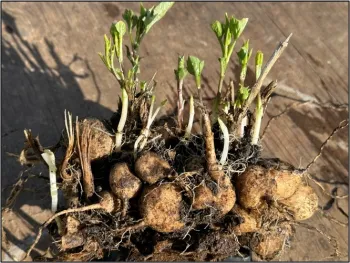
Normal growth on a group of dahlia tubers.
WHAT IS CROWN GALL?
Crown gall is caused by the bacterium Agrobacterium tumefaciens. It creates abnormal growths on plants by stimulating rapid growth of plant cells that results in galls.
Herbaceous plants that can be infected include chrysanthemum, dahlia, geranium, marigold, peony and snapdragon. Galls form on the basal stem and root crown at the soil line or just below the soil surface. The bacteria can survive in soil for long periods and can enter the plant through wounds or newly emerging roots. Crown gall can weaken and stunt the growth of the plant and infect nearby plants through contaminated soil and tools.
WHAT IS LEAFY GALL?
Leafy gall is an abnormal growth of leaf and stem tissue, arising at the base of the tubers and appears as a dense cluster of leaves from stunted shoots or as a mass of shoots fused at their base. Sometimes it is described as a “cauliflower-like growth”. The bacterium, Rhodococcus fascians, causes leafy gall on plants. Identifying leafy gall can be challenging as it resembles normal growth that emerges in the spring as tubers begin to grow or as growth that is obtained by using plant hormones. Appearance of leafy galls can take up to two years to show up on your dahlia.
PREVENTION STEPS
Unfortunately, there is no effective treatment for crown gall or leafy gall. Prevention is the best defense.
- Purchase high quality dahlia tubers from reputable dahlia nurseries.
- Check new tubers carefully. Consider growing in pots for the first 2 years before transferring to your dahlia bed.
- If infected, dig out the entire infected plant and discard in the trash.
- Do not put in your compost!
- Disinfect your tools after using on infected plants before using the tools on healthy plants.
- Consider sending a tissue sample to a lab to confirm the presence of the bacterium. Check with the lab for sampling guidelines.
IMPORTANT
Crown Gall and Leafy gall bacteria are spread through tools, open wounds and water, and are also spread by insects, so any opening in the plant or tuber can be infected. Leaving bits of infected tubers in the ground can spread gall. Knowing what to look for and taking proper steps will help prevent potential problems in your dahlia garden.
Enjoy your beautiful, healthy dahlias for several seasons!

Resources:
Rhodococcus fascians in Herbaceous Perennials
https://apsjournals.apsnet.org/doi/pdf/10.1094/PDIS-91-9-1064
Crown gall – Agrobacterium tumefaciens
https://ipm.ucanr.edu/PMG/GARDEN/PLANTS/DISEASES/crowngall.html
Royal Horticultural Society
https://www.kew.org/plants/dahlia
The Curious Gardener, Vol 25, No 2 Spring 2016
https://ucanr.edu/sites/default/files/2017-04/260550.pdf
Fundamentals of Growing Dahlias – American Dahlia Society
https://www.dahlia.org/growing/fundamentals-of-growing-dahlias/
Purdue University Plant Doctor
https://purdueplantdoctor.com/partproblems/flower-20?from=flowers
Missouri Botanical Garden - Crown Galls
https://www.missouribotanicalgarden.org/gardens-gardening/your-garden/help-for-the-home-gardener/advice-tips-resources/insects-pests-and-problems/diseases/bacterial-galls/crown-galls
Dahlia Gall Basics –Catherine Featherby
https://victoriadahliasociety.org/wp-content/uploads/2023/03/DAHLIA-GALL-2023.pdf
Is It Crown Gall or Leafy Gall -M. Putnam and M. Miller
https://bpp.oregonstate.edu/sites/agscid7/files/bpp/attachments/is_it_crown_gall_or_leafy_gall_for_web.pdf
National Dahlia Society -History of the Dahlia
https://www.dahlia-nds.co.uk/about-dahlias/history
All Dahlia images courtesy of the author, K. Burgesser, UC Master Gardener of Humboldt and Del Norte Counties.