
What a Micro Moth!
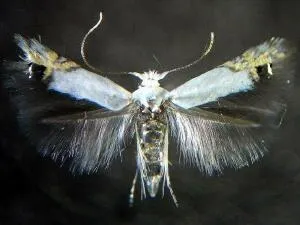
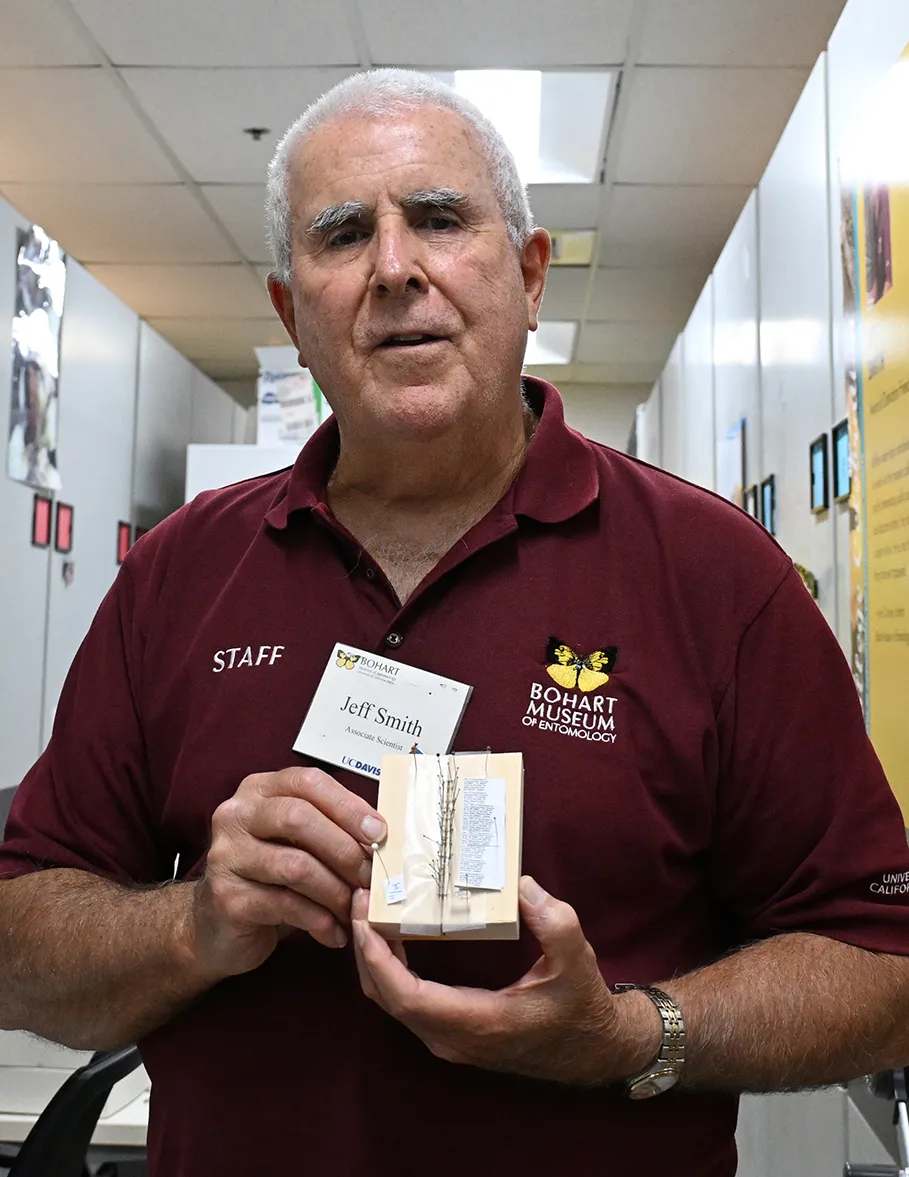
Entomologist Jeff Smith, who curates the Lepidoptera collection at the Bohart Museum of Entomology at the University of California, Davis, has just finished spreading the wings of a moth that has a 4mm wingspan.
"I've been concentrating for months on spreading our huge backlog of field pinned MICRO lepidoptera, many from Central America, many the Caribbean, and of course North America," Smith said. "I'm getting better at the tiniest moths, and am finishing a lot of them from the Delta Project that Brennen Dyer (Bohart Museum collections manager) has worked on and that Lynn Kimsey (UC Davis Distingujished Professor Emerita and the retired director of the Bohart Museum is currently data-basing," he said. "Many have a wingspan of only 5 mm or less."
The one the Bohart volunteer just finished--the one with a wingspan of 4mm--is a Paraleucoptera albella, also known as a cottonwood leafminer moth. It's in the family Lyonetiidae and is found throughout western and eastern North America, including California, Arizona and Colorado. The moth larvae feed on the host plant, Populus deltoides, mining the leaves. Heavy infestations can defoliate the leaves, damaging entire branches.
In describing the adult markings, the website, Moths of North Carolina, relates: "The following is based in part on the description by Chambers (1871) and Forbes (1923). The head, thorax, and ground color of the forewing is snowy white, and there is a small snowy white tuft on the head. The antenna is pale fuscus with the apex and basal joint white. Beginning on the costa just beyond one-half the wing length, there is a short, pale golden, streak that is dark margined on both sides. The streak is posteriorly oblique and extends to about mid-wing. A second similar streak with dark margins (sometimes represented as to a golden spot with dark margins) occurs behind the first at about four-fifths. The ends of both streaks join a pale golden region that extends from the end of the first streak to the wing tip. The most conspicuous mark is a silvery gray metallic spot near the anal angle that is distinct black margined anteriorly and posteriorly."
"The black margin sometimes covering much of the underlying silver spot. A short golden streak that usually has a thin black anterior margin adjoins the anterior margin of the spot. There often is a minute indistinct fuscus spot at the apex of the cilia or other faint grayish black mottling. The abdomen is white and banded above with golden fuscous. This species is similar to Proleucoptera smilaciella and worn specimens can be difficult to place. Forbes (1923) notes that P. smilaciella is larger and that the first fascia (streak) is much narrower (three times as long as wide versus almost squarish in P. albella). The first fascia of Proleucoptera smilaciella is also more oblique and starts nearer the base. There are often three or four dark lines that converge on the apex (often partially missing on worn specimens, and rarely evident in P. albella). The silvery-gray spot is smaller than in C. albella, and is completely surrounded before and above with the golden yellow band."
The Moths of North Carolilna website says that "females glue their whitish, partially translucent eggs in clusters to leaves. The larvae make full-depth mines and often feed communally. The mature larvae are 5.0-6.5 mm long and 0.8-0.9 mm wide. When mature, each larva leaves the mine and spins a white, spindle-shaped cocoon beneath two parallel silken bands that meet in the middle. The cocoon are either spun on leaves, or the larvae drop to the ground or to lower vegetation to pupate. Glitch (1922) noted that the larvae can reach high densities on poplars in Arizona and defoliate entire branches. The final-instar larvae often descended from trees on silken threads where they were a nuisance to humans who were walking by. Overwintering occurred in the pupal stage. Dyer (1902) also observed large numbers of larvae in Colorado that significantly defoliated trees."
How tiny is 4mm? Approximately 0.157 inches, which is slightly more than 1/8th of an inch.
The Bohart Museum is located in Room 1124 of the Academic Surge Building, 455 Crocker Lane, UC Davis campus. Founded in 1946, it now houses a global collection of some eight million terrestrial and freshwater arthropods; a live petting zoo; and an insect-themed gift shop.
The Bohart Museum is the seventh largest insect collection in North America. Director of the museum is Professor Jason Bond, the Evert and Marion Schlinger Endowed Chair of Systemics, UC Davis Department of Entomology and Nematology, and the executive associate dean of the College of Agricultural and Environmental Sciences (CA&ES).