
Central Sierra: How to Collar & Train Livestock to Recognize Virtual Fence Boundaries
Virtual Fencing: Collaring and Training Livestock
In an earlier article, we introduced virtual fencing (VF) as a system for containing livestock without traditional fences. Now, let’s explore how to collar and train livestock to recognize these virtual boundaries.
Setting Up Virtual Fencing Collars
To set up collars, first, charge the collars and allow time for them to connect to your mobile app via cell signal. Once connected, you'll see their locations updating regularly on the app. The collars are now ready to be placed on the herd.
Fitting Virtual Fencing Collars on Livestock
Properly fitted VF collars sit around the neck like a cowbell and are easy to attach using a traditional livestock squeeze. A properly fit collar should hang slightly so that the animal can breathe, eat, and drink freely. Being too tight may restrict this while being too loose may result in the collar falling off (Figure 1). Make sure the fit is checked regularly, especially if the animal’s weight changes.

Figure 1. Example of a proper collar fit.
Training Livestock with Virtual Fencing Collars
Once collars are on, training begins! Place the herd in a pasture with a simple physical fence geometry, like a rectangle or square, and adequate cell reception (Figure 2). Provide easy access to water, feed, and shade that will be set at least 50 feet from the VF boundary. On the mobile app, draw the VF boundary so that one line cuts across the middle of the pasture. The pasture size will depend on the number of livestock but should allow them to roam freely while interacting with the VF boundary several times a day. Too little interaction won’t provide enough training, while too much may confuse them. For example, we trained 16 heifers in a 21 acre pasture, using VF to restrict it to 15 acres. Training usually takes 4 days to a week, depending on the livestock’s response. When you notice the herd staying within the VF area for at least 4 days in a row, they are considered trained and are ready to use VF in various ways!
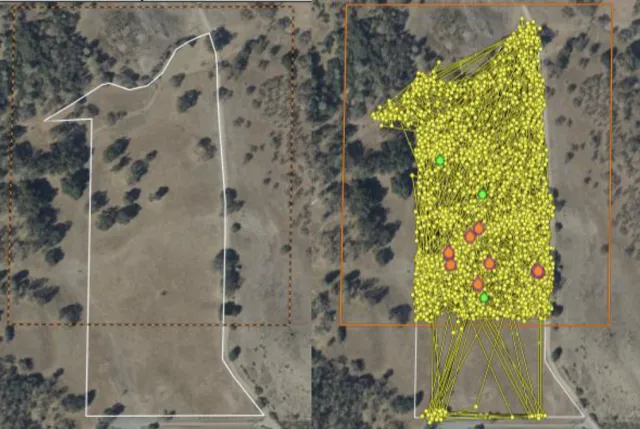
Figure 2. Left: Example of a VF training pasture, with the barbed wire fence (white line) and only a single side of the VF boundary (orange line) crossing the middle of the pasture. Right: Location data (yellow points) of the herd after one week of training. The herd obeyed the VF boundary 99% of the time, however it is normal for some animals to cross the VF boundary during this period, as seen by the few location points in the southern part of the pasture.
Livestock response to VF cues
Livestock usually respond quickly and intuitively to the audio and electric pulse cues emitted from the collar when they cross a VF boundary. For example, in a trial with 37 cattle new to VF, they received the electric pulse about 26% of the time during the first week of training. As they started to understand the cues better, the need for electric pulses dropped to around 4% for the remainder of the trial, despite being rotated to different VF areas (Figure 3). This shows that the herd learned to respect the VF boundary primarily from the audio cues alone. Throughout the trial, the herd stayed within the boundary 99% of the time.

Figure 3. Daily percentage of audio (blue) and electric pulse (orange) cues from a herd of 37 cattle over a month. During the training period, the herd received electric pulses about 26% of the time. After the training period, the need for electric pulses fell to 4% on average for the rest of the trial.
Feel free to reach out to Brian Allen (brallen@ucanr.edu) if you’d like to discuss more about virtual fencing.