
Got an Ant Question?
Got an ant question?
Professor Phil Ward, a myrmecologist or ant scientist with the UC Davis Department of Entomology and Nematology, will be featured at the Davis Science Café on Wednesday, Sept. 10.
Billed as "A Conversation with Professor Phil Ward," the event begins at 5:30 p.m. in the G Street Wunderbar, 228 G St., Davis. It is free and open to the public. Host is Professor Jared Shaw of the Department of Chemistry, who organized Davis Science Café in 2012.
"I will be talking about the evolutionary history of ants, and connecting this to their contemporary diversity and ecological importance," Ward said. "I will provide some background, but I expect to be fielding a wide variety of questions about ants."
Myrmecologists study the taxonomy, evolution, biogeography, and behavior of ants.
Ward and his lab interact with the public at various UC Davis campuswide events, including the annual UC Davis Biodiversity Museum Day and the UC Davis Picnic Day.
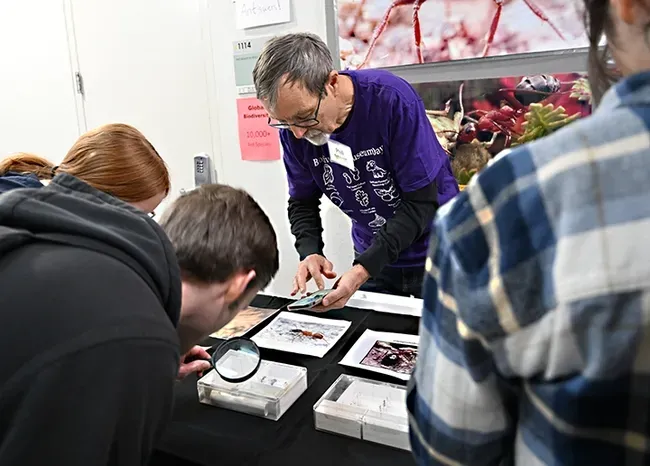
At the 2025 Biodiversity Museum Day, he and and lab answered questions at a Bohart Museum of Entomology table beneath a sign that read "We have the Antswers!" A subsign read: "Global Biodiversity, 10,000-plus ant species."
"In many terrestrial habitats--especially those of the lowland tropics--ants rival other arthropods in numerical abundance, ecological importance, and species richness," according to the Ward website. "Our research is concerned with unraveling details about the evolutionary history of ants and attempting to understand the processes that have generated such an extraordinary diversity of form and function. This work entails species-level taxonomy through analyses of phylogenetic relationships, among other topics."

What questions did the crowd ask at the Biodiversity Museum Day?
A sample:
- "How do ants communicate?" Brief answer: Largely through tactile and chemosensory cues.
- "How long do ants live?" Brief answer: Adult workers typically live one to several months; some ant queens live up to 3-4 decades.
- "How do I get rid of ants in my house or yard?" Brief answer: Ant baits usually work fairly well.
- "What do the winged ants do?" Brief answer: They are the reproductive forms.
- What is the most abundant ant in Davis? The invasive Argentine ants, Linepithema humile.
The Ward lab showed examples of workers of the world's largest (Myrmecia; bulldog ants) and smallest (Carebara) ants. "The Carebara ant garnered as much attention as Myrmecia, in part because it was barely visible to the naked eye," Ward said. "People frequently asked how it was collected." Answer: By sifting leaf litter and then examining extracts of the sifted litter under the microscope.
Ward presented a webinar at the 2021 UC Davis Biodiversity Museum Day. He and his lab also presented a video on ants for the 2021 UC Davis Picnic Day. The 2026 Biodiversity Museum Day, the 15th annual, is scheduled Feb. 21, while the 2026 Picnic Day will take place April 18.
The Davis Science Café series engages the public in a discussion about research, current events, and other aspects of science. It takes place the second Wednesday of the month. Over the years, Café topics have included everything from milk science, wine science, sea level rise and hyperdimensional geometry to coral reef ecology. The series was initially supported by the National Science Foundation and is currently supported by the College of Letters and Science and promoted by Capital Science Communicators.
(Editor's Note: Pictured on the cover is Tapinoma sessile, also known as the odorous house ant. It is a very common species, but tends to be pushed aside by the introduced Argentine ant, according to UC Davis ant specialist Phil Ward. (Photo by Kathy Keatley Garvey)