
Nursery/Landscape/Urban Ag
224 New Urban Trees for a New Climate
Principal Investigator: Dr. Alison M. Berry, Plant Sciences, University of California - Davis. For more project information, click here.
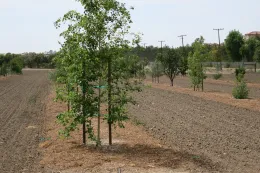
The goal of this study is to evaluate the survival, growth and arboricultural characteristics of a selection of climate-ready trees in the South California Coastal climate zone. Data will be compared with similar plantings in two other climate zones, the Inland Valley (Sacramento-Stockton-Davis), and the Inland Empire (Los Angeles- San Bernardino County). By identifying tree species that perform best under stressors associated with climate change, we can help shift the palette of trees commonly planted to species that will provide the most environmental, social, and economic value in the future.
242 - UC Cooperative Extension Orange County Master Gardener Extension Plots
Principal Investigator: Rita Clemons, Director, University of California Cooperative Extension Orange County
Project Collaborator: Randy Musser, Master Gardener Coordinator, University of California Cooperative Extension Orange
The University of California Cooperative Extension Master Gardeners of Orange County extend science-based gardening related information to the general public. Extension activities consist of workshops, field demonstrations, and tours addressing a variety of topics including composting, beekeeping, pruning, school gardens, and general home horticulture. South Coast Research and Extension Center provides a unique location for the Master Gardeners to demonstrate how the public benefits from the science generated by UC in the areas of agriculture, horticulture, and sustaining the environment. The UC Cooperative Extension Master Gardeners of Orange County have created extension plots addressing critical topics of interest by urban gardeners that include an apiary, composting demonstrations, and school garden training and demonstration areas. These plots serve as training areas for Master Gardeners as well as the site for hands-on workshops and training for the public.
259 - Climate Ready Vines for Western United States
Principal Investigator: Dr. Natalie Levy, UC ANR Soil Health and Organic Materials Management Advisor
This is a multi-state collaborative research effort to evaluate and monitor potential energy saving, water use, ecological, and horticultural characteristics of vine plants across different climates and latitudes. Participating institutions with five study sites located in the western U.S. states of Arizona, California (2 sites), Utah, and Washington will capitalize on an existing network of multi-state research infrastructure. Based on standardized experimental protocols, the project will generate data, knowledge, and information needed to develop a robust database of vine plants suitable for different climates. This will inform best-management practices and the assessment of the associated ecosystem services to achieve multi-functional vine selection and management across the western states.
262 - Can Polyploidy Increase Drought Tolerance in Landscape Plants?
Principal Investigator: Dr. Christopher Shogren, UC ANR Environmental Horticulture Advisor
Project Collaborator: Dr. Natalie Levy, UC ANR Soil Health and Organic Materials Management Advisor
Polyploidy, the state of having multiple chromosomes, is used by breeders to reduce seed set. Polyploidy can lead to other useful traits, though its effects on reduced water use and increased drought tolerance are unclear. Water-related traits are key to nursery productions and landscaping in the West's drying climate. This project aims to gain new knowledge of drought tolerance in landscape plants by measuring the physiological stress of polyploids under water deficit to identify whether ploidy can be used as a tool to improve drought tolerance. Eight polyploids of four species will be measured to test the hypothesis that higher ploidy determines higher drought tolerance. Project success will be measured as a statistically significant increase of drought tolerance in plants with higher ploidy and the willingness of specialty crop breeders and growers to utilize this tool on a larger palette of species to increase the drought tolerance of landscape plants facing climate change.
264 - Agrivoltaic System with Adaptive Shading Addressing the Agronomics and Economics of Vegetational Growth Cycle Needs
Principal Investigator: Grant Johnson, UC ANR Urban Agriculture Technology Advisor
Project Collaborator: Dr. Michael Salvador, Mirai Solar; Derrick Chapman, Community Power Collaborative
In this project we will study the agronomic and economic implications of a new and innovative agrivoltaics system in collaboration with Mirai Solar. Mirai Solar created a proprietary photovoltaic (PV) shading screen, the Mirai Screen, that mimics in its functionality a conventional passive shade screen, yet, transforming the blocked sunlight into useful electricity. As opposed to conventional solar panels, the PV screen consists of lightweight, semi-transparent solar modules that can be retracted on demand, allowing for ideal light management conditions for crops throughout the growing seasons. Here, we will set up a model system of the Mirai Screen that is expanded between two 40-foot shipping containers. The screens will be motorized and can be controlled to set ideal/open closing routines. We will measure the electricity yield delivered by the photovoltaic screens. Further to the energy yield component, we will grow various crops under the Mirai Screen to study and optimize plant physiology and crop yield. As part of the growth system, we are planning to integrate a smart drip irrigation system that will be powered by the PV system. The setup is designed such that new technological features can be adopted in the future to enhance the agricultural and energy yield of the system. For instance, it is conceivable that the shade from the PV screens will have an impact on the irrigation needs of the plant. We aim to assess the water savings potential of the PV screens by measuring the relative amount of moisture remaining in the ground.