
Evaluating Garden Resources
Evaluating Online Garden Information
By Kim Wilson, UC Master Gardener
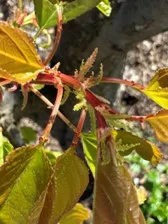
A gardener finds small red bumps on the leaf petioles of her apricot tree. She shows this image to her Facebook gardening group. They identify the problem as red mites. She decides to consult the helpline before using an insecticide.
Our helpline identified this as extrafloral nectaries—normal nectar glands found on non-flower parts of plants. Often seen on cherry and apricot trees and many other plants, they serve as nectar sources for insects.
Caution: Diagnosis through consensus should be verified using credible, science-based sources.
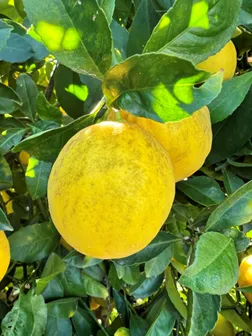
Brown tear staining of lemon was identified using Google Images as anthracnose. Anthracnose and Septoria fungal spores can stain citrus surfaces, but those stains cannot be washed off. The helpline demonstrated that the stains washed off easily. The client revealed nearby deciduous fruit trees had been sprayed with horticultural oil during cool late winter.
Diagnosis: Staining of fruit by overspray of horticultural oil.
Caution: Images alone often do not provide enough information for correct diagnosis.
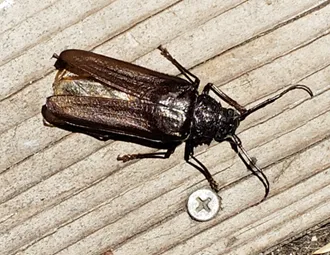
A helpline client identified this insect as a Palo Verde beetle using an insect ID app. The larvae of that beetle feed on tree roots, including olive, and the client believed it was damaging her olive tree.
An entomologist volunteer identified it instead as Trichocnemis spiculatus, the Ponderous Borer Beetle, whose larvae feed on dead or dying conifers. The client reported nearby pines were being removed. The insect posed no risk to her olive tree.
Caution: Apps may be regionally biased and identify pests that do not occur in California.
A client’s sapote tree showed yellowing and spotting in early spring. She found a YouTube video recommending a homemade soap and peroxide mixture. Should she use it? What are the credentials of the speaker?
A diagnosis should always precede treatment. There were no pests or signs of infection. The tree is in a borderline climate zone, and the tentative diagnosis was cold damage. The advice was to protect from future cold injury and monitor changes.
Important lessons: Always obtain a diagnosis before treatment. Avoid relying on non-credible sources. Some problems require no treatment. Homemade or broad-spectrum pesticides may harm plants and the environment.
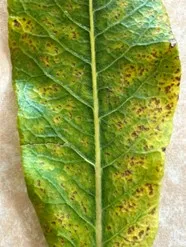
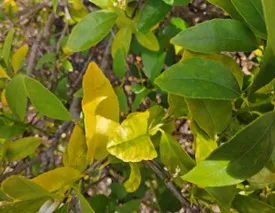
A Wekiwa citrus tree with curled, yellow leaves was identified by an internet search as citrus chlorotic dwarf virus. However, that disease occurs only in Turkey and parts of China and Thailand.
Yellow citrus leaves are common and have multiple possible causes, including overwatering, root dysfunction, and nutrient deficiencies.
Caution: Consult credible sources to verify internet search results.
CARP Analysis: Does the Information Seem Fishy?
C – Credibility: What are the credentials of the author or source? Are they trained in insects, plant science, or soil science?
A – Accuracy: Is the information objective and science-based? Is it current?
R – Relevance: Is the information applicable to home gardens or agricultural monoculture? Is it relevant to your state or county?
P – Purpose: Is the goal to educate—or to sell a product or service?
Always verify information using sources that pass the CARP test.
Resource Options
- UC ANR – University of California Agriculture and Natural Resources: Science-based blogs and horticultural resources. Topics in Subtropics – UC ANR Blogs
- UC IPM – UC Statewide Integrated Pest Management Program: Pest management information focused on minimizing harm to people and the environment.
- UC Statewide IPM Program
- UC Master Gardeners of San Luis Obispo County: Website, YouTube channel, informational documents, and helpline. UC Master Gardeners of San Luis Obispo County
- University extension websites (verify California relevance).
- State agricultural offices, CalFire, and reputable science-based regional sources.