
IJ Archive
UC Marin Master Gardener Articles in the Marin Independent Journal
UC Marin Master Gardeners have contributed to the Marin Independent Journal's "Ask a Master Gardener" column every Saturday since 1999. We have a team of dedicated writers who have covered nearly every aspect of gardening for Marin County over the years. Search our archives below by category of interest, or use the search box to locate stories by year, month or specific subject.


Marin IJ Archive
UC Marin Master Gardener Articles in the Marin Independent Journal
UC Marin Master Gardeners have contributed to the Marin Independent Journal's "Ask a Master Gardener" column every Saturday since 1999. We have a team of dedicated writers who have covered nearly every aspect of gardening for Marin County over the years. Search our archives below by category of interest, or use the search box to locate stories by year, month or specific subject.
> BACK TO ASK US
Succulents
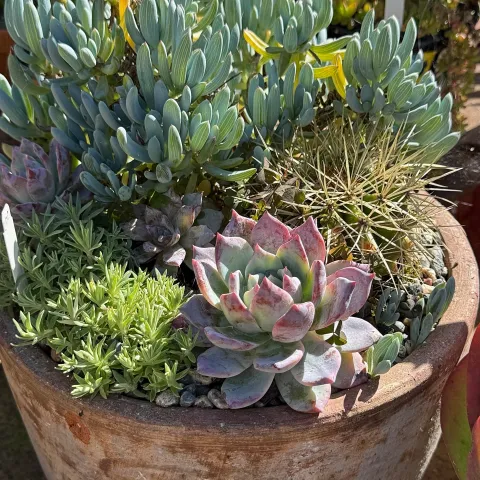
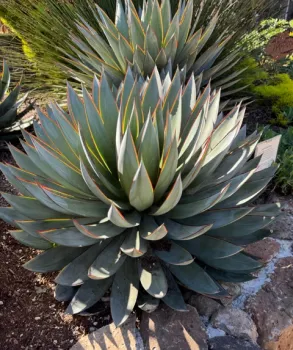
Succulents are one of the most ideal plants you can add to your Marin County garden. These resilient plants come in every shape and size as well as in a variety of textures and colors. Much appreciated by busy gardeners, succulents are drought-tolerant, don’t mind some neglect, and readily adapt to Marin County’s dry and Mediterranean climate.
For best results, select succulents that will thrive in the microclimate in your garden. Most prefer about six hours of full sun and warmth, but some prefer partial shade. Check out the requirements, expected size, and shape of your succulent choices so you know their preferred environment and how best to maintain them in a healthy state. Most remain compact and 2-4 feet tall while some grow to 5-7 feet.
Most succulents thrive in bright, indirect light or in a south-facing window if grown indoors. Move them outdoors once nighttime temperatures are consistently above 60oF; protect them from heavy rain. Transition succulents to the outdoors by placing them in a shady place for a few days and then slowly move them to a sunnier location. Avoid outdoor sites that receive intense, hot sunlight during midday. Move your succulents to another location if the leaves yellow or look droopy. Bring plants back indoors before fall chills set in.
Succulents store water in their thick fleshy leaves, stems, and roots, so they are able to survive equally well whether planted in the ground or in a container. Excellent drainage is essential. In Marin County, watering succulents once a week during the warmer months usually works well, i.e., water only when the top inch of soil feels dry to the touch; pour water directly into the soil, not on the leaves. Choose terra cotta pots with drainage holes, as terra cotta dries faster than plastic. Use a succulent and cactus potting mix that contains sand, perlite, or pumice to prevent soggy roots. Cut back on watering in winter when water needs are markedly reduced.
Repot only when your succulent outgrows its container. Most succulents have adapted to nutrient-poor soils, so a rule of thumb is to only feed with a fertilizer if your specific succulent type requires it. If your plant becomes leggy, prune it back to fresh growth in early spring.
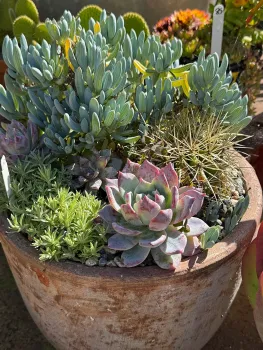
Aphids and mealybugs are their most common pests. Insecticidal soap works best as a defense against aphids. In more severe aphid infestations, a pyrethrin-based or neem oil insecticide is effective. Mealybugs are sometimes more difficult to manage; a Q-tip dipped in rubbing oil and swabbed across all visible insects kills them. Avoid overwatering to help prevent the onset of a fungal disease. Also, if plants are grown indoors, ensure good air circulation. Keep leaves clean by gently wiping away dust; remove damaged or dying leaves. Most diseases in succulents are caused by overwatering or incorrect sun exposure.
Many varieties of succulents can be propagated by stem or leaf cuttings and offsets. Offsets occur when root tissue forms leaf buds which sprout at the base of the mother plant. Once the offsets are big enough and have established roots, they can be separated and replanted in small separate containers. It takes at least a month for cuttings to develop sufficient root growth to be successfully repotted into more permanent settings. Leaf cuttings take longer to mature than stem cuttings.
Join us for the Succulent Sale! The Master Gardeners are hosting their annual succulent sale on Saturday, May 30, from 9 am to 12 pm at the Falkirk Cultural Center’s rear parking lot on Mission Street in San Rafael. There will be individual plants, potted arrangements, and bromeliads for sale. Experienced Master Gardeners will be on hand to answer your questions. For more information, see https://www.youtube.com/watch?v=GKZbJItCz0I.
Whether you are new to gardening or a pro, this sale offers a chance to get expert advice on selecting beautiful, drought-tolerant, easy-care, and mostly pest-free succulents for your garden.
By Martha Proctor, May 23, 2026
Kids in the garden
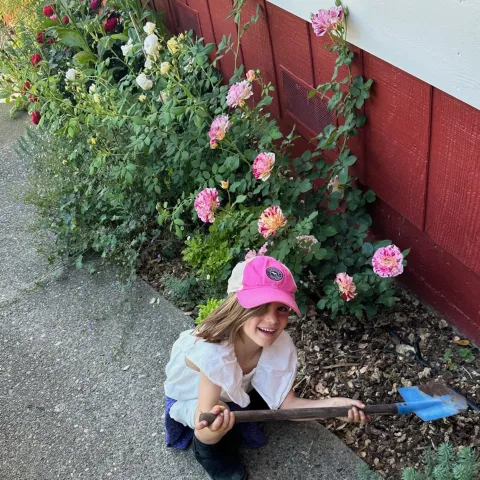
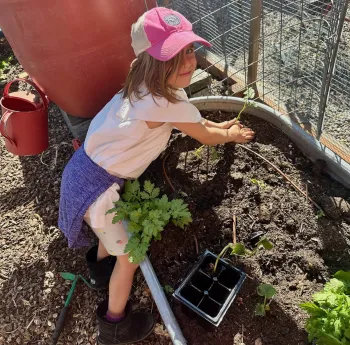
Gardening with children is a total win/win. You get a great way to spend quality time together doing a hands-on activity, and you can make a big difference in fostering their curiosity, patience, love of nature, and an understanding of how and where we get our food and flowers. Gardening with kids not only fosters a green thumb, but also promotes physical, social, and emotional health.
Kids generally love to be outside and playing in the dirt, so it is pretty easy to get them going. You don’t need to be an experienced gardener or have a large garden. Learning garden basics together can be a fun way to explore the process from beginning to a yummy and beautiful result. Successes and failures will happen along the way, providing an important life lesson. Nature is resilient and forgiving and will always give you another chance.
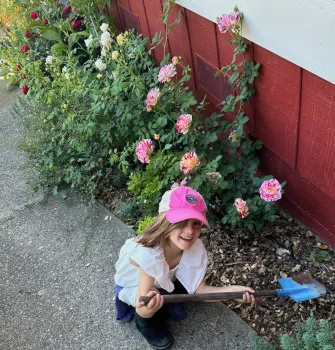
Any space can work. Any size garden can become a place for kids to learn critical thinking, biology, ecology, entomology, ornithology, climatology, planting for wildlife, pollination, and soil and water science. A container is a garden, and, for kids, it is often better to start small to accommodate their interest level. Kids can learn water conservation, learn about the importance of organics and natural fertilizers, and observe how your kitchen scraps can become valuable compost. This is not only the beginning of them learning that they can have an impact on their own space, but also an understanding of how they can make a positive impact on the planet.
Before you all get started, let’s talk safety. Sunscreen and a hat can protect you all from the sun. Gloves are great for kids reluctant to touch soil or anything that they may find in it, and they come in all sizes. Adult tools are too big for small children to use. There are kits of small tools available that are safe for them to use and will give them a sense of responsibility and a chance to teach care of their belongings.
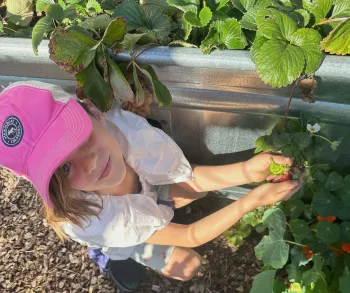
Where you start and what you plant will vary with the age of your children. No matter the age, engage them in every step of the process, from choosing what to plant to watering, weeding, and harvesting. A good place to start is by creating a garden with a salad in mind. Salad greens, carrots, cherry tomatoes, radishes, and cucumbers are easy to grow and can bring pretty quick results, helping to keep the kids engaged. You can start from seed or purchase seedlings from a nursery. Green beans are so fun to watch germinate as they curl their way out of the ground, and they produce heavily. They will see that some veggies are above the ground, some are climbers, and some develop out of sight underground. Strawberries are kid magnets.
Flowers are also a fun grow, and some are super easy. Nasturtiums have big, easy-to-handle seeds that germinate, spread rapidly, and, as a bonus, the organic flowers add color and spice to your salad. Sweet peas also have good-sized seeds, and they fill your home with amazing fragrance. Sunflowers are a kid favorite. They come in so many colors and sizes. The seeds can be left on the plant to feed the birds, or they can be collected and dried for a kid’s snack.
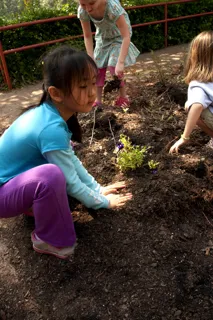
These suggestions are with our spring and summer seasons in mind, but it is fun and easy to make growing your garden a year-round activity, and it is actually healthier for your soil to keep it planted. Here in Marin, fall is the time to plant spinach, snap peas, shelling peas, Swiss chard, broccoli, and cauliflower.
Check your library for books on gardening with your children. They often have activities to enhance your experiences and crafts to explore with your harvest. It is so much fun to see it all through their eyes.
By Dot Zanotti Ingels, May 16, 2026
Mulch and fire: A scientific study
A common bit of advice from Marin Master Gardeners is “mulch, mulch, mulch” to help retain soil moisture and suppress weeds. Mulch can be inorganic and noncombustible, like rocks used for paths and to surround structures. Within the garden, however, many homeowners prefer to cover bare ground using organic mulch like wood chips in various sizes, shapes, and colors.
But wood burns.
If you live in a WUI (wildland urban interface) area, an area deemed to have substantial fire risk, or are simply concerned about fire, the best practice is to keep any type of wood mulch at least five feet from your house and other structures. In fact, new regulations will likely forbid wood mulch in this “zone zero” area.
Elsewhere, though, gardeners can use wood mulch. But, which type?
To answer that question, researchers working in Marin County evaluated the burn characteristics of two commercially available wood mulch categories: Composited and non-composited.
Composited mulch is made from chipped wood and bark piled on the ground and repeatedly turned over for several months, and this turning brings soil into the pile as it composts. Typically, you can see chunks of decomposed bark and wood particles in the final mix, although it can approach the consistency of soil.
Non-composited mulch is, as the name suggests, made of raw chipped wood and sometimes bark.
For the study, researchers sourced composited mulch from one provider in West Marin and another in San Jose. And they bought five types of non-composited mulch from Marin companies: Black Mulch, Forest Floor, Redwood, and two sizes of Fir Bark. Fir Bark A chips ranged from half to three-quarters of an inch. Fir Bark B, often called “Quarter-inch Fir Bark,” had chips smaller than a quarter-inch.
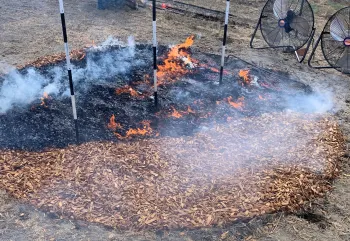
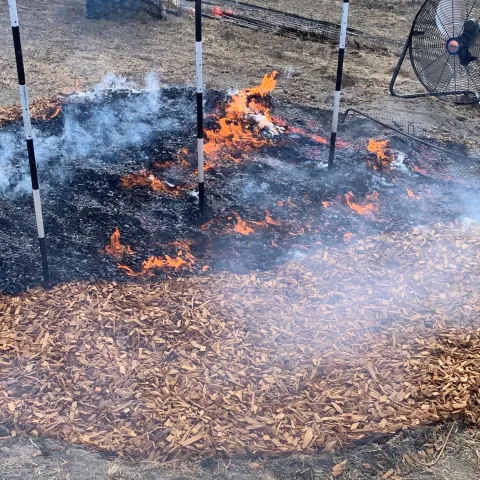
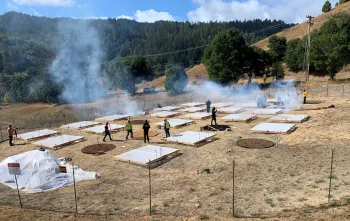
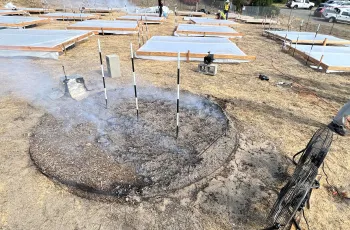
The mulch study took place at the Marin County Fire Department Admin Headquarters at the San Geronimo Golf Course from October 10-12, 2023. Ten different mulch plots, five each of composited and non-composited, were placed into 30 circular, three-inch deep surrounds, with each mulch type replicated three times. After being left to dry and weather for four months, researchers ignited the material and instruments recorded flame length, rate of flame spread, and radiant heat.
The result confirmed an earlier, smaller study done in Nevada.
“Basically, we found that the composited mulch does perform better from a fire perspective,” says UC Cooperative Extension Advisor Emeritus Stephen Quarles. “The products tended to smolder, meaning there was no flame to speak of. If you had needles, leaf debris, twigs, etc., blown into an area with smoldering mulch, it could easily transition into flame, so it isn’t totally safe. But, it’s safer.”
As for the non-composited mulch, two types produced the highest flames and thus could be most dangerous to use: Black Mulch and large Fir Bark A. Forest Floor and Redwood mulch also produced worrisome flames, although not as high. Only the Quarter-inch Fir Bark B had insignificant flames.
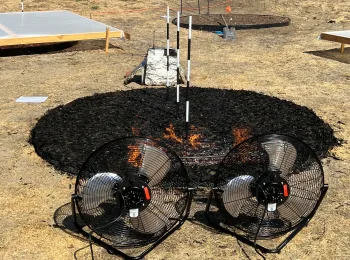
“The Quarter-inch Fir Bark acted a lot like the composited mulch,” Quarles says. “Composited mulch would be my first choice when considering fire, but if you don’t like that aesthetic, Quarter-inch Fir Bark would be your next best choice.”
Because the small Quarter-inch Fir Bark particles compact well, there is a lack of oxygen in the mulch. The other four non-composited mulch types don’t compact as well, which means oxygen can get inside and around the chunks and pieces of various sizes. That produces flames and more rapid flame spread.
“That’s what we worry about if you have mulch around vegetation,” Quarles says. “Flames igniting shrubbery and combustible siding.”
Funded by the Marin Wildfire Prevention Authority, the study was carried out by Quarles working with a team of other researchers led by Professor Michael Gollner at the Fire Research Lab at the UC Berkeley Mechanical Engineering Department. For more information check the FireSafe Marin website.
By Barbara Robertson, May 9, 2026
Sunflowers: the perfect way to brighten your day
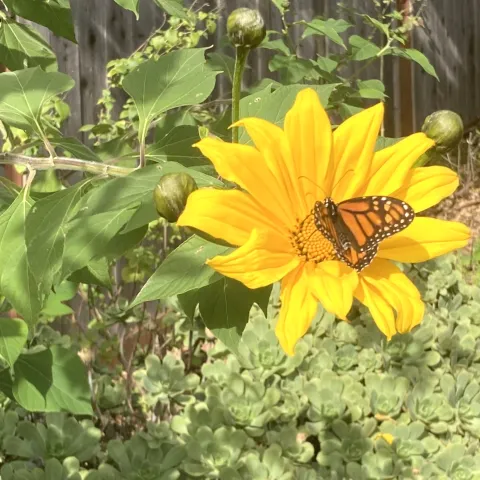
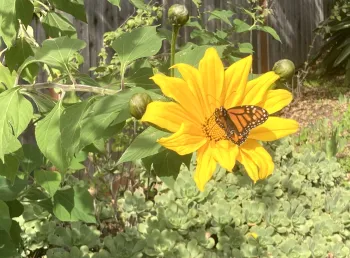
The sunflower, Helianthus annuus, is an annual in the Asteraceae family widely seen across California. From ancient domestication to modern gardens, sunflowers are easy to grow, offer food and habitat for wildlife, and brighten our gardens with cheerful blooms.
Dating back 4500 or more years, Indigenous peoples of North America were the first to domesticate the sunflower. As part of the Eastern Agricultural Complex, sunflowers were selected over generations for larger seeds and more pronounced flower heads. They were used for food, oil, dye, medicinal treatments, and ceremonial purposes.
Spanish explorers arrived in North America in the 16th century. They brought sunflower seeds back to Europe. Russians embraced sunflowers for ornamental and agricultural purposes. By the 19th century, sunflowers became a key oil crop in Eastern Europe. In some interpretations of the traditional “Three Sisters” planting system, corn, beans, and squash, the sunflower is the symbolic “Fourth Sister” attracting pollinators and watching over the other plants.
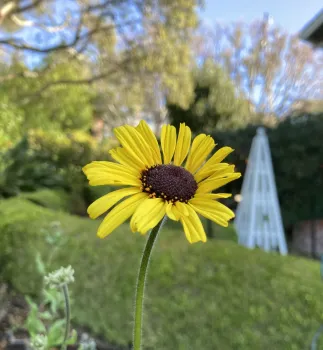
Some sunflower cultivars can be used to remove toxins and heavy metals from the soil, highlighting their ecological value for phytoremediation. In U.S. agriculture, oilseed sunflowers produce small black seeds used in cooking, cosmetics, and biofuel.
One of the sunflowers’ most fascinating traits is heliotropism. Young plants track the movement of the sun across the sky. They begin the day facing east, follow the sun to the west, and reset overnight to face the east again. Once mature and in full bloom they stay facing east, which warms the seed’s head early in the day and attracts more pollinators.
Sunflowers are easy to plant. Most varieties thrive in full sun (6- 8 hours a day) and well-drained soil. Seeds can be sown directly into the ground after the threat of frost has passed. Space seeds 12- 18 inches apart depending on the variety.
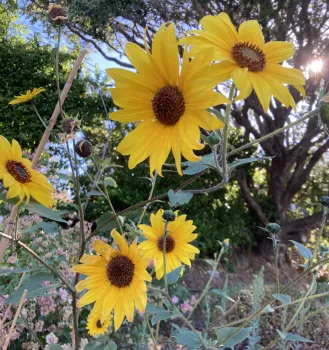
Sunflowers are heavy feeders. Amend the soil with compost or well-rotted manure before planting. Other natural amendments include bone meal for root development and blood meal for rapid leaf growth. Water deeply and infrequently, allowing the plant to develop a robust root system. Remember to provide mulch for water conservation.
If you are growing sunflowers for seed, know when to harvest. Once the back of the flower is dry, cut the heads and let them dry in a well-ventilated space or hang them upside down. The seeds should rub out easily by hand. Wait too long and the squirrels will help themselves.
In Marin County both annual and perennial sunflowers can shine. Some favorites are:
- Common woolly sunflower (Eriophyllum lanatum) a California native perennial that looks like a sunflower, host to 7 species of butterflies and moths.
- Delta sunflower (Helianthus annuus) Grows 6 ft. tall and 5ft. wide, multiple blooms for several months, native to California and deer resistant.
- Jerusalem artichoke (Helianthus tuberosus) A perennial prized for nutty tubers. The “sunchokes” (tubers) are edible. Harvest tubers for replanting next year.
- Lemon Queen (Helianthus annuus) A hybrid variety with soft yellow blooms and branching stems.
- Mammoth Russian(Helianthus annuus) enormous heads 1 ft. wide with stalks 10 – 12 ft. tall. - seeds for roasting and feeding birds.
- Mexican sunflower (Tithonia diversifolia) 6-10 ft. tall with large yellow flowers provide an ideal landing pad for butterflies.
- Teddy Bear (Helianthus annuus) 2- 3 ft. dwarf with soft fuzzy flower heads great for kids’ gardens.
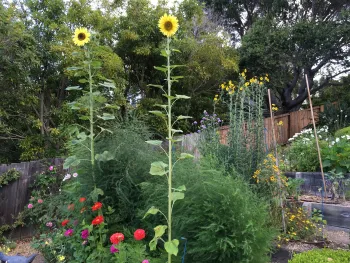
Plant sunflowers with companions like marigolds and zinnias that thrive in the same conditions. Pair them with herbs like basil, dill, and rosemary. These aromatic plants also attract beneficial insects like ladybugs and butterflies. Consider the tall varieties as living trellis. Branched sunflowers work well with sprawling mini pumpkins.
Beyond their beauty, sunflowers are excellent habitat plants offering nectar and pollen for a wide array of bees and butterflies. Their seeds are a valuable food source for birds, making them a wonderful choice for wildlife and earth-friendly gardens.
By Alice Cason, May 2, 2026
Plant these veggies now to produce bountiful summer and fall harvests
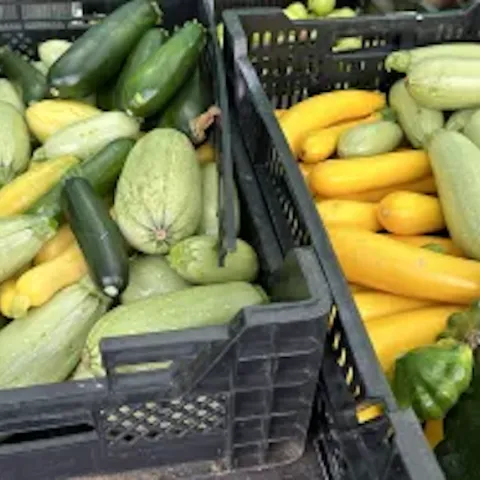
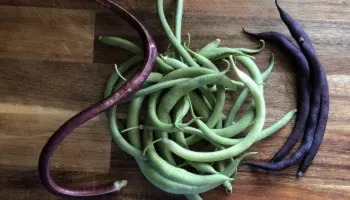
You’ve already planted luscious tomatoes, probably purchased from our recent UC Marin Master Gardeners’ Tomato Market Sale. What other veggies should you plant to contribute to bountiful summer and fall harvests? Good choices are beans, cucumbers, peppers, summer squash, winter squash, and/or pumpkins. They are perfect to plant now, easy to grow, and thrive in our Marin climate.
Beans are warm-season legumes native to Central or South America. Pole beans grow six to ten feet; bush beans grow two feet tall and wide. Plant now through the end of July in an area with at least four to six hours of sun a day. Beans prefer well-drained, sandy loam soil that has been amended with compost or other organic materials. Keep soil evenly moist, with consistent and adequate irrigation, preferably drip to keep leaves dry. Varieties that do well in Marin include Scarlet Runner, Romano, Blue Lake, and Kentucky Wonder.
Cucumbers are a warm-season crop from South Asia. Plant now through the end of June. Cucumbers prefer full sun, with six to eight hours a day. They don’t do well in foggy or windy locations. Consider trellising for straighter cucumbers and to save space. Cucumbers prefer organic, nitrogen-rich, and well-drained soil. Water regularly to keep the soil constantly moist, focusing on the base of the plant. Harvest cucumbers when they are about one to one and a half inches in diameter, six to seven inches long. Varieties for slicing include Dasher 11, Marketmore, Sweet Success, and Sweet Slice.
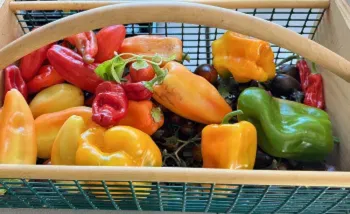
Photo: Jean Christofferson
Peppers are native perennials in Central and South America but are grown as annuals here. Plant now through the end of June in northern Marin, and through mid-June in southern Marin. Don’t plant where peppers, tomatoes, potatoes, or eggplants have been grown in the past three years (they share the same soil-borne diseases, like blight; rotating your crops helps prevent disease). Peppers prefer full sun. Before planting, amend the soil with a nitrogen-rich aged manure or compost. Peppers require moderate, even watering. Pick your peppers when they stop getting larger and cut the stems to avoid damaging the plant. Good varieties include California Wonder, Gypsy F1, Sweet Banana, and Minibell.
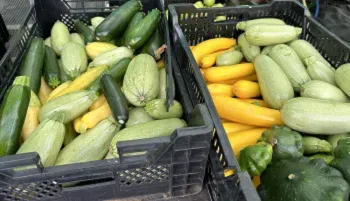
Photo: Jean Christofferson
Summer squash, originating in the Americas, bears fruit until the weather cools in the fall. Depending on the variety, plant now until the end of July. Summer squash needs a minimum of six hours of full sun. They prefer well-drained soil rich in organic matter, so add plenty of compost before planting. Regular, even watering is key. Harvest when the skin is tender, and the seeds are small. Leaving the fruit on too long results in massive, tough squash and fewer fruits. Good varieties include Peter Pan Hybrid, Scallopini, Early White Bush, and Sundance.
Winter squash, also from the Americas, can be planted now until the middle of June in an area with at least six hours of sun a day, in well-drained soil, with consistent moisture. Leave winter squash on the vine until fully mature and cut to make a two-to-four-inch stem for longer storage life. Popular varieties include Butternut, Kabocha, Acorn, Delicata, and Spaghetti squash.
Pumpkins, originating in North America, are a winter squash that grows from a flower. They are a fruit, but usually prepared as a vegetable. Plant now through the end of June. Choose a sunny spot with at least six hours of full sun. Pumpkins prefer soil rich in organic matter, so add plenty of compost or composted manure before planting. They need lots of space and may be trellised. Even watering is key. In cooler microclimates, stop irrigation in mid-August to hasten ripening. Harvest pumpkins when the stems are no longer fleshy. Good varieties include Small Sugar, Howden, Connecticut Field Pumpkin, and Spirit.
Now is the perfect time to plant beans, cucumbers, peppers, summer squash, winter squash, and/or pumpkins to produce a bountiful harvest this summer and fall.
By Julie McMillan, April 25, 2026
Venturing into the world of tropical plants
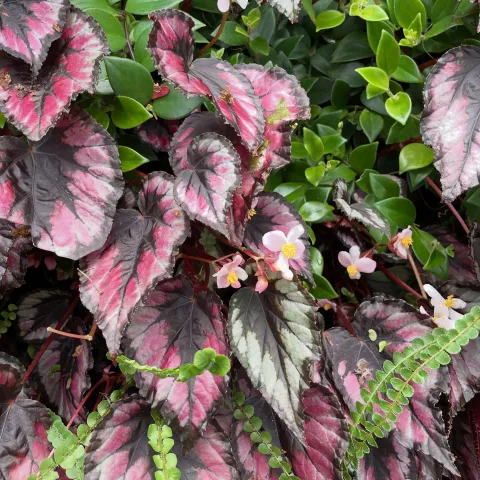
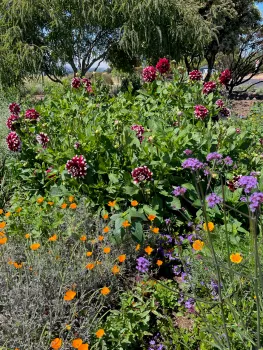
Most of us don’t have gardens as expansive as those created by 18th century landscape architect Capability Brown who moved a river to create the beautiful vistas at Chatsworth House, or large enough to design outdoor “rooms” like those created in the 20th century by Vita Sackville West at her Sissinghurst Castle home. Nonetheless, we enjoy our gardens and can introduce a moment of perfection and “paradiso” by including tropical plants. Tropical plants come from the area of the world known as the tropics at the equator between the Tropic of Cancer (latitude 23.5 degrees N) and the Tropic of Capricorn (Latitude 23.5 degrees S), or about 1,500 miles above and below the equator. Within this equatorial region is roughly one-third of our planet’s land mass and population. Only one U.S. state, Hawaii, lies in the tropics where 85- degree temperatures foster tropical plants both native and introduced. So, how do we include tropical plants in our gardens here in Marin at Latitude 38?
All plants have a preferred balance of warmth, seasonal rainfall, and dry periods, guaranteeing the plant enough water to grow but not so much as to get waterlogged or threatened with fungal diseases. Marin gardeners learn this growing tomatoes, native to South America. We have learned that by adopting adaptive strategies, we can grow some edible and ornamental tropical plants. Others we cannot grow successfully because Marin doesn’t have the warmer temperatures and humid environments required. So, we grow tomatoes as annuals not perennials; this is adaptive strategy. We do not grow Vanilla planifolia, a clinging orchid vine that grows to 300 feet with 4- inch green orchid flowers. In Mexico, native vanilla is pollinated by native bees and hummingbirds, but when transplanted to Hawaii, Tahiti, and the island of Reunion off Madagascar, vanilla must be pollinated by hand, another adaptive strategy, albeit making vanilla the second most expensive spice in the world after saffron.
The ancient Greek physician, botanist, and pharmacologist Dioscorides wrote a five- volume Herbal describing about 500 species representing all then known world plants. In the 1500’s, the King of Spain sent Francisco Hernandez, the Spanish court’s physician, to New Spain, to catalogue plants in the “new world”, including their environmental and ecological context. The Aztecs served Hernandez hot chocolate flavored with vanilla, and Hernandez spent three years learning from the Aztecs, cataloguing plants and increasing by sixfold the number of plants known to science. For an informative list of edible tropical plants from around the world, including fruits, vegetables, starches, shoots and roots, nuts, and spices, go to the Missouri Botanical Garden “A Tropical Feast”, pdf available online.
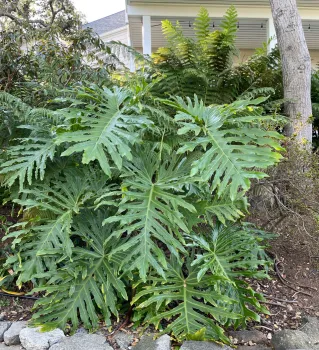
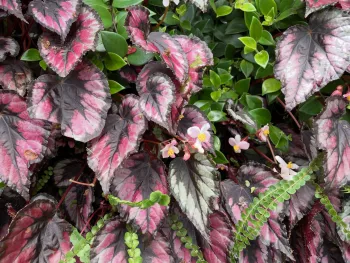
Just like edible tropical plants, ornamental tropical plants provide garden benefits including vibrant colors, exotic ambiance, biodiversity, increased humidity, and seasonal appeal. Some of the most popular ’New World’ tropical plants that grow well in Marin include Bougainvillea (with prolific blooms), Canna Lily (with vibrant leaves of yellow, gold, and burgundy) Plumeria rubra (a small tree known as frangipani whose blooms are used to make leis), and Heliconia rostrata (with its lobster claw- like blooms). The list also includes Begonias (that grow until cold weather arrives), Dahlias (the national flower of Mexico), Tagetes, Zinnias, Impatiens, Lobelia, Giant Water Lillies, Philodendron, Agave, Yucca, Monstera (the Swiss cheese plant that grows in shady areas with holes in its leaves so light reaches lower leaves), Choisya ternata (Mexican orange) and so many more.
If you decide you favor plants with a tropical look, remember the master gardener mantra ‘Right plant in the right place’. Choose those tropical plants that can survive Marin’s climate. Remember, contrary to popular belief, many tropical plants do not do well in direct sunlight and prefer shadier environments. Conversely, some tropical plants can endure blazing heat, humidity, heavy rains, or drought and low temperatures. Adaptive strategies can ensure success.
By Anne-Marie Walker, April 18, 2026
Growing together: Good neighbors in the garden
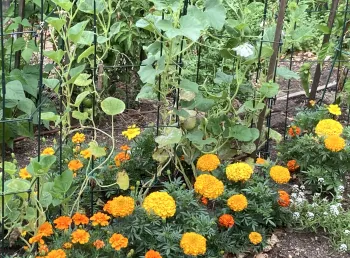
Companion planting means growing different plants close together so they can help each other. Some plants help keep bugs away. Others improve soil health, and many attract beneficial insects such as bees and butterflies. When plants work together, the entire garden thrives. Companion planting is not simply about putting two plants side by side. It is about creating a healthy, earth-friendly garden where plants, insects, and soil all work together as a living system.
The most famous example of companion planting is the Three Sisters Garden used by the native American people of Central and North America. Archeological records show the Iroquois using raised mounds rather than rows and interplanting, dating to 1000 AD. Corn, beans, and squash were planted together. The corn grows tall as a trellis and supports the beans. The beans add nitrogen to feed the soil. The squash spreads along the ground, helping keep weeds away and conserve water. Together, these plants help each other grow and provide a healthy combination of food. This method of planting is called Milpa Garden and may be the foundation of what we call agriculture.
Many gardeners use companion planting to reduce pests without using chemicals. Gardeners once believed that strong-smelling plants repelled insects. Plants like marigolds, peppermint, sage, and thyme were planted for their scent. Scientists now know that these plants do not chase bugs away. Instead, they help by hiding the smell of the main host plant, making it harder for pests to find it.
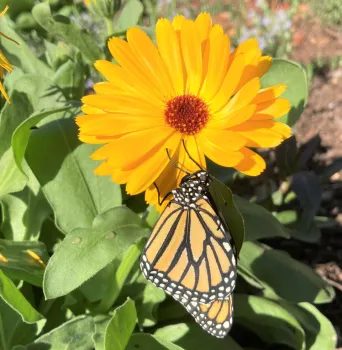
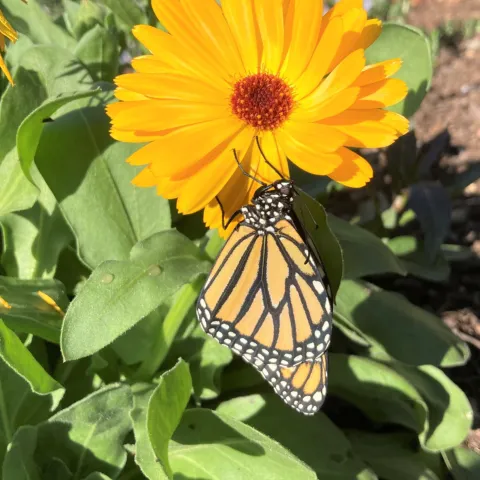
Some plants grow especially well together. Nasturtiums planted near zucchini can help reduce squash bugs. Onions planted near peppers can help keep aphids away. Basil planted near tomatoes may help protect them from tiny insects called thrips. Calendula, also known as pot marigold, helps protect many plants from aphids. Easy to grow from seeds, its bright flowers attract bees and helpful insects like lacewings and tiny wasps that eat garden pests. The petals are edible and can even be used to make tea and calendula oil.
Low-growing plants used as cover crops also benefit the garden. They cover the soil, block weeds, and help retain moisture. Beans and peas enrich the soil by adding nitrogen, an essential nutrient. Other helpful cover crops include clover, buckwheat, and fava beans. These plants act as “living mulch” by protecting bare soil.
Some plants are called trap plants because they attract bugs away from other crops. Ornamental tobacco (nicotiana) traps aphids, mites, and whiteflies. Dill is a trap crop for tomato hornworm. Nasturtiums can help reduce cabbage worms and make a colorful, edible ground cover.
Companion planting also brings beneficial insects into the garden. Ladybugs eat aphids. Hover flies and bees help pollinate flowers to make more seeds and fruit. Plants like yarrow, alyssums, cosmos, borage, and sunflowers provide nectar and food for these helpful insects.
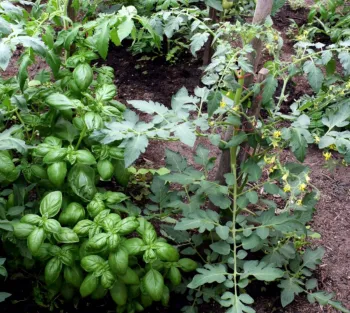
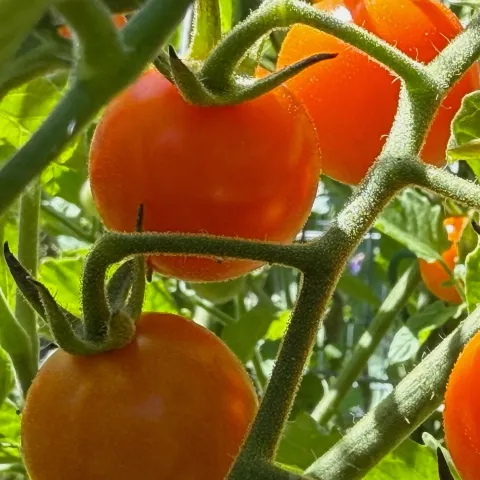
Tomatoes and basil are good partners in the garden and in the kitchen. Basil may deter pests and even improve tomato flavor. Tomatoes need wind movement or the buzzing vibration of bumble bees to set fruit. This is called buzz pollination. Beans and peas with large, hooded flowers attract bumblebees, which also help pollinate squash, blueberries, and eggplant.
Some plants do not grow well together. This is called allelopathy. One plant can stop another from growing. Black walnut trees and eucalyptus are examples. Fennel should be planted alone because it can inhibit the growth of neighboring plants. Tomatoes should not be planted near cabbage, broccoli, or corn because these plants compete for nutrients.
Companion planting is both a science and an art. It helps plants grow stronger, protects the soil, attracts beneficial insects, and keeps pests in balance. Best of all, it shows us that nature works best when living things grow together.
Find a complete list of companion plants from the Edible Landscaping Handbook, Companion chart: https://ucanr.edu/sites/default/files/2023-09/388577.pdf
By Alice Cason, April 4, 2026
Seeing red? Boxelder bugs, our native neighbors
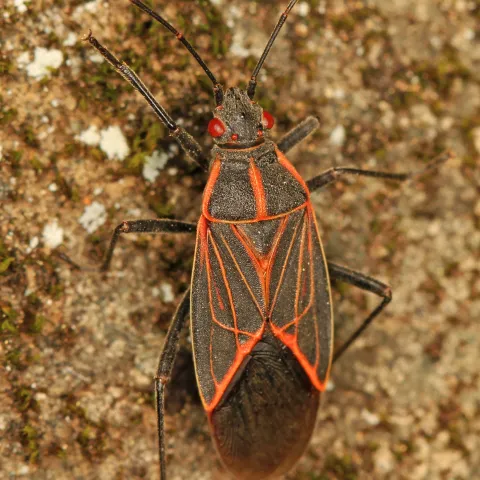
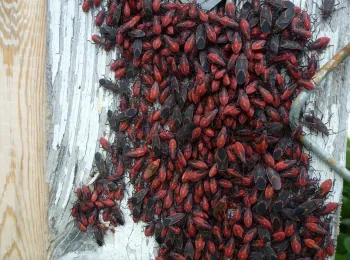
If you’ve noticed clusters of red-and-black insects sunning themselves on your house lately, you’re not imagining things, those are probably Western boxelder bugs.
Most of us associate boxelder bugs with fall — when they suddenly blanket warm, west-facing walls and make it feel like your house is being swallowed. Fall is their most dramatic season. But it’s not the only time they show up.
Here in Marin, especially near creeks and mature maples, boxelder bugs can be seen on sunny walls in multiple seasons. What changes is the reason.
The Western boxelder bug (Boisea rubrolineata) is native to the western United States and has long been part of our local ecosystem. Adults are about half an inch long, black with thin red lines tracing the thorax and wings. The younger stages are bright red at first, gradually developing darker markings. They’re eye-catching, which is part of why they feel alarming.
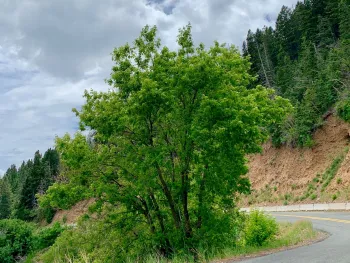
Their main food source is the boxelder tree (Acer negundo), a maple that thrives in riparian corridors. You’ll often see boxelder growing along Lagunitas Creek through Fairfax and San Geronimo Valley, along Corte Madera Creek as it winds through Ross and Kentfield, and beside Miller Creek and Novato Creek in the North Bay. They’re also common near Gallinas Creek, Arroyo Corte Madera del Presidio in Mill Valley, and other streamside areas where soils stay moist and deep.
Because these trees cluster along waterways and in older neighborhoods planted decades ago, homes nearby naturally see higher numbers of boxelder bugs. The insects feed mostly on seeds and sap. They may wander onto other maples, ash, or even fruit trees, but they rarely cause meaningful damage. Established trees typically tolerate them without issue.
So why are they on your house in March?
In fall, adults gather on warm, south- and west-facing walls as they prepare to overwinter. They’re looking for tiny cracks and gaps where they can shelter through colder months. That’s when we see the big aggregations — sometimes hundreds or thousands at once.
Over winter, many remain tucked into siding gaps, attic vents, or other protected spaces. Then, on warm late-winter and early-spring days — like the ones we’ve been having — they re-emerge and cluster on sunny surfaces to warm up. It’s essentially their version of stretching in the morning sun.
During summer, you’ll mostly find them near host trees, feeding and developing. So while fall is the main event, wall congregations aren’t strictly seasonal.
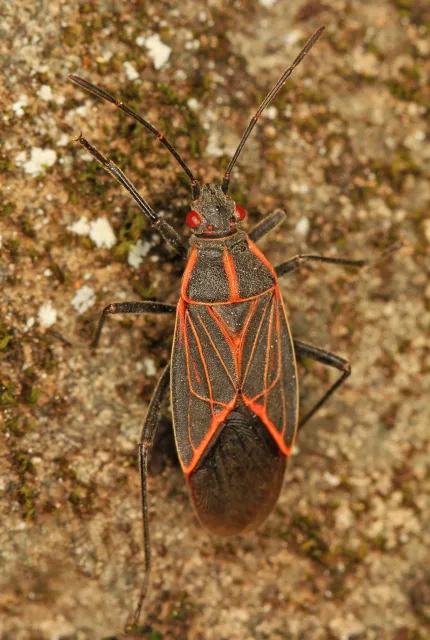
The good news is that boxelder bugs are far more dramatic than destructive. They don’t bite, they don’t sting, they don’t transmit disease, and they don’t reproduce indoors. If they wander inside, it’s accidental — they’re just looking for shelter.
This is where a little Integrated Pest Management mindset really helps. Instead of reacting with sprays — which rarely solve the problem and can harm beneficial insects — it’s more effective to think about what the bugs are trying to do.
They’re looking for warmth and entry points.
If they’re getting inside your house, the long-term solution is sealing cracks around windows, doors, vents, siding seams, and utility lines. A careful afternoon with caulk can make a noticeable difference next season.
If they’re clustered outside, a strong stream of water will break up the group. It won’t eliminate them, but it disrupts the aggregation. Indoors, a vacuum works well. Crushing them isn’t recommended — they can stain surfaces, and they can stink.
Living in Marin means sharing space with a lot of wildlife, some more charming than others. Boxelder bugs may not win popularity contests, but they were here before we were. If they’re sunning themselves on your wall this week, take it as a sign that spring is warming up. And know that, with a few simple adjustments, you can keep the relationship manageable — even when fall brings the encore performance.
By James Campbell, March 28, 2026
Pick a pepper and plant it!
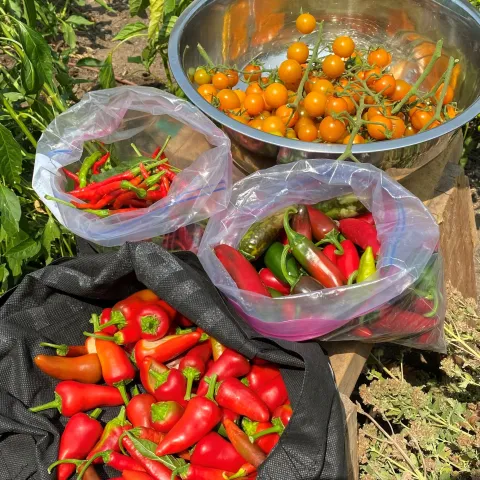
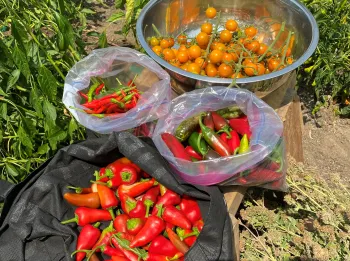
A walk through any Marin market will reveal bins piled high with a dazzling array of peppers in many colors, shapes, and sizes. Those familiar market staples offer only a small sampling of the vast choices available to home gardeners eager to grow something new. Our fascination with peppers is the most recent chapter in a much longer story that began in the late 15th century, when European explorers stumbled upon thriving agricultural systems in the Americas that were already thousands of years old. Enthralled by their heat and flavor, explorers carried pepper seeds and plant materials back to the Old World. Five species of the plant genus Capsicum created an instant culinary sensation that went viral, quickly spreading worldwide. The genetic diversity that had begun thousands of years earlier expanded dramatically as peppers were bred by gardeners and adopted into cuisines across Africa, Asia, and Australia. Today, more than 6,000 commercially named varieties of peppers trace their ancestry to just five species native to Central and South America.
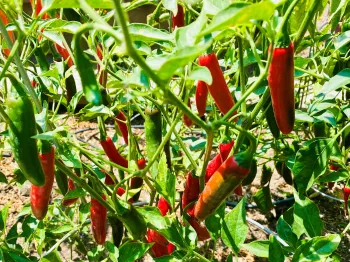
Marin gardeners can share in this extraordinary story, and it’s not too late to begin a new chapter at home. Grown as annuals in Marin, peppers are considered a warm-season crop, and starting from seed is still possible, even in late March. Seed starting does require more planning, patience, and a bit of shopping. A recent visit to a local nursery revealed more than forty varieties on a single seed rack, while online sources offer hundreds more. The selection available from seed far exceeds the choices of seedlings that may later appear at garden centers. Seeds selected from local garden centers or California-based seed companies often carry an added advantage: they have been chosen with regional conditions in mind, giving them a strong likelihood of success in Marin’s diverse gardens. California Wonder, Early Jalapeño and Cherry Bomb F1 are among the many varieties chosen by the Marin Master Gardeners for our unique Mediterranean climate.

Peppers are slow to germinate. Even in a toasty greenhouse, and aided by gentle bottom heat and ideal light, moisture, and humidity it will take six to ten weeks before seedlings are ready to harden off and plant outdoors. Seeds planted in March can produce seedlings ready for the garden by May or early June. Everything is temperature dependent. After a week to 10 days of hardening, and once nighttime temperatures remain consistently above 55° F with daytime temps between 65 and 85°F, pepper seedlings can be planted outdoors. In warmer inland areas, this often occurs by mid to late April. In cooler, coastal, or fog-influenced gardens, transplanting may need to wait until May. Many early varieties recommended for Marin will begin producing 60 to 70 days after planting, with harvests beginning in late summer and continuing into October or even November.
Garden site selection can also be critical. Peppers will thrive in the warmest, sunniest spot you can provide. They should never be planted where tomatoes, potatoes, or eggplants have been grown within the past three years, allowing soil time to clear pests and pathogens common to these nightshade relatives. For this reason, many gardeners grow peppers in containers or fabric grow bags filled with sterile potting soil. A well-hydrated five-gallon grow bag will weigh between 25 and 30 pounds, making it possible to move plants to safety during cold snaps or storms while providing stability. Peppers will need support once fruiting begins. A simple stake or cage works well. While smaller containers will still produce a modest harvest, larger pots generally yield more peppers.
Growing peppers in Marin County is more than simply producing a beautiful and tasty harvest. It is a chance to take part in an ancient culinary and gardening tradition, adapted to our unique climate and landscapes. Each pepper grown here links a modern home garden to thousands of years of human curiosity, selection, and exchange, an enduring story that continues to grow, one plant at a time.
By Terry Amerson, March 21, 2026