
Succulent Garden

Succulent Garden Plant List
With their distinctive colors, form and beautiful flowers, succulents are highly prized by many gardeners. They adapt well to the driest conditions, using leaves and roots to store water. The plants in this garden receive little supplemental water during the summer.
| Botanical Name | Common Name | Description |
| Aeonium ‘Carol’ | A plant whose fleshy leaves are in rosettes at the tips of the branches. Thought to be a hybrid of Aeonium canariense, a plant from the Canary Islands, it was first found in Santa Barbara, Ca. A cool season grower that goes dormant in the summer to conserve water. | |
| Agave americana | Century Plant | A plant with gray-green leaves up to 6' long, with a sharp spine at the tip of each and hooked spines along the edges. Blooms after years of growth, with a large stalk bearing yellow-green blossoms. The blooming rosette dies after flowering. Sap may cause a severe rash. |
| Agave americana "Mediopicta Alba' | White Century Plant | See Agave americana above. Leaves have white stripes and the plants are generally about half as large as the species plants. |
| Agave americana variegata | Century Plant, variegated green and yellow | See Agave americana above. Leaves have yellow stripes and the plants are generally about half as large as the species plants. |
| Agave attenuata ‘Nova’ | Blue Foxtail Agave | Spineless broad fleshy blue-green leaves up to 2 feet long, grows in clusters 3-4 feet high and up to 8 feet across. Produces an upright flower spike with dense greenish yellow flowers that flower starting from the bottom to the top. |
| Agave geminiflora | Twin Flowered agave | An unusual Agave with numerous narrow, flexible, dark green leaves that spread from the center of the plant, forming a dense rosette. It bears yellow flowers in twos up an unbranched spike that can reach 10' in height. |
| Aloe arborescens | Torch Aloe, Candleabra aloe | A large evergreen succulent with multiple rosettes on branching stems. Leaves are blue-green, sword shaped, with pale teeth along the edges. Vibrant red-orange flowers occur on multiple racemes from each rosette. From Southern Africa. |
| Aloe striata | Coral Aloe | A small, stemless South African Aloe species, striata, means "stripes", and refers to the long lines (sometimes very faint) on its blue-green leaves. The leaves of this Aloe are not toothed, but have a smooth pink margin. |
| Aloe striatula | Aloe striatula | A succulent shrub with a dense low-branching habit and attractive dark green decurving leaves that have small white teeth along the margins and with the leaf bases clasping the attractively longitudinally green-striped stems. The brilliant yellow inflorescence rises above the foliage typically in late spring into summer but we often have stray fllowering at other times of the year. This form was noted to have more robust stems and leaves than the more commonly cultivated form of this species. |
| Beschorneria yuccoides | Mexican Lily | This hardy plant is native to Mexico and related to yuccas and agaves. It forms a rosette of tough, pliable but soft lance-shaped gray-green leaves lined with soft fine teeth. The flower stalk is red and rises 6-8 feet above the rosette. The bell shaped flowers are yellow tinted green with red bracts and are attractive to hummingbirds. |
| Dasilyrion wheelerei | Desert Spoon | Grows in a roundish clump up to 5' high and round. Blue gray 3 foot long leaves are edged with teeth. Forms a trunk to 3 feet, retains the old dried leaves as a shag. Base of leaves form a spoon at the trunk. |
| Dasylirion longissimum | Mexican Grass Tree | A shrub with a clump of 4-6 foot long narrow grass-like green leaves radiating from a woody trunk. The trunk can grow to be treelike. Flowers are white to cream colored |
| Euphorbia mauritanica | Pencil Milkbush | A shrubby euphorbia from South Africa with lime green pencil shaped leafless branches arising from a central stem. The new growth has tiny leaves that disappear. The sap is toxic and can cause eye irritation. |
| Sedum reflexum ‘Angelina' | Golden Sedum | Honey to chartreuse-colored succulent with little nuggety leaves that develop pink highlights as they mature. Star-shaped yellow-white flowers for added charm. |
| Sempervivum tectorum | ||
| Senecio mandraliscae | Blue Chalksticks |
Aeonium ‘Carol’
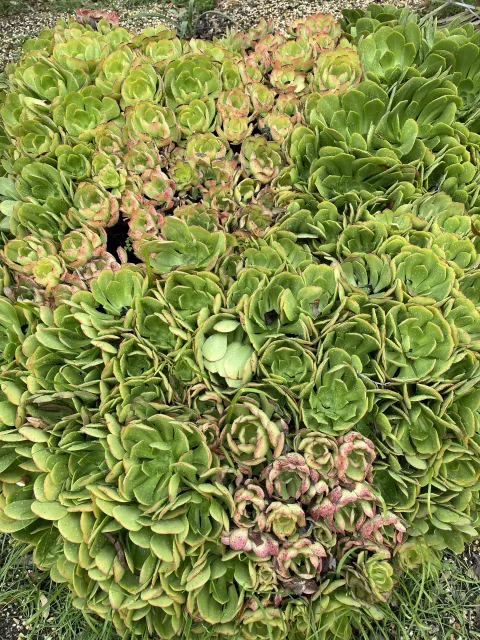
A plant whose fleshy leaves are in rosettes at the tips of the branches. Thought to be a hybrid of Aeonium canariense, a plant from the Canary Islands, it was first found in Santa Barbara, Ca. A cool season grower that goes dormant in the summer to conserve water.
Advantages: Evergreen succulent that forms attractive clumps, with thick slightly wavy leaves in broad 12-18 inch rosettes.
Bloom Period: Spring
Height: Up to 3" tall
Width: Up to 3" wide
Light Requirements: Coastal full sun to light shade
Water Requirements: Low to moderate, summer dormant.
Back to Top
Agave americana
Century Plant
A plant with gray-green leaves up to 6' long, with a sharp spine at the tip of each and hooked spines along the edges. Blooms after years of growth, with a large stalk bearing yellow-green blossoms. The blooming rosette dies after flowering. Sap may cause a severe rash.
Advantages:
Bloom Period: Blooms once per rosette after years of growth.
Size: Up to 8" tall and 12' wide. Flower stalk can be 15' or more.
Light Requirements: Full sun to partial shade.
Water Requirements: Low to moderate
Back to Top
Agave americana 'Mediopicta Alba'
White Century Plant
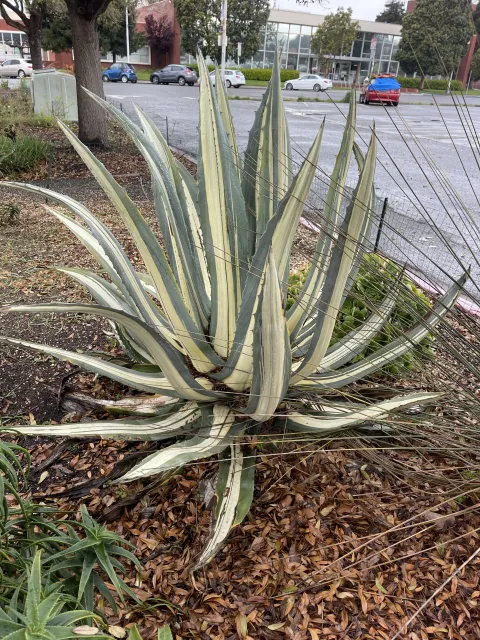
See Agave americana above. Leaves have white stripes and the plants are generally about half as large as the species plants.
Advantages: Grown for its attractive leaves.
Bloom Period: After years of growth, each rosette blooms once and then dies.
Size: 4' tall by 6 feet wide.
Light Requirements: Full sun to partial shade.
Water Requirements: Low to moderate
Back to Top
Agave americana variegata
Century Plant, variegated green and yellow

See Agave americana above. Leaves have yellow stripes and the plants are generally about half as large as the species plants.
Advantages: Grown for its attractive leaves.
Bloom Period: After years of growth, each rosette blooms once and then dies.
Size: 4' tall by 6 feet wide.
Light Requirements: Full sun to partial shade.
Water Requirements: Low to moderate
Back to Top
Agave attenuata ‘Nova’
Blue FoxtailAgave
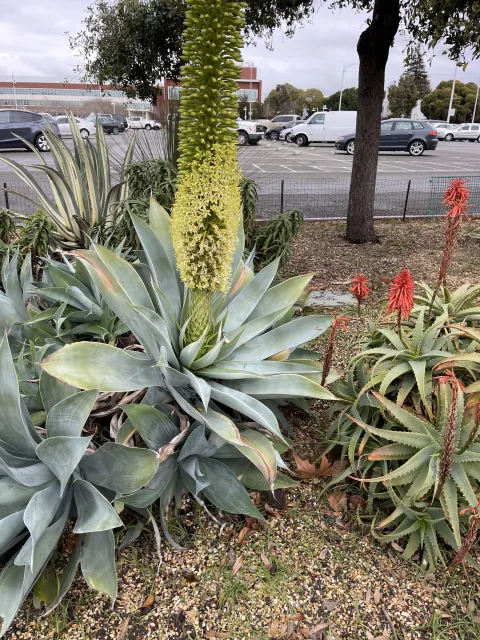
Spineless broad fleshy blue-green leaves up to 2 feet long, grows in clusters 3-4 feet high and up to 8 feet across. Produces an upright flower spike with dense greenish yellow flowers that flower starting from the bottom to the top.
Advantages: An attractive spineless agave with soft, blue gray, pliable leaves that form a large rosette.
Bloom Period: After years of growth, each rosette blooms once and then dies.
Size: Clusters to 4 feet high, 8 feet wide.
Light Requirements: Coastal full sun to partial shade.
Water Requirements: Low water
Back to Top
Agave geminiflora
Twin Flowered agave
An unusual Agave with numerous narrow, flexible, dark green leaves that spread from the center of the plant, forming a dense rosette. It bears yellow flowers in twos up an unbranched spike that can reach 10' in height.
Advantages: An attractive and unusual agave that does not have spines on its leaves.
Bloom Period: Infrequent
Size: 3' high by 4' wide, with a flower spike of 8-10 feet
Light Requirements: Coastal full sun, partial shade inland
Water Requirements: Low water
Back to Top
Aloe arborescens
Torch Aloe, Candleabra aloe
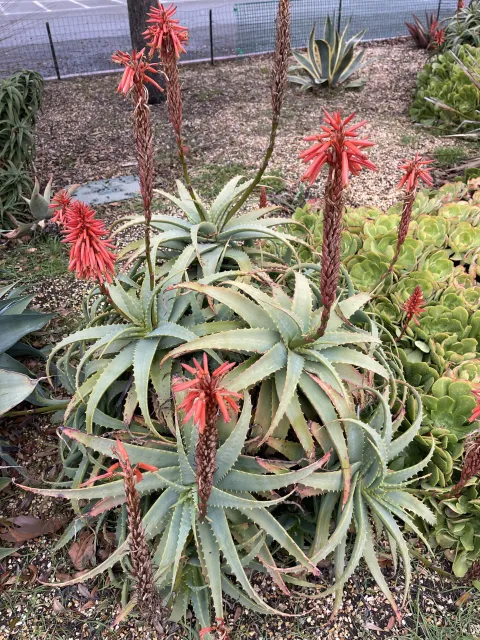
A large evergreen succulent with multiple rosettes on branching stems. Leaves are blue-green, sword shaped, with pale teeth along the edges. Vibrant red-orange flowers occur on multiple racemes from each rosette. From Southern Africa.
Advantages: Succulent evergreen leaves, multiple large vibrant flowers, winter blooming and attractive to bees and birds.
Bloom Period: Winter
Size: To 10 feet high and wide
Light Requirements:
Water Requirements: Low water
Back to Top
Aloe striata
Coral Aloe
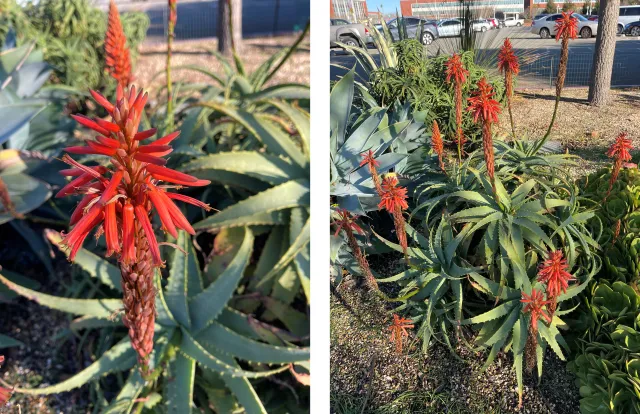
Photo Courtesy of Dan Lent
A small, stemless South African Aloe species, striata, means "stripes", and refers to the long lines (sometimes very faint) on its blue-green leaves. The leaves of this Aloe are not toothed, but have a smooth pink margin.
Advantages:
Bloom Period: Winter
Size: 2' high, 18" wide
Light Requirements: Full Sun
Water Requirements: Low water
Back to Top
Aloe striatula
Aloe striatula
A succulent shrub with a dense low-branching habit and attractive dark green decurving leaves that have small white teeth along the margins and with the leaf bases clasping the attractively longitudinally green-striped stems. The brilliant yellow inflorescence rises above the foliage typically in late spring into summer but we often have stray fllowering at other times of the year. This form was noted to have more robust stems and leaves than the more commonly cultivated form of this species.
Advantages: Large hardy aloe that attracts birds
Bloom Period: Spring and Summer
Size: 6' high, 16' wide
Light Requirements: Full Sun
Water Requirements: Low water
Back to Top
Beschorneria yuccoides
Mexican Lily
This hardy plant is native to Mexico and related to yuccas and agaves. It forms a rosette of tough, pliable but soft lance-shaped gray-green leaves lined with soft fine teeth. The flower stalk is red and rises 6-8 feet above the rosette. The bell shaped flowers are yellow tinted green with red bracts and are attractive to hummingbirds.
Advantages: Hardy yucca like plant with attractive flower stalk and flowers. Needs little water in summer, hardy to <15 degrees F.
Bloom Period: Late spring to summer
Size: 3 feet tall by 4 feet wide with a 6-8 foot flower stalk
Light Requirements: Full sun
Water Requirements: Low
Back to Top
Dasilyrion wheelerei
Desert Spoon

Grows in a roundish clump up to 5' high and round. Blue gray 3 foot long leaves are edged with teeth. Forms a trunk to 3 feet, retains the old dried leaves as a shag. Base of leaves form a spoon at the trunk.
Advantages: Spoon-like base of leaves is used in dried plant arrangements. Blooms eventually on 10-12 foot spike with white flowers
Bloom Period: Occasional
Size: 5' x 5'
Light Requirements: Full sun, part shade
Water Requirements: Low
Back to Top
Dasylirion longissimum
Mexican Grass Tree
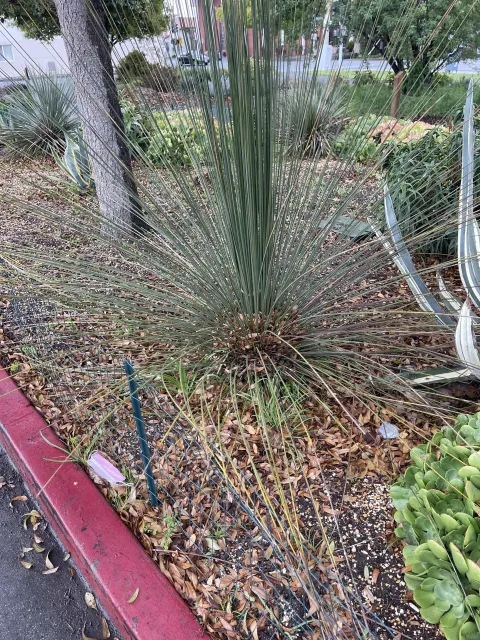
A shrub with a clump of 4-6 foot long narrow grass-like green leaves radiating from a woody trunk. The trunk can grow to be treelike. Flowers are white to cream colored
Advantages:
Bloom Period: Summer
Height: 5'
Width: 5'
Light Requirements: Full sun, light shade
Water Requirements: Low
Back to Top
Euphorbia mauritanica
Pencil Milkbush
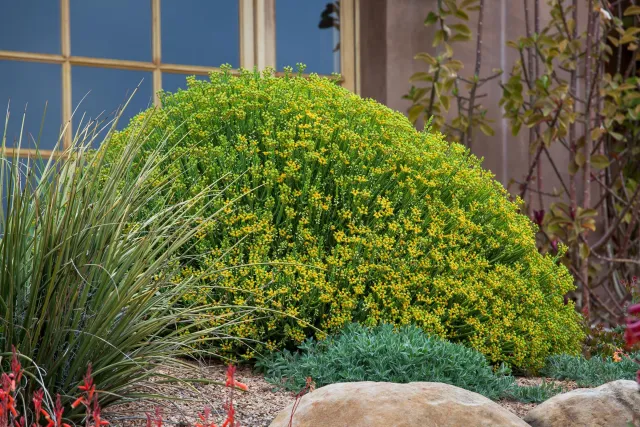
A shrubby euphorbia from South Africa with lime green pencil shaped leafless branches arising from a central stem. The new growth has tiny leaves that disappear. The sap is toxic and can cause eye irritation.
Advantages: An attractive succulent plant with late winter flowers. Resistant to gophers, deer and rabbits.
Bloom Period: Winter/spring
Height: 5'
Width: 5'
Light Requirements: Full sun, light shade
Water Requirements: Low
Back to Top
Sedum reflexum ‘Angelina'
Golden Sedum
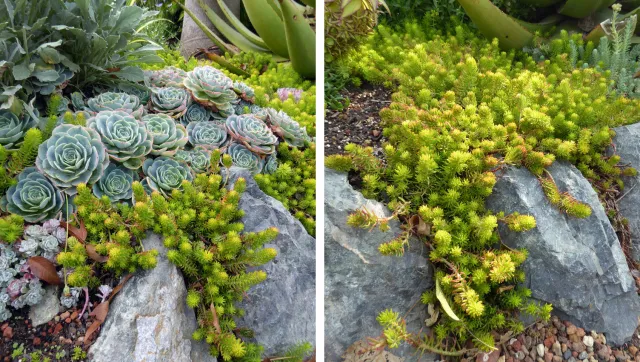
Photo Courtesy of Annie's Annuals & Perennials
Honey to chartreuse-colored succulent with little nuggety leaves that develop pink highlights as they mature. Star-shaped yellow-white flowers for added charm.
Advantages: Really great cascading over the side of a container or low wall.
Bloom Period: Summer
Height: 6" - 12"
Width: 1' - 2'
Light Requirements: Full sun to part shade
Water Requirements: Low
Back to Top
Senecio mandraliscae
Blue Chalksticks
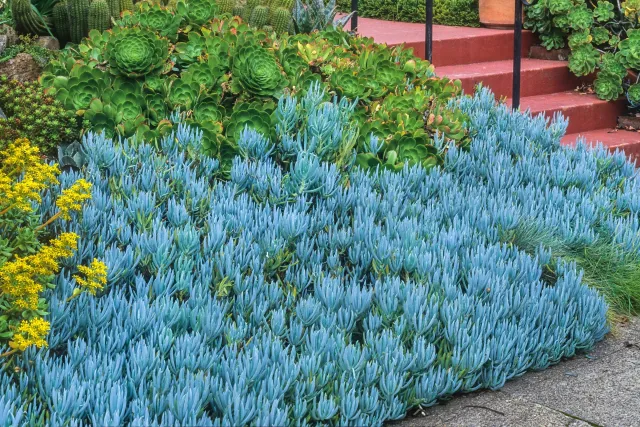
Photo courtesy of WUCOLS